
Heated extensions on Yate's later estates
Homes built between 1973 and 1999 make up 41% of Yate's stock. They include the later Radburn estates and the conventional streets planners returned to in the late 1980s. Houses of this age often suit a rear extension, with a kitchen and family room opened out onto the garden, and underfloor heating is often the choice for that kind of room.
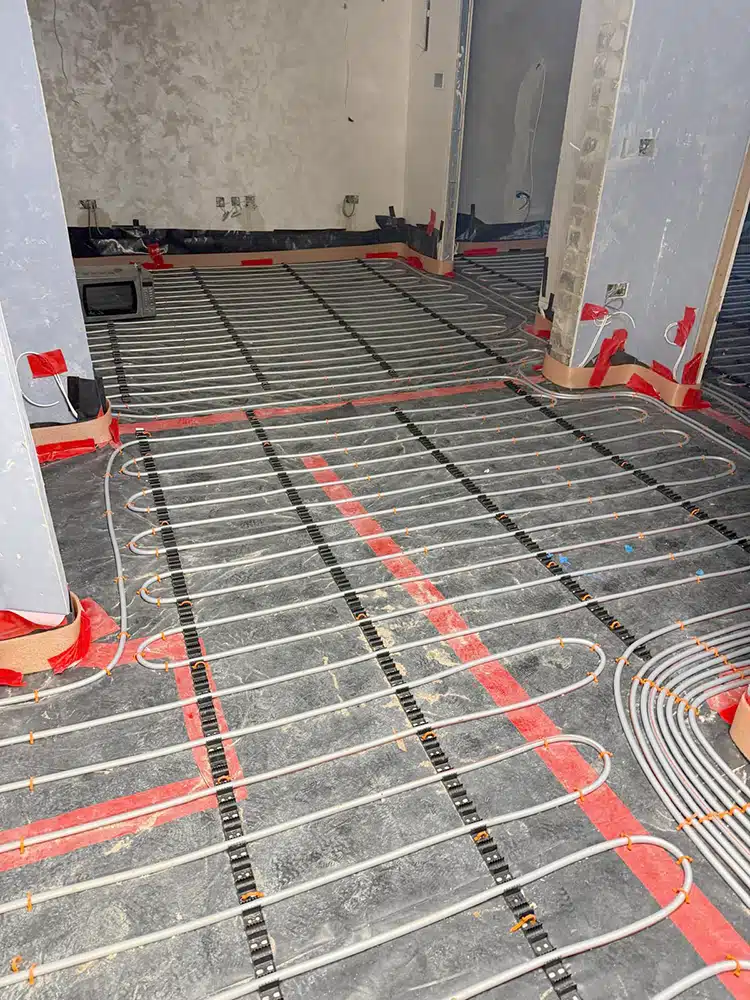
Getting the screed right is half of a heated floor. It must surround every pipe without voids, carry the heat across the room and give a flat base for tiles, LVT or engineered wood. Liquid screed does this well because it flows around the pipes as it is poured. Above the pipes it needs 25mm or more, which makes the floor roughly 45 to 50mm deep. Sand and cement has to cover them by around 45mm, giving a thicker floor overall.
Where an extension joins the house, the two floors normally have to finish level. That sets the depth available for insulation, pipes and screed, so check the build-up with your builder early. Our liquid screed for Yate page explains how the pump reaches houses set back from the road.
Adding heating to a room that already exists is trickier, since the doors and stairs fix how high the floor can go. There may not be room for full insulation, pipes and screed, so the build-up has to be measured before anything is ordered.
Bringing a Yate heated floor up to temperature
A new heated floor has to be warmed slowly. Warm it too early or too quickly and the edges can curl or the screed can crack, which is a costly way to learn the rule.
The heating can usually be switched on to a calcium sulphate screed at about 7 days, while a hand-laid cement floor has to wait a minimum of 21. Then the temperature is raised in small steps, held for a period and adjusted following the heating engineer's and the screed maker's schedule. We hand that guidance over in writing. The North Yate new builds follow the same process, plot by plot, and a site manager can use it to plan when flooring goes in.
For calcium sulphate screed specified by grade, the anhydrite flow screed page explains laitance and moisture testing.
By pour day the pipes should be down, clipped and pressure tested, on insulation with the edge strip fitted, so nothing beneath the screed needs touching again. Pouring a flowing screed over the pipes in a Yate extension or new build is priced between £20 and £35 a square metre on the 2026 national rates. For a job in Corsham, see underfloor heating screed in Corsham.
Underfloor Heating Screed prices in Yate
Liquid screed over underfloor heating: £20 to £35 per m² supplied and laid (trade2base, June 2026), so £700 to £1,230 for 35 m². trade2base gives these figures excluding VAT. See our floor screeding cost guide or screed calculator.
Who lays your underfloor heating screed in Yate
K & B Screeding’s own team, led by director Donatas Bardisevicius. Founded 2019, company 12298780.
See what customers say in our Google reviews and on our testimonials page.
Underfloor Heating Screed from Slough to Yate
As the crow flies, our yard in Slough is about 76.5 miles from Yate, which lies to the west. Postcodes here include BS37 and BS36, and Bath (11.2 miles), Corsham (12.5 miles), Chippenham (14.3 miles) and Stroud (16.6 miles) are close by.
More on underfloor heating screed, part of our screeding services.
