
Reading an anhydrite specification for North Yate
A new build floor specification often names a calcium sulphate grade in the form CA-C25-F5. C gives the strength in compression and F the strength in bending, each in N/mm2.
CA-C20-F4 is the light-traffic domestic grade. CA-C25-F5 is the mainstream specification for houses, flats and offices. Harder working floors get CA-C30-F6. If no grade is given for a self-build or extension, we suggest one based on the rooms, the heating and the finish. Purpose-built flats make up 8% of Yate's homes, and apartment floors are usually specified at CA-C25-F5. Use the grade on the drawings, not a guess.
If speed of drying or a shallower floor matters, an alpha hemihydrate product may be on the drawings. Its own data sheet, not the usual figures, sets the depth and drying time.
Calcium sulphate moves very little as it cures, so wide floors can be poured as large bays that need only a few joints. Bays and joints are set out in advance, and our team puts in the layers underneath, from insulation and membrane to the edge strip. If you want the basics, how anhydrite screed works covers them.
One rule is fixed. Calcium sulphate is kept out of anywhere that will see water, like a shower or wet room. Those rooms are poured with a flowing cement product or done as traditional hand-laid screed, even in a North Yate house that is anhydrite everywhere else.
Yate anhydrite floors: laitance, testing and primers
While calcium sulphate dries, laitance, a thin and weak film, builds up on its surface. Adhesive, primer and levelling compound cannot be relied on to stick to that film, so it is sanded away once the screed has dried. The dust is then vacuumed up and a primer compatible with calcium sulphate is rolled on.
Moisture is the other point to get right. Many flooring manufacturers set their moisture limit lower for calcium sulphate than for a cement screed. A surface that feels dry under your hand can still hold more moisture than your flooring maker allows. A hygrometer test, taken properly and read against the manufacturer's figure, settles the question.
Drying can be speeded up. Where there is underfloor heating, it can usually be used to force dry the screed from roughly a week, 7 days, after the pour, turned up a little at a time. Good ventilation also helps.
Our written handover covers both drying and laitance. If a separate contractor is sanding and priming, our floor preparation service can do that stage instead. For a project in Stroud, see anhydrite flow screed in Stroud.
Anhydrite & Flow Screed prices in Yate
Liquid flowing screed (which includes anhydrite): £24 to £31 per m² supplied and laid (MyJobQuote, August 2026), so £960 to £1,240 for 40 m². MyJobQuote does not say whether these figures include VAT. See our floor screeding cost guide or screed calculator.
Who lays your anhydrite and flow screed in Yate
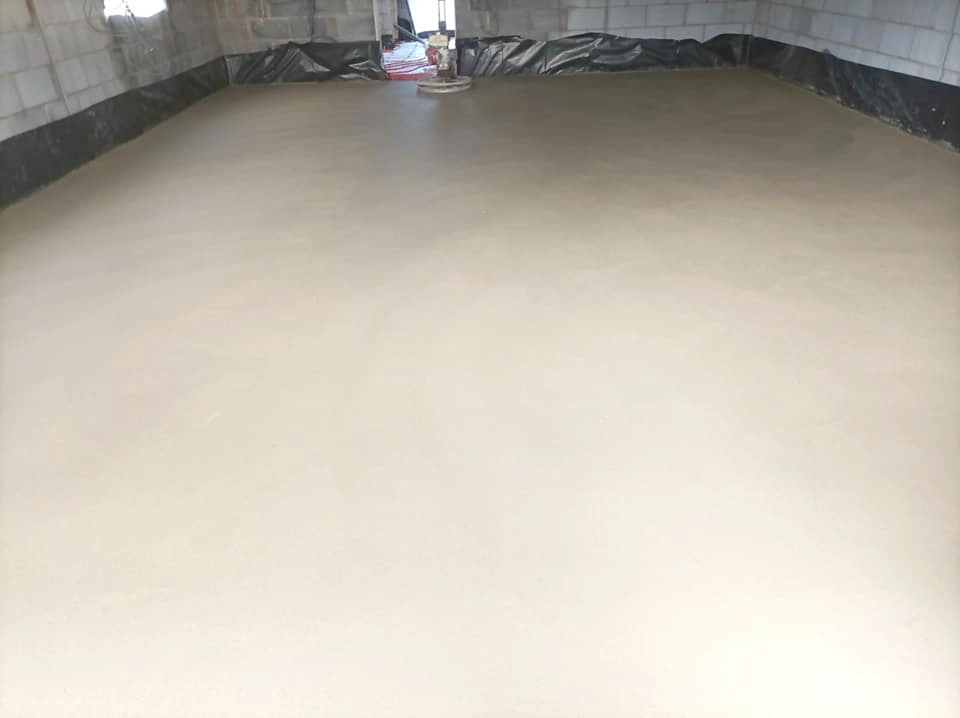
K & B Screeding’s own team, led by director Donatas Bardisevicius. Founded 2019, company 12298780.
See what customers say in our Google reviews and on our testimonials page.
Anhydrite & Flow Screed from Slough to Yate
As the crow flies, our yard in Slough is about 76.5 miles from Yate, which lies to the west. Postcodes here include BS37 and BS36, and Bath (11.2 miles), Corsham (12.5 miles), Chippenham (14.3 miles) and Stroud (16.6 miles) are close by.
More on anhydrite screed, part of our screeding services.
