
Calcium sulphate grades for Frome apartments and new builds
Calcium sulphate screed, often called anhydrite, is a separate material from cement screed. Shrinkage is very low, which allows big bays with few joints, and heat from underfloor pipes passes through it well. That is why it turns up on apartment schemes and groups of new homes.
Specifications describe it by class under the screed standard. For light domestic traffic, CA-C20-F4 is enough. Homes, apartments and offices in general take CA-C25-F5, while CA-C30-F6 is used where wear is heavier. In the screed standard, the C number is compressive strength and the F number flexural strength, measured in N/mm2. On a development of the size planned at Saxonvale and Garsdale, the grade normally comes from the engineer, and we pour to it rather than substituting a different product.
Purpose-built blocks hold 12% of Frome's homes. On an apartment floor, the low shrinkage and flat finish of calcium sulphate let a whole flat be poured in one go with few joints.
Alpha hemihydrate products come in when the programme needs a quicker dry or the floor has to be thinner, and each follows its own data sheet, so include that sheet with your enquiry. For the chemistry behind it, see our guide to anhydrite screed.
Before pouring, we plan bays and joints to line up with doorways and heating zones, and our own team prepares the full build-up.
Drying, laitance and priming on Frome new builds
Calcium sulphate leaves a thin, weak skin called laitance on top as it dries. It has to be sanded off and vacuumed before primer, levelling compound or adhesive, or the finish may not bond.
With this material, moisture readings need more care than they would on cement. Flooring makers often set a tighter limit on moisture for calcium sulphate, so a floor can look dry and still fail. A hygrometer test against the maker's limit is the check to rely on. From about 7 days, running the heating on a slow schedule can usually force the drying.
Primers must be made for calcium sulphate, and the primer goes on after sanding, before any adhesive or compound. For a thin compound over the finished screed, see levelling a new floor.
Bathrooms and utility rooms, where floors may get wet, are no place for calcium sulphate, so they take a cement based flowing screed instead, which we also supply.
On a new build programme, time has to be set aside for these steps between the screed and the flooring trades. Skipping any one of them can cause a floor finish to fail.
Anhydrite & Flow Screed prices in Frome
Liquid flowing screed (which includes anhydrite): £24 to £31 per m² supplied and laid (MyJobQuote, August 2026), so £960 to £1,240 for 40 m². MyJobQuote does not say whether these figures include VAT. See our floor screeding cost guide or screed calculator.
Who lays your anhydrite and flow screed in Frome
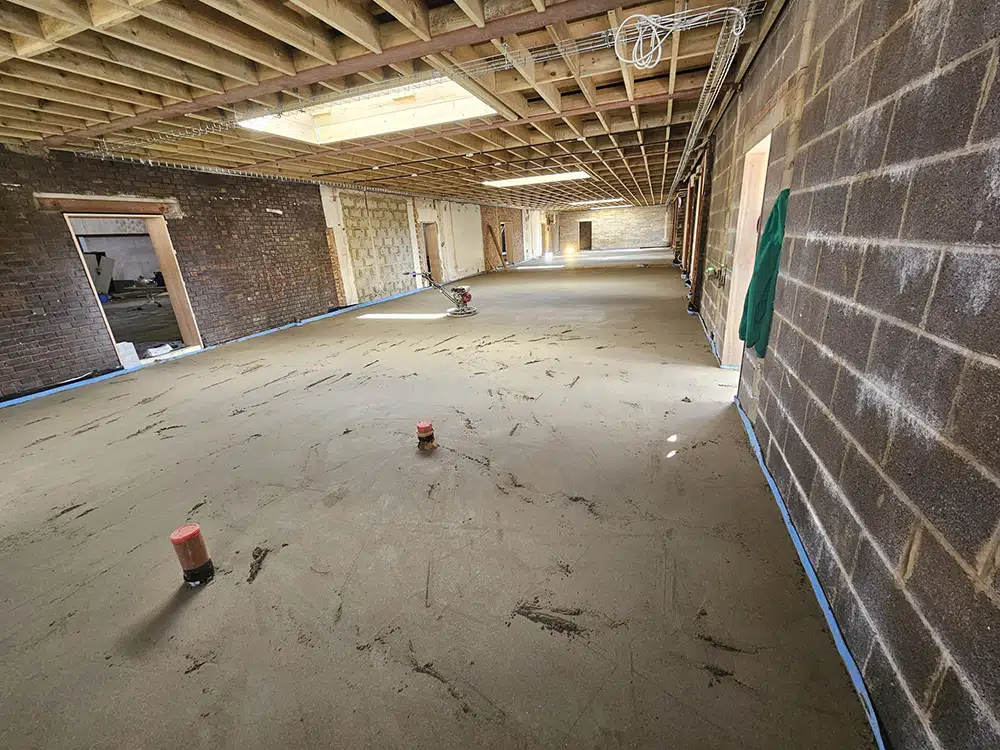
K & B Screeding’s own team, led by director Donatas Bardisevicius. Founded 2019, company 12298780.
See what customers say in our Google reviews and on our testimonials page.
Anhydrite & Flow Screed from Slough to Frome
As the crow flies, our yard in Slough is about 75.4 miles from Frome, which lies to the west-south-west. Postcodes here include BA11, and Westbury (6.3 miles), Warminster (6.4 miles), Trowbridge (7.9 miles) and Bath (10.6 miles) are close by.
More on anhydrite screed, part of our screeding services.