
Rebuilding floors in Trinity and around Catherine Hill
The Trinity area is a rare example of early industrial housing, built between 1660 and 1756, with the surviving houses restored between 1980 and 1984. Catherine Hill and Sheppard's Barton hold a notable group of small late 17th and 18th century houses. None of these were built with damp proof membranes, and their ground floors can be damp, uneven or breaking up.
When a floor like that is replaced, it is excavated carefully to the depth needed, a new base laid, and then a membrane, insulation and screed built up to meet the old thresholds and walls. Every step has to respect the building, and where it is listed, consent may be needed before work starts. Our insulation and membrane service supplies and lays the layers under the screed.
Sand and cement suits these houses because it is mixed in small batches and taken through narrow doorways by barrow, with no pump needed on the street. Where old floors vary in height from room to room, each one can take a different depth.
The post-war years, 1945 to 1972, produced 21% of Frome's homes, and solid floors from that period can also fail, for example through settlement or a leaking pipe.
A hand-laid floor dries at a slower pace than a liquid pour: around 40 days for 40mm, then longer per millimetre. A fast drying cement mix can help where the programme is tight.
Wet rooms and garages in Frome homes
Wet rooms and level-access showers need a floor that falls to the drain. We trowel those falls in sand and cement because it copes with water where calcium sulphate would not, and the tanking and tiles then follow that shape.
Garage conversions often start with a slab lower than the house floor. Building it up to hall level takes insulation, a membrane and then the screed, and the depths are set out in our garage screed guide.
Converted flats are a small part of Frome, at 4% of homes, but conversions of older buildings often need screed laid room by room around existing walls and structure, which suits a hand-laid method.
Where an existing concrete slab is sound, a bonded screed of 25 to 40mm fixed to the prepared surface gives a new level without the full floating depth. A floating screed over insulation must be the full 65mm in a home to stay strong, or 75mm in commercial use. The bonded option depends entirely on preparation: the slab is cleaned, roughened and primed with a bonding agent so the new screed and the old concrete act as one. Our bonded screed service explains when that thinner route is worth taking.
Sand and Cement Screed prices in Frome
Sand and cement screed: £18 to £25 per m² supplied and laid (MyJobQuote, August 2026), so £450 to £630 for 25 m². MyJobQuote does not say whether these figures include VAT. See our floor screeding cost guide or screed calculator.
Who lays your sand and cement screed in Frome
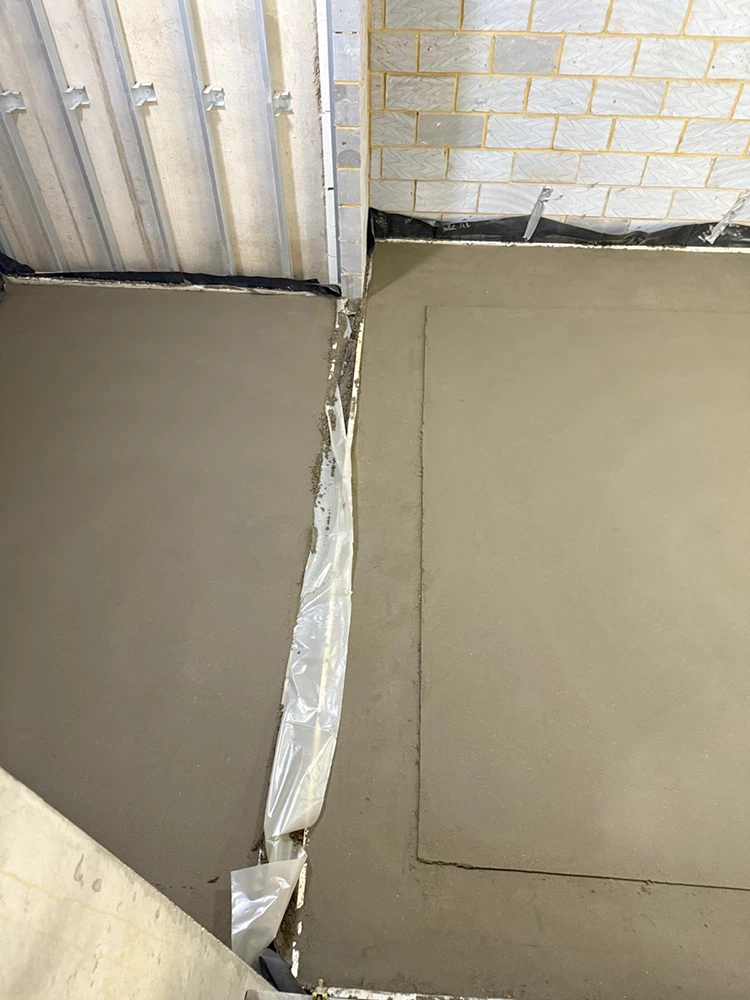
K & B Screeding’s own team, led by director Donatas Bardisevicius. Founded 2019, company 12298780.
See what customers say in our Google reviews and on our testimonials page.
Sand and Cement Screed from Slough to Frome
As the crow flies, our yard in Slough is about 75.4 miles from Frome, which lies to the west-south-west. Postcodes here include BA11, and Westbury (6.3 miles), Warminster (6.4 miles), Trowbridge (7.9 miles) and Bath (10.6 miles) are close by.
More on sand & cement screed, part of our screeding services.
