
Rebuilding solid floors in Warminster's historic town
Refurbish one of the older houses around Portway House or the Minster Church of St Denys and sooner or later the original ground floor may have to come up. Damp, uneven or too thin for modern insulation, it gets broken out and rebuilt in layers: damp proof membrane first, insulation where the depth allows, then fresh screed. Old rooms rarely share one level, so we measure the depth available in each one before we price the build-up.
For a rebuild like this, sand and cement makes sense. We mix it on site to the depth each room needs, so a hallway wanting a bit more and a back kitchen wanting a bit less can both be done in one visit. Compacted by hand and floated off dense and level, it also copes with cramped rooms and awkward doorways where a hose would only get in the way.
How deep it goes depends on the method. Floating on insulation in a home, it needs about 65mm, or 75mm for commercial use. Bonded straight onto a sound concrete base, 25 to 40mm can be enough. Our screed thickness guide runs through the options.
Often the larger share of the work is ripping out the old floor and getting the base right, and our floor preparation service handles that before screeding begins.
Wet rooms, garages and small rooms in Warminster
In Warminster, terraced houses account for 23% of homes, and the work in them is often small scale: one bathroom, a utility room, or a single room whose floor has failed. With no pump to set up, a hand-laid screed stays good value at that size.
For a wet room, hand-laid cement screed is the obvious material. With a level-access shower, the floor has to slope down to the drain, and that slope is shaped by hand. Cement based screed also tolerates water, which calcium sulphate does not.
Garages work the same way. If a floor might later carry a car, a workbench or a converted room, it needs a cement substrate, and a hand-laid screed can take load sooner. More on conversions is in our garage floor screed guide.
What you give up is drying speed. Reckon on about a day for every millimetre through the first 40mm and longer beyond, so a 65mm floor takes patience before flooring goes on. Fibres can go into the mix to help keep cracking in check, at an extra £1 to £3 a square metre, and a faster drying screed mix can cut the wait on a tight programme.
Sand and Cement Screed prices in Warminster
Sand and cement screed: £18 to £25 per m² supplied and laid (MyJobQuote, August 2026), so £450 to £630 for 25 m². MyJobQuote does not say whether these figures include VAT. See our floor screeding cost guide or screed calculator.
Who lays your sand and cement screed in Warminster
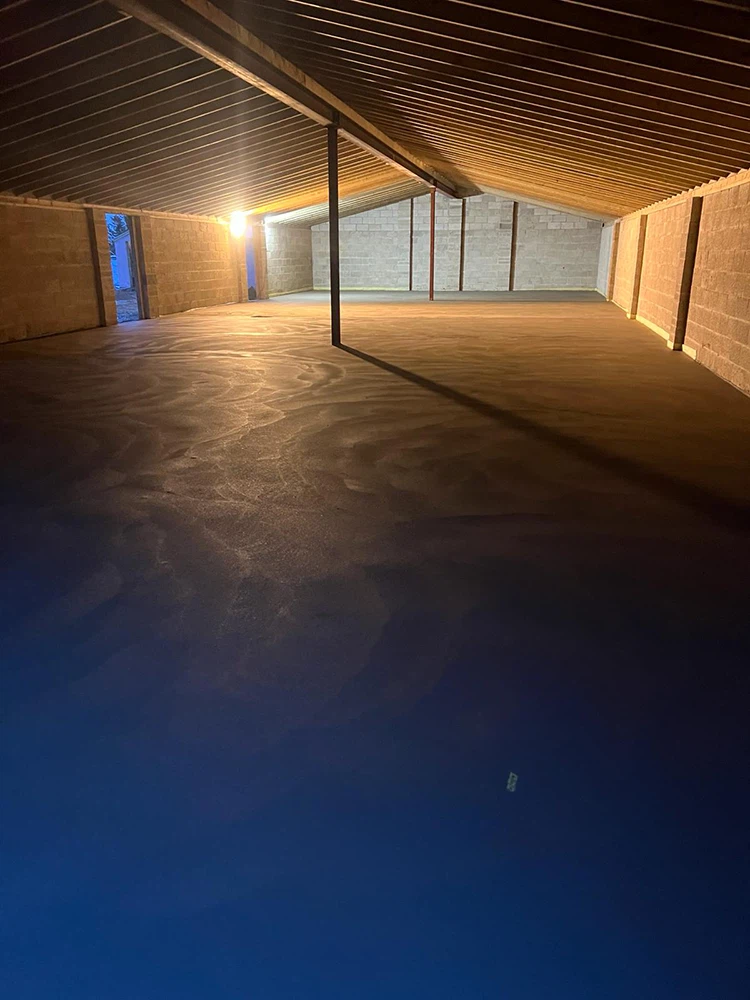
K & B Screeding’s own team, led by director Donatas Bardisevicius. Founded 2019, company 12298780.
See what customers say in our Google reviews and on our testimonials page.
Sand and Cement Screed from Slough to Warminster
On the map, Warminster sits west-south-west of Slough, about 70.2 miles from our base in a straight line (postcodes including BA12), next to Westbury (3.9 miles), Frome (6.4 miles), Trowbridge (8 miles) and Melksham (11.8 miles).
More on sand & cement screed, part of our screeding services.