
New membranes under old floors in Westbury Leigh
Floors in Georgian and Victorian houses were never built with a damp proof membrane or insulation. Over time, an original solid floor can become damp, cold and uneven, and a refurbishment is the moment to put that right.
The usual sequence is to break out the old floor, lay a membrane that links to the wall damp proofing, add insulation if there is depth, and then screed. Getting the base and the levels right before any screed is laid is a job in itself, and our floor preparation work covers it.
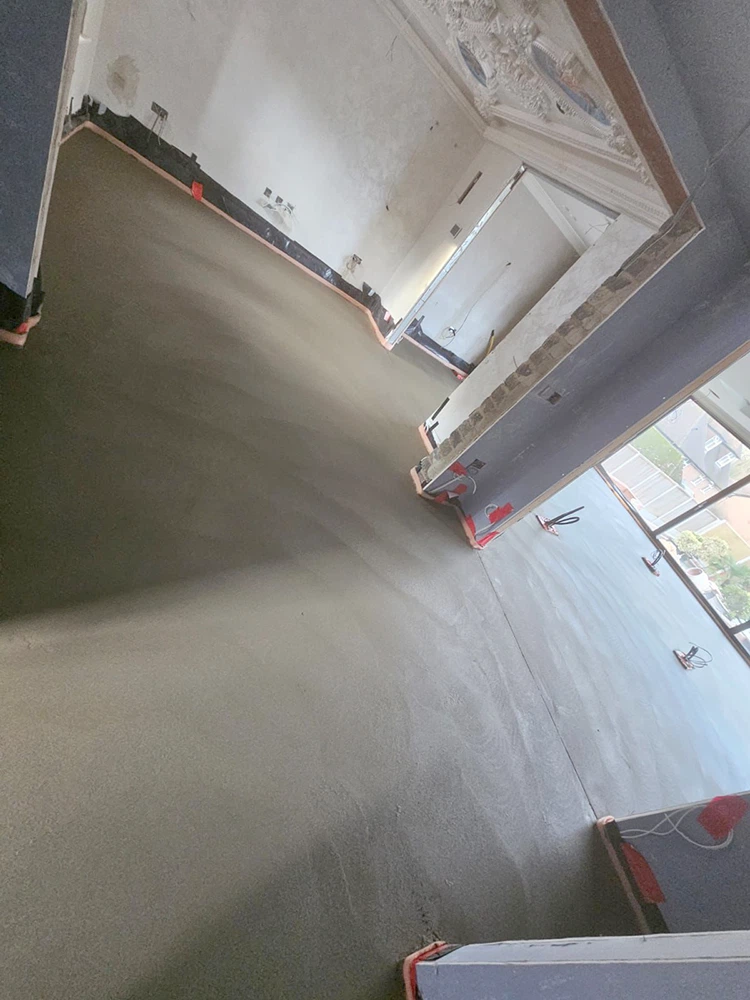
For houses of this age, a floor laid by hand makes sense. It is mixed to suit each room, so a floor that varies in depth from front to back can be dealt with in one visit. Old houses rarely have square rooms or level thresholds, and a screed laid by hand can be worked into corners, around hearths and up to door frames that a pumped screed would flow past.
How thick? Floated on insulation in a house, allow about 65mm. In listed buildings around the Market Place, where floor heights and original features may be protected, the build-up can be tighter, so check any listed building consent before work begins. Where only a thin layer is possible on sound concrete, a bonded screed of 25 to 40mm is the alternative.
Bonded or floating screed in Westbury terraces
Terraces account for 24% of Westbury's homes. Jobs in houses like these are often room by room, which is where a hand-laid screed is cost effective: no pump to set up, and the mix is made in the quantity needed.
The main decision is how the screed meets the floor below. A floating screed sits on insulation or a membrane, separated from the base, and needs depth to be strong. A bonded screed is fixed to a sound, prepared concrete slab with a bonding agent, so it can be much thinner. Read about screed bonded to concrete to see when that is the right call; 2026 published prices for it sit between £12 and £18 a square metre.
Sand and cement also goes where calcium sulphate cannot: wet rooms, shower areas laid to falls, and garages. A garage floor that will take a car or become a habitable room needs a cement substrate, and our guide to garage floor screed covers conversions.
Mixing in fibres costs an extra £1 to £3 a square metre and helps resist cracking. Expect slower drying than a pumped floor: about one day for each millimetre through the first 40mm. The same service is available about 6 miles away as sand and cement screed in Frome.
Sand and Cement Screed prices in Westbury
Sand and cement screed: £18 to £25 per m² supplied and laid (MyJobQuote, August 2026), so £450 to £630 for 25 m². MyJobQuote does not say whether these figures include VAT. See our floor screeding cost guide or screed calculator.
Who lays your sand and cement screed in Westbury
K & B Screeding’s own team, led by director Donatas Bardisevicius. Founded 2019, company 12298780.
See what customers say in our Google reviews and on our testimonials page.
Sand and Cement Screed from Slough to Westbury
As the crow flies, our yard in Slough is about 69.1 miles from Westbury, which lies to the west-south-west. Postcodes here include BA13, and Warminster (3.9 miles), Trowbridge (4.2 miles), Frome (6.3 miles) and Melksham (8 miles) are close by.
More on sand & cement screed, part of our screeding services.
