
Relaying older Melksham floors by hand
An old solid ground floor that has cracked, dropped or stopped keeping the damp out rarely stays fixed if it is just patched. The repair that holds is to break it up, dig deep enough to fit insulation, put down a damp proof membrane and lay a fresh screed on top. Sand and cement suits that kind of job.
Because each batch is mixed on site, the depth can change from area to area, which helps when one floor has to meet several thresholds at slightly different heights. It is packed down by hand, finished dense and level, and it works neatly around chimney breasts, pipework and short runs between doors. Laid floating on insulation, a home needs 65mm of it and a commercial building 75mm.
It also leaves a cement base. Certain floor finishes and adhesives ask for exactly that, and it can carry load sooner in a floor's life than calcium sulphate. When damp is the reason the old floor is coming up, the layers under the screed are handled by our insulation and damp membrane service.
It is slow to dry, though. At 65mm it takes far longer than a thin liquid floor, roughly one day per millimetre until 40mm and then longer. On a tight programme, putting a rapid drying additive in the mix, or switching to a faster drying screed, can win back time, and fibres can go into the mix to help resist cracking. If your floor is newer and wider, start with pumped screed for Melksham homes instead.
Wet rooms, garages and bonded screeds in Melksham
Some rooms call for sand and cement however old the house is. Showers without a tray, and wet rooms, have to slope towards the drain, and that fall is formed by hand. Calcium sulphate must not go where it could stay damp, so sand and cement goes under the tiles in those rooms.
Garage conversions are the other regular one. Turning a garage into living space usually means lifting its floor up to the level of the house, with insulation and a membrane under a new screed; the levels are explained in our guide to screeding a garage floor.
Terraced houses are 22% of Melksham's homes, which means a fair number of narrow ground floors where barrows and a small mixer are easier than bringing in a pump.
Should the floor be floating or bonded? Floating means the screed rests on a membrane or insulation, and it needs the full 65mm. Bonded means it is fixed straight onto sound concrete underneath, so 25 to 40mm will do, handy when height at the doors is short and the slab is in good shape.
Sand and Cement Screed prices in Melksham
Sand and cement screed: £18 to £25 per m² supplied and laid (MyJobQuote, August 2026), so £450 to £630 for 25 m². MyJobQuote does not say whether these figures include VAT. See our floor screeding cost guide or screed calculator.
Who lays your sand and cement screed in Melksham
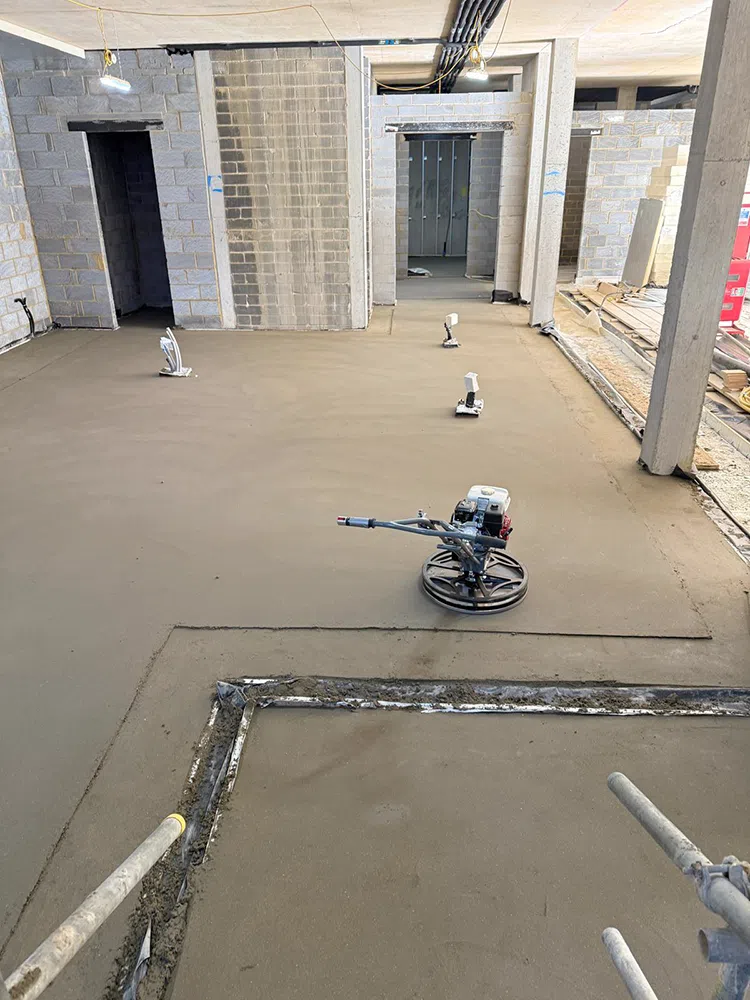
K & B Screeding’s own team, led by director Donatas Bardisevicius. Founded 2019, company 12298780.
See what customers say in our Google reviews and on our testimonials page.
Sand and Cement Screed from Slough to Melksham
As the crow flies, our yard in Slough is about 65.4 miles from Melksham, which lies to the west. Postcodes here include SN12, and Corsham (4.7 miles), Trowbridge (4.7 miles), Chippenham (6 miles) and Devizes (6.3 miles) are close by.
More on sand & cement screed, part of our screeding services.
