
Relaying solid floors in Gillingham's brick terraces
Of all Gillingham's homes, 12% went up before 1919. Many older houses in the historic centre have solid floors, and plenty of those were put straight on the ground, or on a thin slab, with no insulation and not much to stop damp. Years later they have cracked, dropped or simply stay cold and damp underfoot.
We begin by breaking the old floor out and digging deep enough to fit a proper build-up. First a damp proof membrane, then rigid insulation, then the screed on top. In a house, a floating sand and cement floor over insulation goes down at 65mm, a depth that lets it take load without cracking. How those lower layers fit together is set out on our membranes and insulation page.
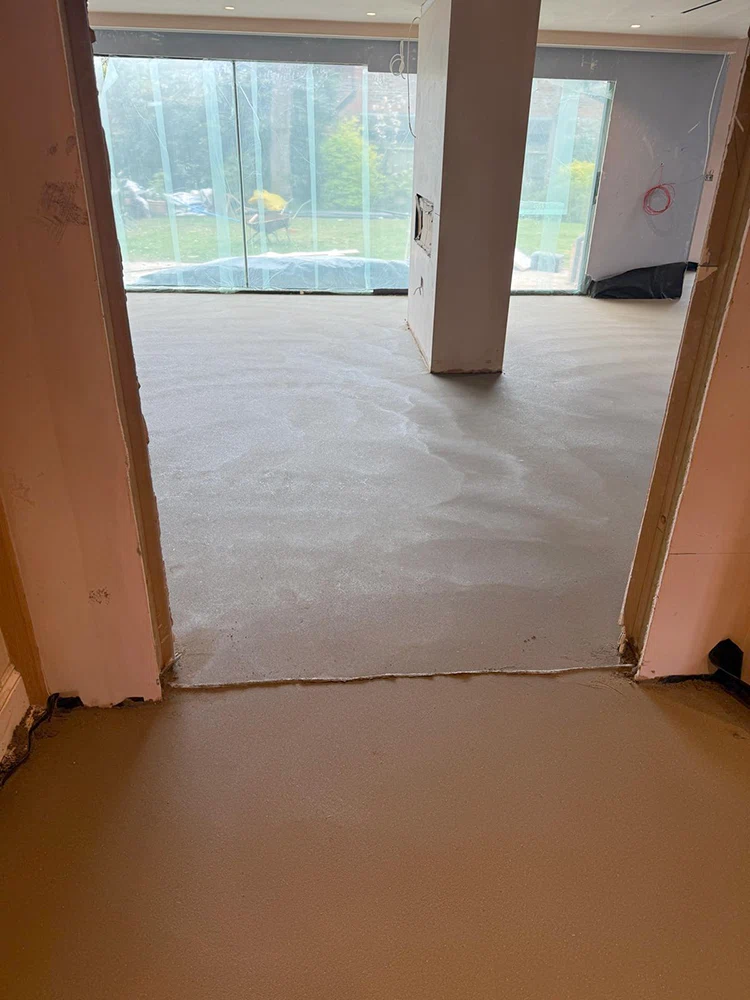
Because we mix it a batch at a time on site, sand and cement deals easily with a narrow hall, a back kitchen with several doors or a floor that changes level from room to room. If the concrete underneath is sound and just needs a new top, a bonded screed of 25 to 40mm stuck straight to it can be enough and saves depth.
The catch is the wait. Allow roughly one day for each millimetre of thickness up to 40mm, and longer again past that point, which puts it behind a pumped floor. If your kitchen fitter already has a date in an old Gillingham house, build that drying time into the plan instead of trying to squeeze it. Where the floor is likely to move, screed with added fibres gives extra resistance to cracking.
Wet rooms, garages and falls in Gillingham houses
Some rooms call for cement screed no matter how old the house is. Take a level-access shower. Long exposure to water weakens calcium sulphate, so a shower floor that slopes to the drain should be sand and cement. We shape that slope by hand while laying, so water heads for the gully instead of collecting in the corners.
Garage conversions are the next. The floor in a garage is usually below the level of the house and has no insulation under it. Adding insulation and a new screed lifts it to match the rest of the ground floor, and our guide to screeding a converted garage walks through the layers.
You also want sand and cement if the floor has to bear weight early, or if the flooring maker insists on a cement base. On commercial premises, the floating depth goes up to 75mm.
Planning underfloor heating? Pipes want roughly 45mm of this mix above them, and three weeks at minimum, 21 days, must pass before anyone turns the heat on. Our heated floor screed page for Gillingham explains it in full.
Sand and Cement Screed prices in Gillingham
Sand and cement screed: £18 to £25 per m² supplied and laid (MyJobQuote, August 2026), so £450 to £630 for 25 m². MyJobQuote does not say whether these figures include VAT. See our floor screeding cost guide or screed calculator.
Who lays your sand and cement screed in Gillingham
K & B Screeding’s own team, led by director Donatas Bardisevicius. Founded 2019, company 12298780.
See what customers say in our Google reviews and on our testimonials page.
Sand and Cement Screed from Slough to Gillingham
Gillingham is about 78.5 miles west-south-west of our Slough base as the crow flies, with postcodes including SP8. The nearest towns to it are Warminster (12.3 miles), Frome (13.5 miles), Westbury (15.9 miles) and Trowbridge (19.7 miles).
More on sand & cement screed, part of our screeding services.
