
Where liquid screed earns its place in Gillingham
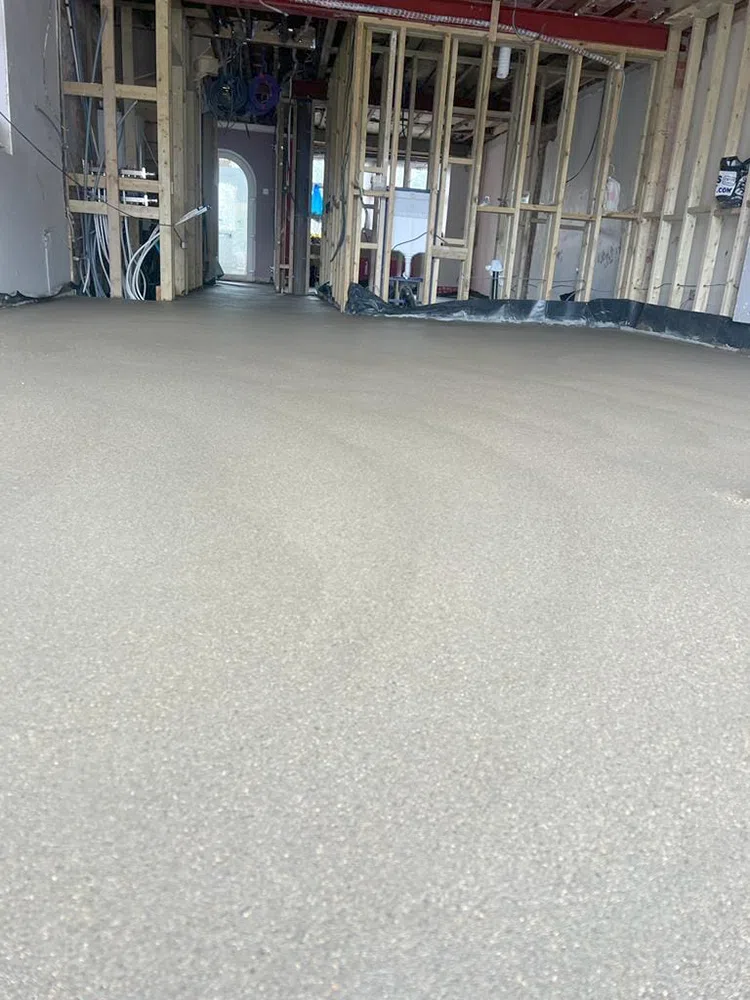
A pumped screed pays its way on wide, open ground floors. Picture a Wyke or Peacemarsh house where the kitchen, dining area and family room have been knocked into one space, or a rear extension on a cul-de-sac home. Because the mix flows out and settles flat by itself, SR1 or SR2 flatness is readily achievable, and the floor usually needs little or no compound before LVT or tiles.
It suits the new homes planned for the Southern Extension too, since that type of house commonly has underfloor heating. The screed wraps every pipe with no air gaps, so heat gets through to the room faster.
Apartments are a good match as well. Purpose-built flats make up 9% of Gillingham's homes, and pouring a whole flat floor in one session plays to a pumped product's strengths.
As for thickness, 35mm or so is the floor's starting point when it floats on insulation in a house, rising to 40mm in commercial premises. It barely shrinks, which keeps joint lines to a handful. Pumped mixes are made with either a calcium sulphate or a cement binder, and the room plus your chosen flooring decide which one we bring.
There are rooms where we would steer you elsewhere. One small room, a wet room laid to falls, or a floor that has to carry weight early tends to be better done in hand-laid sand and cement. Our guide comparing liquid screed with the traditional mix weighs up the differences.
Getting the hose into Gillingham homes
On the day, the mixer and pump pull up as close to your house as the road lets them. A hose then runs to the room through a side gate, the garage or the house itself, and we cover the route as we go. A cul-de-sac drive makes that quick to set up. In the older streets of the town centre, terraces can have little space at the front, so mention any parking restrictions or a tight passage to the back garden when you send details.
Height is not a problem. We can take the hose up a stairwell or in through a window to reach a flat on an upper floor, which is part of why pumped screed and apartments go well together.
Have the insulation boards and perimeter strip down beforehand, with doors and windows able to shut out draughts. Afterwards, leave doors and windows shut for a day or two, then open them up so moisture can escape. Expect around a day of drying per millimetre for the first 40mm, and remember that a floor you can walk on may still be too damp for flooring. Our guide to how long screed takes to dry goes further, and bigger pours are covered by our screed pump service.
Liquid Screed prices in Gillingham
Liquid screed: £24 to £31 per m² supplied and laid (MyJobQuote, August 2026), so £960 to £1,240 for 40 m². MyJobQuote does not say whether these figures include VAT. See our floor screeding cost guide or screed calculator.
Who lays your liquid screed in Gillingham
K & B Screeding’s own team, led by director Donatas Bardisevicius. Founded 2019, company 12298780.
See what customers say in our Google reviews and on our testimonials page.
Liquid Screed from Slough to Gillingham
Gillingham is about 78.5 miles west-south-west of our Slough base as the crow flies, with postcodes including SP8. The nearest towns to it are Warminster (12.3 miles), Frome (13.5 miles), Westbury (15.9 miles) and Trowbridge (19.7 miles).
More on liquid screed, part of our screeding services.
