
Specifying calcium sulphate grades for Gillingham new builds
Read the code printed on an anhydrite delivery note: after CA comes a C number for crushing strength and an F number for bending strength, both in N/mm2 and both set by the European screed standard. Read together, they tell you how the floor will stand up to footfall, furniture and point loads. In practice three codes do most of the work. Lightly used domestic rooms get CA-C20-F4. Typical family homes, apartment floors and office space sit at CA-C25-F5. A unit at Brickfields or Kingsmead with heavier use would call for CA-C30-F6.
On a new-build plot, the engineer or the manufacturer's specification decides the grade. We pour exactly what is written, and we do not swap in something else, even if a cheaper grade seems near enough on paper. Just 6% of Gillingham's homes were built in 2015 or later, so most of the new building in the Southern Extension is still to come, and every plot there will turn up with its own specification.
A designer chasing a faster dry or a shallower floor may write in an alpha hemihydrate product. Those come with a maker's data sheet giving depth and drying, and that sheet is what we work to.
Calcium sulphate barely shrinks while it sets, which means big bays can go down with few joints. Any joints, usually across doorways or where one heating zone meets another, are marked out and agreed with you ahead of the pour. There is more background in anhydrite screed explained.
Laitance, primers and moisture checks on Gillingham floors
Pouring is only half the job. While calcium sulphate dries, a weak, dusty skin called laitance forms on top. Leave it there and your tile adhesive or compound grips that crust instead of the screed itself, so we sand it off first. Once sanded, the surface gets a primer made for calcium sulphate, since some primers meant for cement react badly with it.
Then comes moisture. Plenty of flooring brands set a stricter moisture ceiling on calcium sulphate than on a cement base, and a surface can look ready long before the readings agree. A hygrometer reading settles it, and you get our drying and sanding advice on paper. Where pipes run through it, the heating can usually speed things up from about day 7.
Do not use calcium sulphate anywhere that might get wet, such as a shower room, a utility with a washing machine or a boot room. Those rooms want cement: either a flowing cement mix or traditional hand-laid screed. Anyone across in Frome can have this material poured too.
Anhydrite & Flow Screed prices in Gillingham
Liquid flowing screed (which includes anhydrite): £24 to £31 per m² supplied and laid (MyJobQuote, August 2026), so £960 to £1,240 for 40 m². MyJobQuote does not say whether these figures include VAT. See our floor screeding cost guide or screed calculator.
Who lays your anhydrite and flow screed in Gillingham
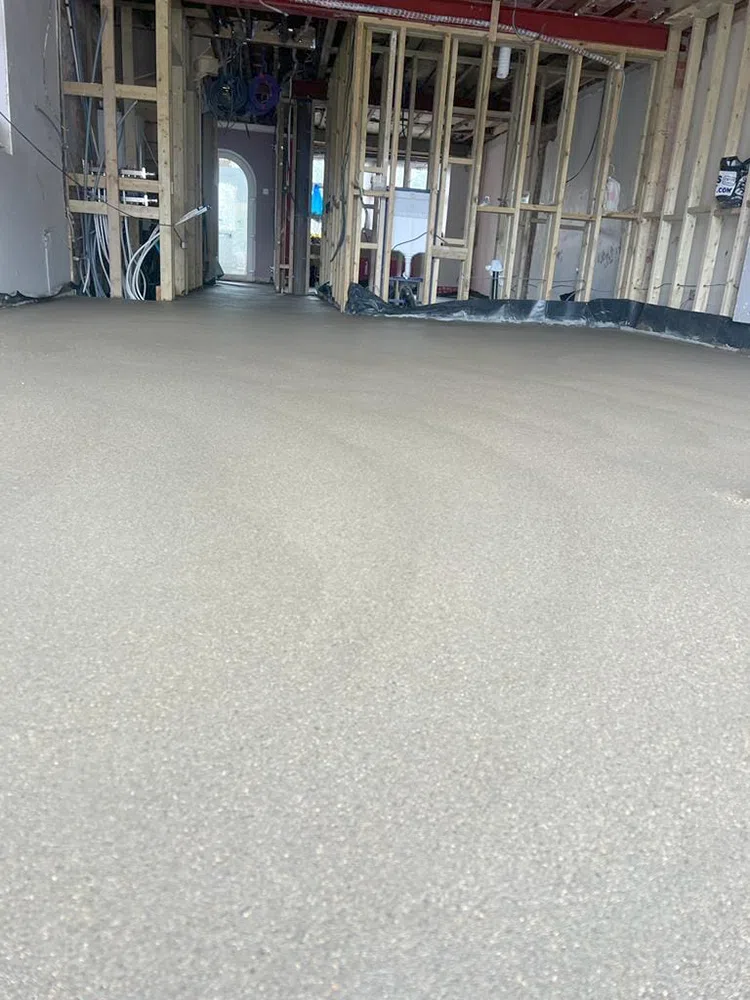
K & B Screeding’s own team, led by director Donatas Bardisevicius. Founded 2019, company 12298780.
See what customers say in our Google reviews and on our testimonials page.
Anhydrite & Flow Screed from Slough to Gillingham
Gillingham is about 78.5 miles west-south-west of our Slough base as the crow flies, with postcodes including SP8. The nearest towns to it are Warminster (12.3 miles), Frome (13.5 miles), Westbury (15.9 miles) and Trowbridge (19.7 miles).
More on anhydrite screed, part of our screeding services.
