
Reading the screed grade on a Warminster specification
The name of a calcium sulphate screed tells you its strength. In the European screed standard, C gives compressive strength and F gives flexural strength, each in N/mm2, so CA-C25-F5 means calcium sulphate at 25 compressive and 5 flexural.
If a drawing leaves the grade unclear, ask us before ordering. It is far easier to settle the mix on paper than to argue about it once the floor is down.
Three grades cover the bulk of the work. CA-C20-F4 is for lightly used domestic floors. For houses, apartments and offices alike, the everyday choice is CA-C25-F5. CA-C30-F6 goes in where floors see heavier use. If the house type drawing for a new plot names one, we pour that grade, with the bays and joints planned ahead of the day.
Alpha hemihydrate products sit in their own family. They are picked when quicker drying or a thinner depth matters, and each one follows its own product sheet, not a general rule.
In Warminster, purpose-built flats account for 10% of homes, and apartment floors suit this material well. Because calcium sulphate barely shrinks, it can go down in large bays with few joints, which works for open-plan flats and long corridors.
For more on the chemistry, see our anhydrite screed explainer. If there is no specification and you simply want to pick a pumped floor, begin with our general liquid screed page.
Laitance, moisture and primers for Warminster floors
Calcium sulphate needs aftercare that cement screeds can do without. As the material sets, a thin, weak skin called laitance comes up to the top. When the screed has dried, that skin has to be sanded away, otherwise adhesives and levelling compounds end up stuck to it instead of to the screed.
Then comes moisture testing. Flooring makers are often stricter about how damp a calcium sulphate floor may be than a cement one, so a floor that passes for one covering can still be too damp for another. A hygrometer reading settles it before anything is laid. With underfloor heating in, the heating can usually force dry the screed from about 7 days, which cuts the wait a good deal.
Once sanded and tested, the surface is primed with a product made to work with calcium sulphate, giving the adhesive or compound something sound to hold.
Keep this material away from floors that may get wet. For wet rooms, or utility areas where water could end up on the floor, use a pourable cement mix or sand and cement laid by hand instead. Just up the road, we handle the same specification work as anhydrite screed in Westbury.
Anhydrite & Flow Screed prices in Warminster
Liquid flowing screed (which includes anhydrite): £24 to £31 per m² supplied and laid (MyJobQuote, August 2026), so £960 to £1,240 for 40 m². MyJobQuote does not say whether these figures include VAT. See our floor screeding cost guide or screed calculator.
Who lays your anhydrite and flow screed in Warminster
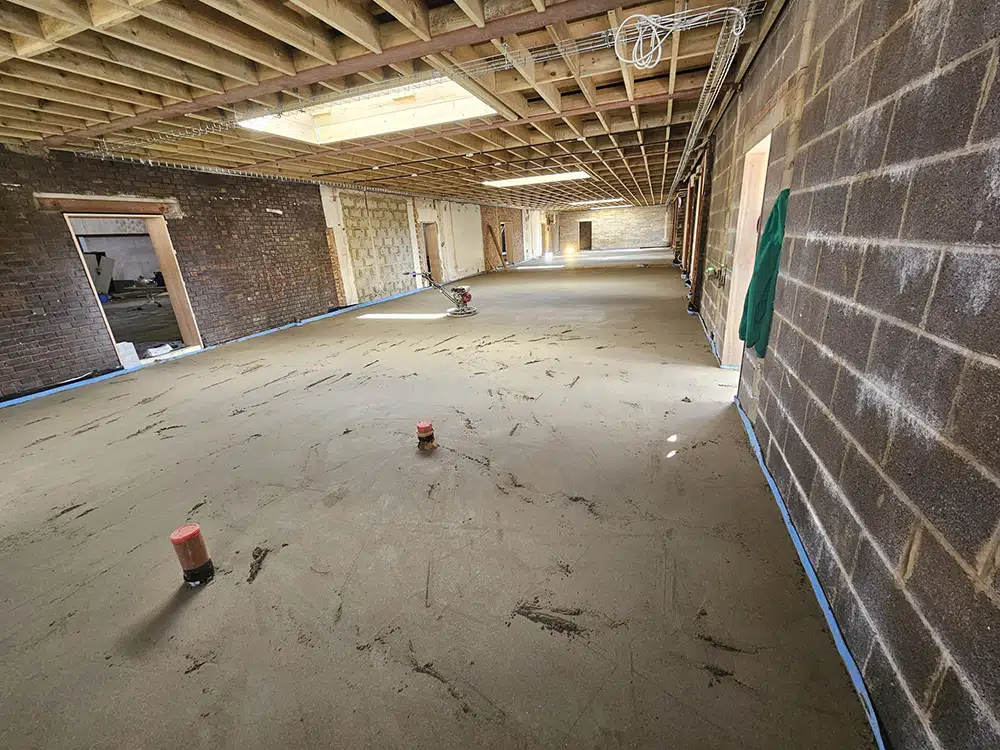
K & B Screeding’s own team, led by director Donatas Bardisevicius. Founded 2019, company 12298780.
See what customers say in our Google reviews and on our testimonials page.
Anhydrite & Flow Screed from Slough to Warminster
On the map, Warminster sits west-south-west of Slough, about 70.2 miles from our base in a straight line (postcodes including BA12), next to Westbury (3.9 miles), Frome (6.4 miles), Trowbridge (8 miles) and Melksham (11.8 miles).
More on anhydrite screed, part of our screeding services.