
What latex screed is, and where Warminster floors need it
The name confuses people, because latex screed is not a screed in the usual sense. It is a two part levelling compound: a bag of cement powder plus a container of latex, which is used in place of the mixing water. The latex makes the set layer slightly flexible and helps it grip surfaces that a water-mixed compound would struggle on. We spread it a few millimetres thick, and it cures to a smooth, closed face that thin coverings can be stuck straight onto.
Its value is on bases that are sound but awkward. In a Warminster kitchen being refitted, that might be old quarry tiles still firmly bonded to the slab, where lifting them would mean days of breaking out. Latex bridges the grout lines and the slightly dished tile faces so sheet vinyl or LVT lies flat over the top. In a bathroom, it might be a timber floor the builder has covered with flooring grade plywood, screwed down at close centres. Latex goes over that ply. It never goes straight onto bare floorboards, which shift with every footstep and would crack it.
Uneven older concrete, and firm layers of old adhesive left when vinyl is lifted, can often be covered too, once we have tested that the residue is hard and compatible.
The finishes that depend on it are the thin, flexible ones: sheet vinyl, LVT, lino, rubber and safety flooring, which show every joint and bump beneath them. Carpet is more forgiving, though a smooth latex layer still stops ridges wearing through. For flatness classes and choosing between compound and a new screed, see our Warminster floor levelling page.
When latex is the wrong answer in Warminster
Latex hides an awkward surface, but it cannot cure a faulty floor, and laying it over one only delays the trouble.
Springy boards are the first warning. If a timber floor flexes as you cross it, the joists or boards need attention and the plywood has to be fixed down properly before any compound goes on. Latex laid over movement soon cracks along the board lines.
Damp is the second. A latex layer will not stop moisture coming up through an old solid floor, and sheet vinyl on top can trap it until the adhesive lets go. Around the historic town, where older properties may already want damp proofing, we take a moisture reading before any latex is mixed. Where it is high, the honest answer is a membrane and a new floor, laid as a hand-laid sand and cement rebuild.
The third is level. A floor that drops a long way from one side of a room to the other needs more depth than a few millimetres can give. Local hollows can be filled, but a sunken or broken base wants a repair to the failed screed or fresh screed first.
Calcium sulphate bases are a special case. Their laitance has to be sanded away and a primer made for calcium sulphate applied, every time, before latex touches it. Other bases get whichever primer their surface calls for.
How we price latex screed in Warminster
A fixed written price within 24 hours, once we know the area and the base. See our floor screeding cost guide.
Who lays your latex screed in Warminster
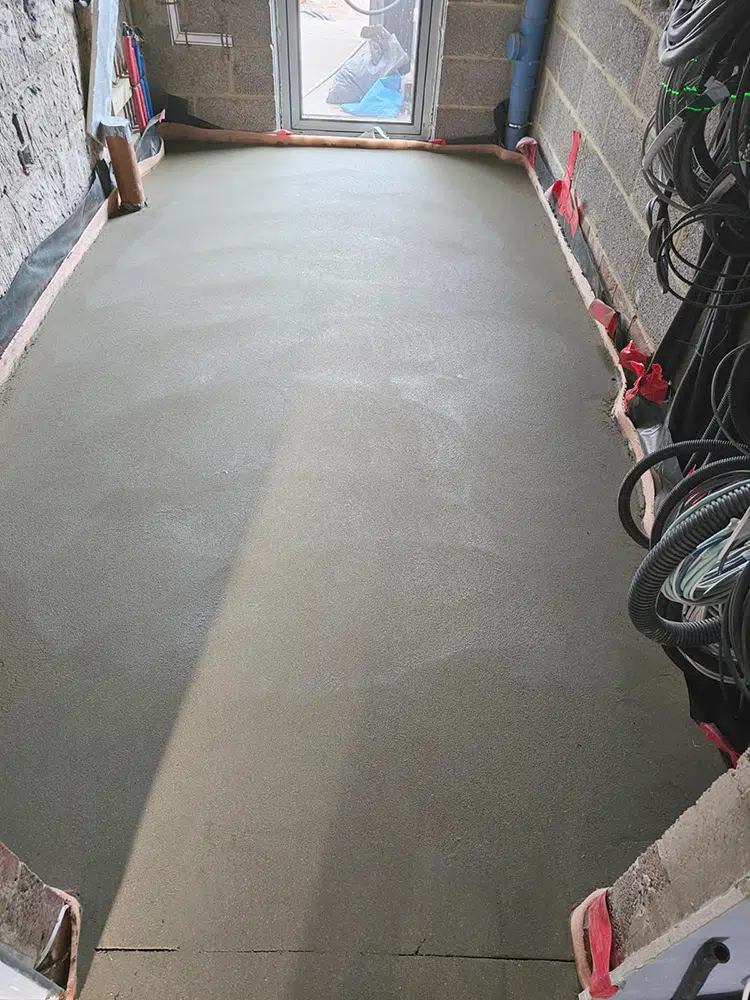
K & B Screeding’s own team, led by director Donatas Bardisevicius. Founded 2019, company 12298780.
See what customers say in our Google reviews and on our testimonials page.
Latex Screed from Slough to Warminster
On the map, Warminster sits west-south-west of Slough, about 70.2 miles from our base in a straight line (postcodes including BA12), next to Westbury (3.9 miles), Frome (6.4 miles), Trowbridge (8 miles) and Melksham (11.8 miles).
More on latex screed, part of our screeding services.