
Latex over mixed bases in Frome refits
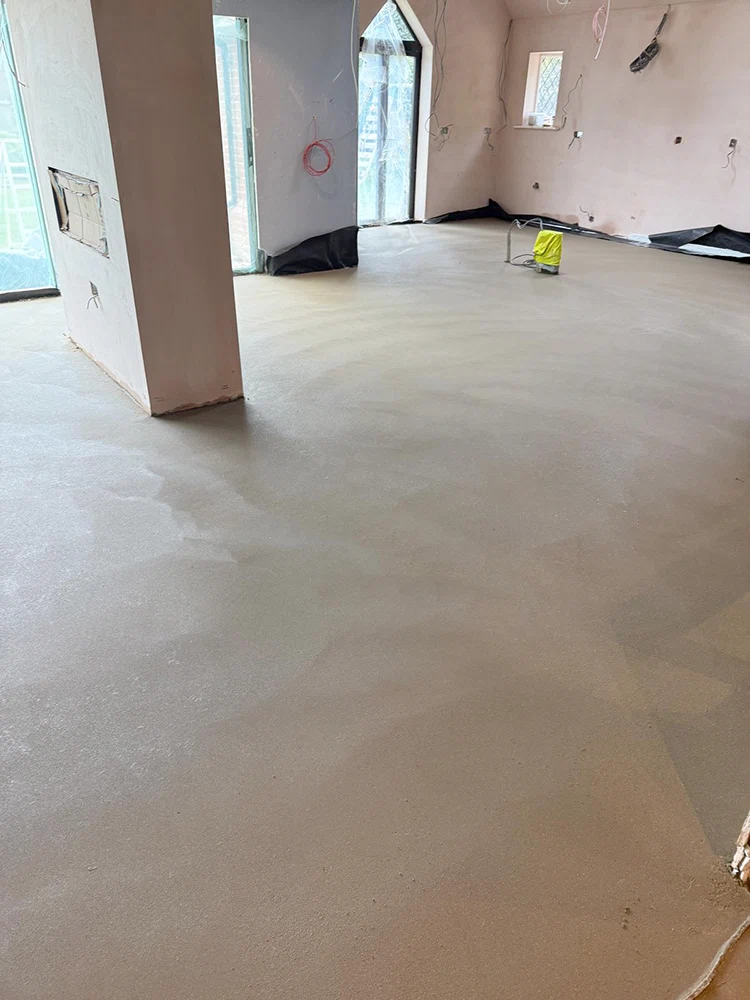
Latex screed is the name the trade uses for one kind of levelling compound. It comes in two parts: a cement based powder and a latex liquid that replaces the water you would add to an ordinary compound. Mixed together, they cure into a thin layer with a little give and a strong grip, which makes latex the usual choice over bases that are awkward rather than badly damaged.
A ground floor refit in a 1980s semi can uncover almost anything: old ceramic tiles, a run of quarry tiles by the back door, thin ply where a previous owner overboarded, and concrete roughened where a wall came out. If every part of that floor is sound and dry, each surface gets the primer that suits it, and latex then joins them into one smooth base.
Flats make up 16% of Frome's homes. Where a flat or an upstairs room has a timber floor, latex never goes straight onto bare boards, because they bend underfoot and crack a thin cement layer. The boards are fixed down, overboarded with flooring grade plywood screwed at close centres, and the latex is spread over the ply.
The finishes that ask for this smooth base are the thin and flexible ones: sheet vinyl, LVT, lino, rubber, safety flooring and carpet. Old adhesive is checked before latex. A thin, hard film can stay under the primer, but loose or soft residue comes off, and on a heavily coated floor diamond grinding for Frome floors may come first.
Damp and old floors around Trinity and Catherine Hill
Latex has limits, and Frome's oldest houses show them clearly. Houses from the 17th and 18th centuries in the Trinity area, on Catherine Hill and at Sheppard's Barton were built long before damp proof membranes existed. A thin latex layer will not keep moisture out. Laid over a damp floor and sealed under vinyl, it can trap water that then lifts the covering.
Homes built before 1919 make up 18% of the town's stock, so a damp test comes before any quote for latex in an older house. Where the floor is wet, it needs rebuilding with a membrane, which is covered on our Frome sand and cement page.
Springy boards are the second limit. No compound stays intact over a timber floor that moves, so joists and boards are fixed before any ply goes down.
The third is height. Latex is a thin layer, and where a floor dips well beyond a few millimetres, the right step is a repair, overboarding or new screed first. Our guide to screed thickness explains the depths involved.
If an extension floor near Adderwell was poured in calcium sulphate, its laitance must be sanded off and a compatible primer applied before latex is laid on it.
How we price latex screed in Frome
A fixed written price within 24 hours, once we know the area and the base. See our floor screeding cost guide.
Who lays your latex screed in Frome
K & B Screeding’s own team, led by director Donatas Bardisevicius. Founded 2019, company 12298780.
See what customers say in our Google reviews and on our testimonials page.
Latex Screed from Slough to Frome
As the crow flies, our yard in Slough is about 75.4 miles from Frome, which lies to the west-south-west. Postcodes here include BA11, and Westbury (6.3 miles), Warminster (6.4 miles), Trowbridge (7.9 miles) and Bath (10.6 miles) are close by.
More on latex screed, part of our screeding services.
