
Older solid floors around the Cornmarket and High Street
The town keeps a large collection of 15th, 16th and 17th century buildings, protected by conservation controls around the Cornmarket and High Street. None of those floors were laid to the standards a modern Wimborne extension has to meet. Stone flags, early solid floors and later patches may all sit in one room.
These floors need careful repair, often with lime friendly methods and with a membrane only where the rules allow. The first step is to find out what is there and what the conservation officer will accept, rather than breaking everything out.
Where a section of floor is replaced and a modern build-up is allowed, a sand and cement screed is often the practical choice. It is mixed in small batches, placed by hand into awkward rooms and compacted to a dense finish. When it floats on insulation in a home, we lay it 65mm deep. If the base below is sound, a bonded topping just 25 to 40mm thick, stuck straight to it, saves height. Our page on insulation and membranes explains the layers that sit below a floating screed.
The same approach works in older houses outside the conservation area where a failed solid floor is dug out and relaid with insulation.
Expect a slower dry than with a pumped floor: about one day per millimetre until you pass 40mm, and slower beyond. Nationally, the 2026 going rate is £18 to £25 a square metre.
Wet rooms and garages in Wimborne Minster homes
Wet areas need a cement screed. Calcium sulphate loses strength if it stays wet, so a walk-in shower in a Wimborne Minster home gets sand and cement, shaped by hand to slope towards the drain. The waterproofing and tiles then follow that fall.
Garages being converted into rooms are another natural fit. The slab usually sits below the house floor, and raising it with insulation and screed brings it level. We explain each layer in screeding a converted garage.
Sand and cement is also chosen where a floor has to take a load early, or where a flooring manufacturer asks for a cement substrate. On a commercial floor, a floating screed is 75mm. Fibres can be added for crack resistance at about £1 to £3 per m², which helps on a garage slab that may move a little.
Running heating pipes through it? Then we need about 45mm of this mix on top of them, and the system has to stay off for 21 days or more. For heated rooms where depth is tight, a pumped liquid screed in Wimborne Minster may suit better.
Sand and Cement Screed prices in Wimborne Minster
Sand and cement screed: £18 to £25 per m² supplied and laid (MyJobQuote, August 2026), so £450 to £630 for 25 m². MyJobQuote does not say whether these figures include VAT. See our floor screeding cost guide or screed calculator.
Who lays your sand and cement screed in Wimborne Minster
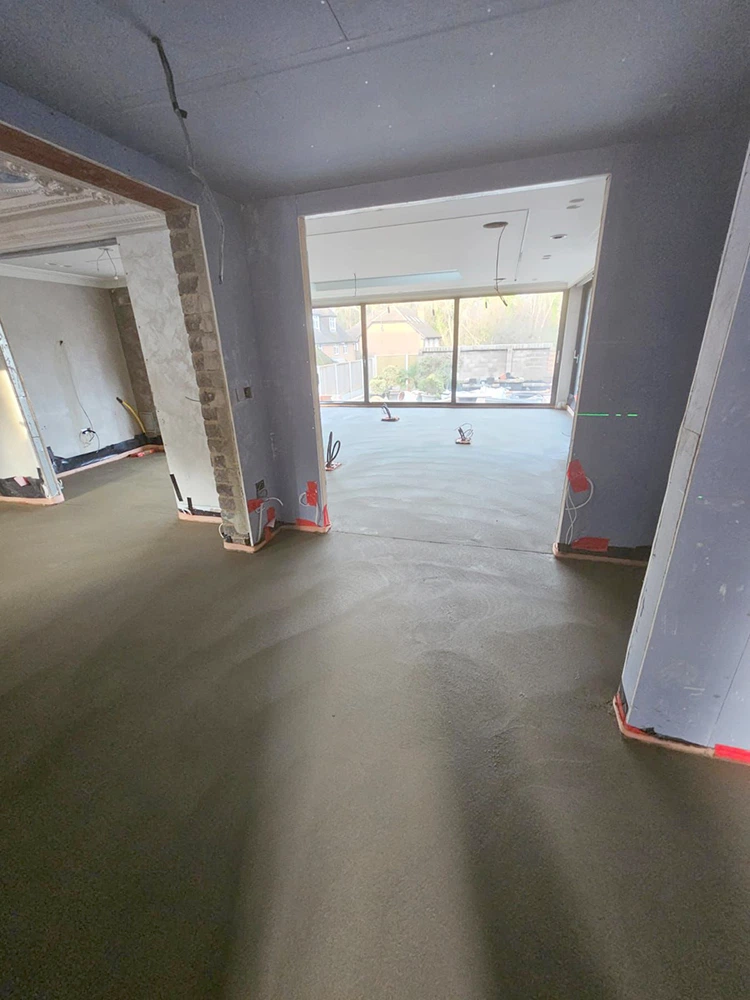
K & B Screeding’s own team, led by director Donatas Bardisevicius. Founded 2019, company 12298780.
See what customers say in our Google reviews and on our testimonials page.
Sand and Cement Screed from Slough to Wimborne Minster
On the map, Wimborne Minster sits south-west of Slough, about 77.2 miles from our base in a straight line (postcodes including BH21), next to Ferndown (4.3 miles), Bournemouth (7.3 miles), Verwood (7.4 miles) and Ringwood (9.2 miles).
More on sand & cement screed, part of our screeding services.
