
Garage conversions and small rooms in Ferndown
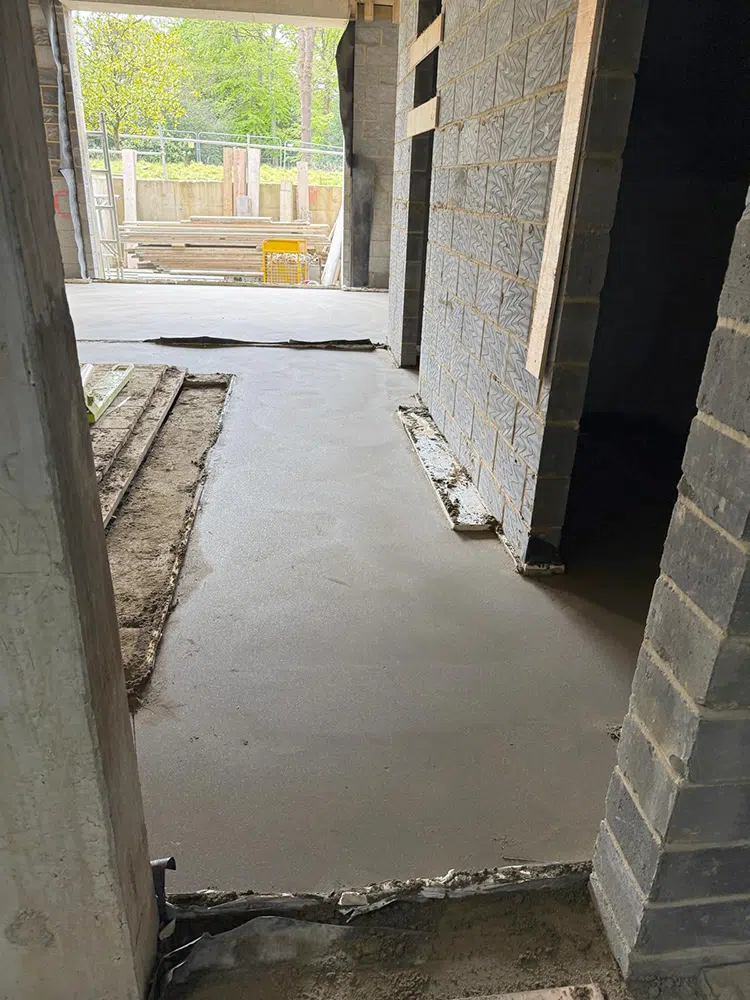
Garage conversions are a common building job in Ferndown, and the floor is usually the first problem. A garage slab sits lower than the house, has no insulation and often no reliable membrane. Turning it into a bedroom or study means building it up with a membrane, insulation and a screed so it meets the house floor at the doorway.
Sand and cement suits this. It is mixed on site in the quantity needed, barrowed in through the garage door and laid to the exact height required, including any changes in level. For the full picture of depths and damp proofing, read our guide to garage floor screed for conversions.
The second job that nearly always goes to sand and cement is the wet room. To get a level-access shower, the floor must run downhill to the drain, and that slope is trowelled in by hand. Calcium sulphate is not suitable for wet areas, and a self-levelling screed cannot form a fall.
Depths follow the build-up. Over insulation in a converted Ferndown garage, the floating screed has to be 65mm, and a commercial building would take 75mm. Fixed straight onto a sound garage slab instead, 25 to 40mm can do, as explained under screeds bonded to the base. Over underfloor heating pipes it needs about 45mm of cover, which matters if a converted garage is to be heated.
On a small room, the lack of a pump also keeps the set-up simple and the price in proportion to the job.
Replacing cold, uninsulated floors in Ferndown
Much of Ferndown was built in the post war boom, and some of those solid floors have little or no insulation. Replacing them is a common part of a full renovation: the old floor comes up, insulation and a membrane go down, and a new screed is laid on top. If underfloor heating is being added, the pipes go in before the screed; our underfloor heating screed page covers cover depths and heat-up.
Sand and cement has two strengths here. It gives a cement substrate that can take early load, and it is cost effective on smaller rooms, where a pump would be out of proportion. Expect £18 to £25 per m² on the 2026 published figures, and another £1 to £3 per m² if fibres go in.
It does dry slowly. Give it roughly a day for every millimetre up to 40mm and more after that, and check it with a test before laying any finish. Where time is tight, a quick drying screed can shorten the wait before tiles or wood go down, at a published £20 to £28 per m².
Sand and Cement Screed prices in Ferndown
Sand and cement screed: £18 to £25 per m² supplied and laid (MyJobQuote, August 2026), so £450 to £630 for 25 m². MyJobQuote does not say whether these figures include VAT. See our floor screeding cost guide or screed calculator.
Who lays your sand and cement screed in Ferndown
K & B Screeding’s own team, led by director Donatas Bardisevicius. Founded 2019, company 12298780.
See what customers say in our Google reviews and on our testimonials page.
Sand and Cement Screed from Slough to Ferndown
Ferndown is about 74 miles south-west of our Slough base as the crow flies, with postcodes including BH22, BH21 and BH24. The nearest towns to it are Wimborne Minster (4.3 miles), Ringwood (5.3 miles), Bournemouth (5.6 miles) and Verwood (5.6 miles).
More on sand & cement screed, part of our screeding services.
