
Reading the CA grade on a Ferndown specification
The grade on a Ferndown drawing is written in the form set by the European standard for screed materials. CA means calcium sulphate. The two numbers after C and F are strengths in N/mm2, compressive first, flexural second. On a Ferndown plot you are most likely to see CA-C25-F5, which most homes, apartments and offices use; a drawing for lightly trafficked domestic rooms might give CA-C20-F4, and one for heavier use CA-C30-F6.
Whatever grade is written down is the one that goes in. On a new build plot, that is the engineer's call. On a self-build or heated extension without a specification, we recommend one based on the rooms and the finish.
There is also alpha hemihydrate. A designer reaches for it when the floor has to dry quicker or be thinner, say because the flooring fitter is booked early, and it is laid to its own maker's sheet, not the usual rules of thumb.
Because it barely shrinks, big bays can go in with very few joints. That suits an apartment floor or the open ground floor of a large house. Joints go at the thresholds and where heating zones meet, marked out ahead of the pour, and our own people put the build-up together underneath.
If calcium sulphate is wrong for a room, a flowing screed with a cement base takes its place. For the wider background, read anhydrite screed explained.
After the pour: laitance and testing in Ferndown
Calcium sulphate dries with a thin, feeble layer on top, the laitance. It gets sanded back to sound screed after drying, and then primed using a product meant for calcium sulphate. Adhesives, levelling compounds and tiles all need that clean, primed surface to bond to, and a cement primer is not a substitute.
Moisture comes next. Flooring makers often demand a drier floor on calcium sulphate than on a cement screed, so a hygrometer test comes before we hand the floor back. In a heated extension, the system can normally drive the drying from around day 7, brought up to temperature gently. Without heating, steady warmth and ventilation do the same job more slowly.
Keep calcium sulphate away from water. Shower rooms, wet rooms and utility floors where leaks are possible should use a cement based screed, and in a Ferndown garage conversion, a sand and cement screed is often the more suitable base. If a new calcium sulphate floor needs levelling before thin sheet flooring, see floor levelling in Ferndown.
Anhydrite & Flow Screed prices in Ferndown
Liquid flowing screed (which includes anhydrite): £24 to £31 per m² supplied and laid (MyJobQuote, August 2026), so £960 to £1,240 for 40 m². MyJobQuote does not say whether these figures include VAT. See our floor screeding cost guide or screed calculator.
Who lays your anhydrite and flow screed in Ferndown
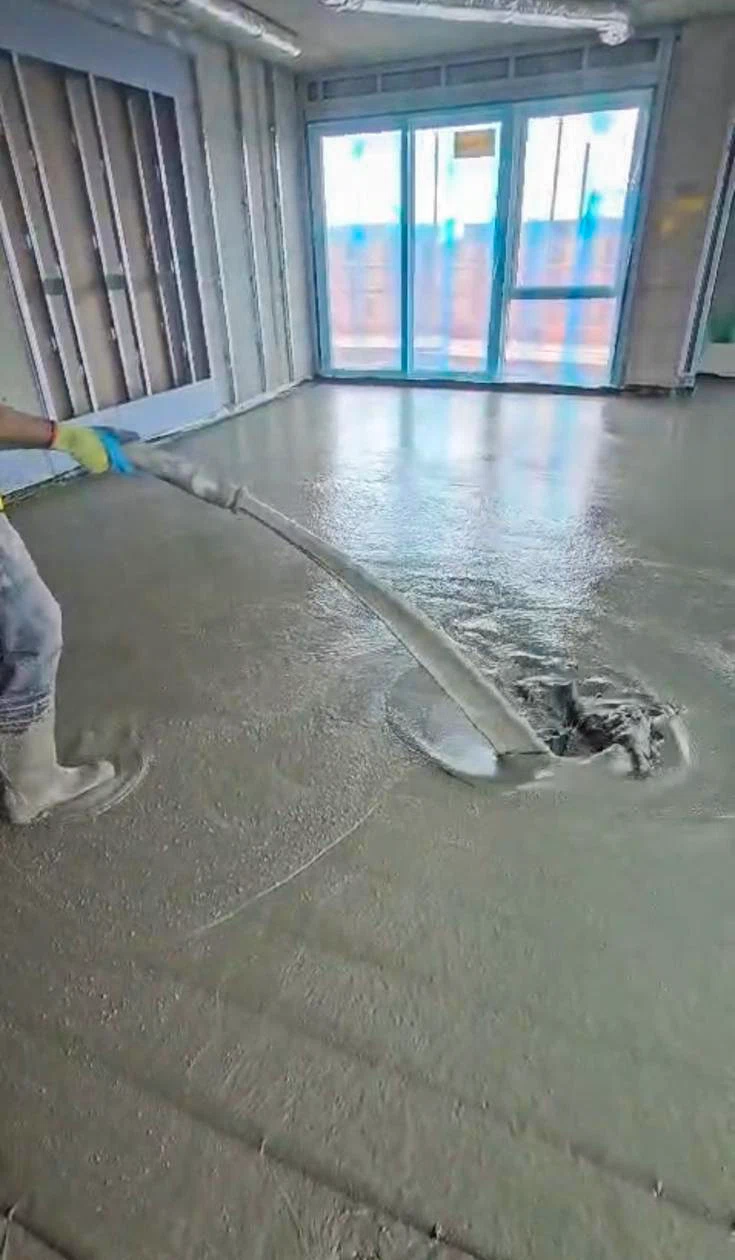
K & B Screeding’s own team, led by director Donatas Bardisevicius. Founded 2019, company 12298780.
See what customers say in our Google reviews and on our testimonials page.
Anhydrite & Flow Screed from Slough to Ferndown
Ferndown is about 74 miles south-west of our Slough base as the crow flies, with postcodes including BH22, BH21 and BH24. The nearest towns to it are Wimborne Minster (4.3 miles), Ringwood (5.3 miles), Bournemouth (5.6 miles) and Verwood (5.6 miles).
More on anhydrite screed, part of our screeding services.