
Reading a Lymington specification: CA grades explained
Anhydrite is specified by a short code. Under the European standard for screed materials, CA flags a calcium sulphate binder, then C and F give the crushing and bending strengths in N/mm2. You will meet three grades on most Lymington drawings:
CA-C20-F4, for house floors that see little traffic.
CA-C25-F5, which covers most homes, apartments and office floors.
CA-C30-F6, kept for the hard-wearing end of the scale.
On a block of flats or a single new plot the engineer chooses, and that is the grade that goes down, no substitutes. For a private extension or renovation with nothing specified, we propose a grade after weighing up the rooms, the finish and the loads.
Some drawings list an alpha hemihydrate product in place of a CA grade, picked where quicker drying or a slimmer section is wanted. Those products carry their own data on depth and drying, and we take our figures from that data rather than from rules of thumb.
The material scores on low shrinkage. Large areas can be poured in one go with hardly any joints, handy for an open-plan flat or a broad family room. Doorways and the boundaries between heating zones still get a joint, marked out and agreed with you ahead of pour day. For the material's background, read anhydrite screed explained.
Sanding, testing and wet rooms in Lymington homes
Anhydrite leaves itself a flaky, chalky crust called laitance as the water leaves it, and no floor covering should go on until that crust is gone. Once moisture allows, a sander takes it off and a calcium sulphate primer goes on, giving glue and compound sound material to hold.
Then comes the moisture test. Manufacturers are usually stricter with anhydrite than with cement, so a figure that passes on a cement base may fail on this one. The hygrometer decides. Pipes in the floor help here: running them from about day 7 normally speeds the drying.
Rooms that might get wet are no place for calcium sulphate. Put a cement flowing screed, or Lymington sand and cement screed, under any shower, wet room or utility where a leak could happen. On a mixed ground floor the two can sit side by side with a planned joint between them.
Even sanded and primed, a floor taking a thin sheet finish may want a skim to hit SR1, covered under levelling floors in Lymington.
Anhydrite & Flow Screed prices in Lymington
Liquid flowing screed (which includes anhydrite): £24 to £31 per m² supplied and laid (MyJobQuote, August 2026), so £960 to £1,240 for 40 m². MyJobQuote does not say whether these figures include VAT. See our floor screeding cost guide or screed calculator.
Who lays your anhydrite and flow screed in Lymington
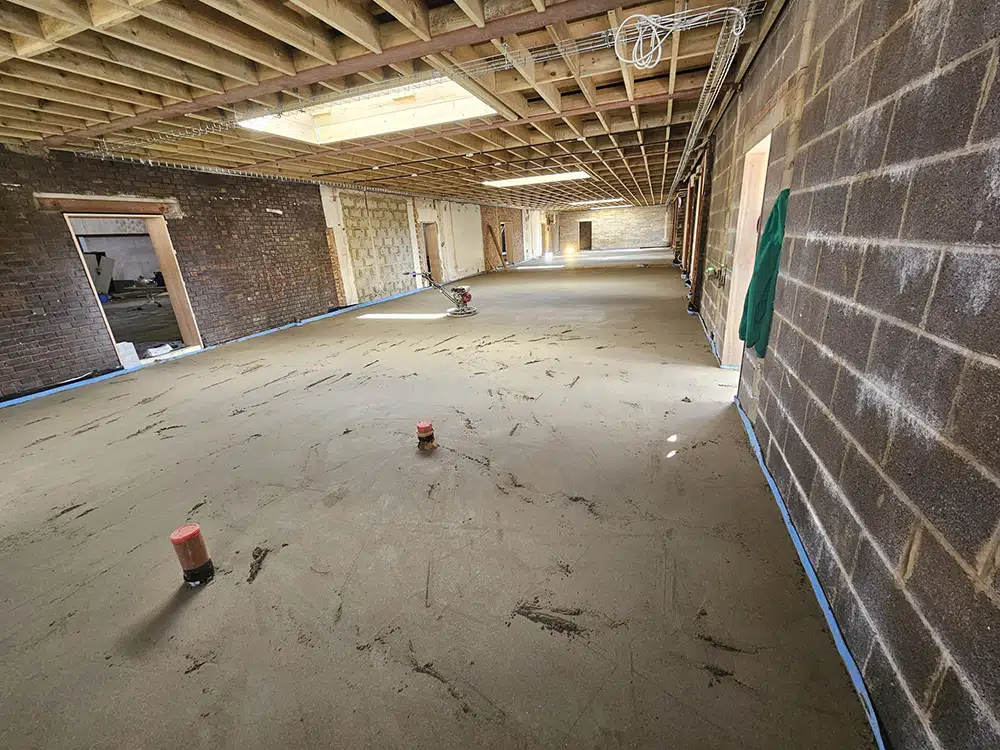
K & B Screeding’s own team, led by director Donatas Bardisevicius. Founded 2019, company 12298780.
See what customers say in our Google reviews and on our testimonials page.
Anhydrite & Flow Screed from Slough to Lymington
Lymington is about 66.2 miles south-west of our Slough base as the crow flies, with postcodes including SO41. The nearest towns to it are New Milton (5 miles), Christchurch (10.6 miles), Totton (11.3 miles) and Southampton (11.8 miles).
More on anhydrite screed, part of our screeding services.