
Calcium sulphate grades on Bournemouth apartment specifications
A Bournemouth apartment drawing names its calcium sulphate screed by a short code taken from the European standard for screed materials. Its C figure is the compressive strength and its F figure the flexural, both in N/mm2. For a seafront apartment block, CA-C25-F5 is the usual call, since it serves most homes, apartments and offices; CA-C20-F4 sits below it for lightly trodden domestic rooms, and CA-C30-F6 above it for heavier wear.
An engineer or developer normally sets the grade, and we pour what is written rather than swapping products on the day. A tight programme or a shallow build-up can lead the designer to name an alpha hemihydrate product. In that case the manufacturer's sheet decides how deep it goes and how long it needs, and we stick to it.
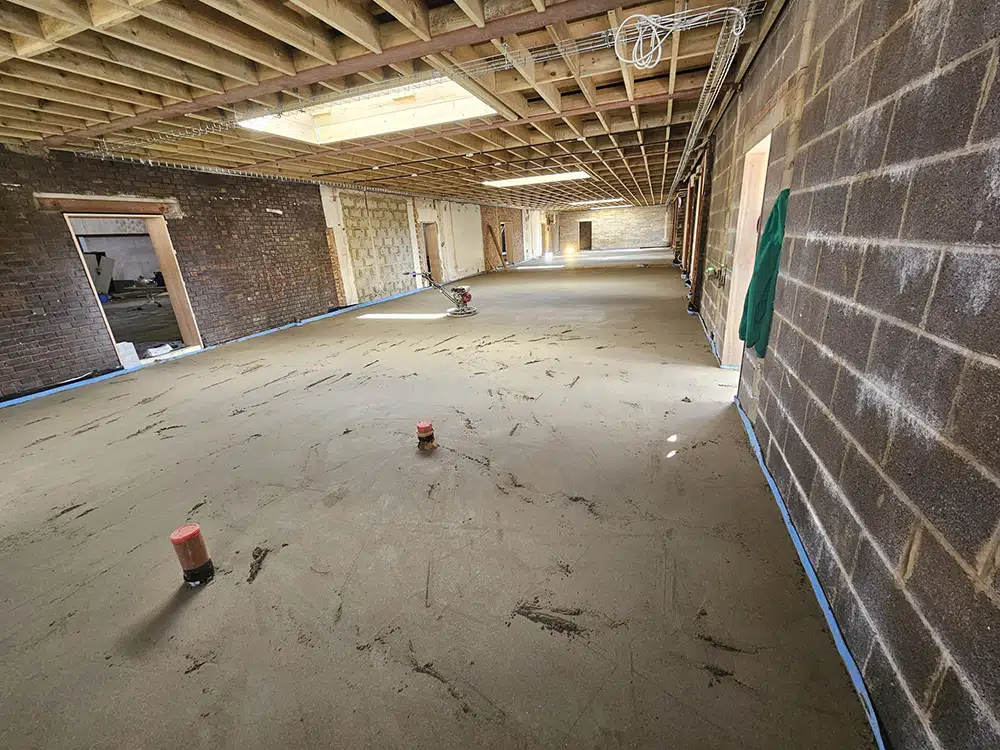
The material's main advantage on a block of flats is how little it shrinks. Wide open bays need only a handful of joints, which lets a complete flat floor be poured on one visit. Doorways and the line where one heating zone meets the next are the exceptions, and their joints are set out on the floor before any screed arrives.
In a Bournemouth conversion or new block, the screed usually floats on an acoustic or thermal layer, and the edge detail matters as much as the pour itself. Our own team prepares that full build-up, so the insulation, edge strip and membrane are checked by the people who will pour over them. Our anhydrite screed guide gives the wider background on the material.
Laitance, moisture and wet areas in Bournemouth flats
As it dries, calcium sulphate leaves a thin, weak crust on top, known as laitance. That crust is sanded away before adhesive or compound touches the floor, and a primer designed for calcium sulphate goes on afterwards. Skip that step and the finish bonds to a crust rather than to the screed.
Testing comes next. Flooring makers often allow less moisture in calcium sulphate than in cement, and a Bournemouth apartment floor can feel dry to the hand yet still be over the limit. Our check is a hygrometer test, and you get the figure it gives. If the flat has pipes in the floor, switching the heating on at around day 7 will normally help the screed dry out faster.
The one thing calcium sulphate should not be is wet. So in a flat, the shower room, wet room and utility get a cement based flowing screed, or hand-laid sand and cement suited to wet areas. If the base in an older building needs work before any pour, see our floor preparation service, and for a general view of pumped screeds, the liquid screed page for Bournemouth.
Anhydrite & Flow Screed prices in Bournemouth
Liquid flowing screed (which includes anhydrite): £24 to £31 per m² supplied and laid (MyJobQuote, August 2026), so £960 to £1,240 for 40 m². MyJobQuote does not say whether these figures include VAT. See our floor screeding cost guide or screed calculator.
Who lays your anhydrite and flow screed in Bournemouth
K & B Screeding’s own team, led by director Donatas Bardisevicius. Founded 2019, company 12298780.
See what customers say in our Google reviews and on our testimonials page.
Anhydrite & Flow Screed from Slough to Bournemouth
Bournemouth is about 77.5 miles south-west of our Slough base as the crow flies, with postcodes including BH1, BH4, BH11 and BH5. The nearest towns to it are Christchurch (4.3 miles), Ferndown (5.6 miles), Wimborne Minster (7.3 miles) and Ringwood (9.4 miles).
More on anhydrite screed, part of our screeding services.