
Anhydrite grades and products for Hedge End plots
Look on the drawings and you will find a code for the screed, set under the European standard, that tells you what loads it is made for. After the C comes its crushing strength and after the F its bending strength, both given in N/mm2.
A house floor with light foot traffic can be CA-C20-F4.
A typical Hedge End family home, like most flats and offices, gets CA-C25-F5.
Floors that take a harder life get CA-C30-F6.
The designer or engineer picks the grade for each plot, and we pour exactly that, with no substitutions. Where drying time or depth is tight, a specification may call for an alpha hemihydrate product; those follow their own product sheet, which then sets the depth and drying rules.
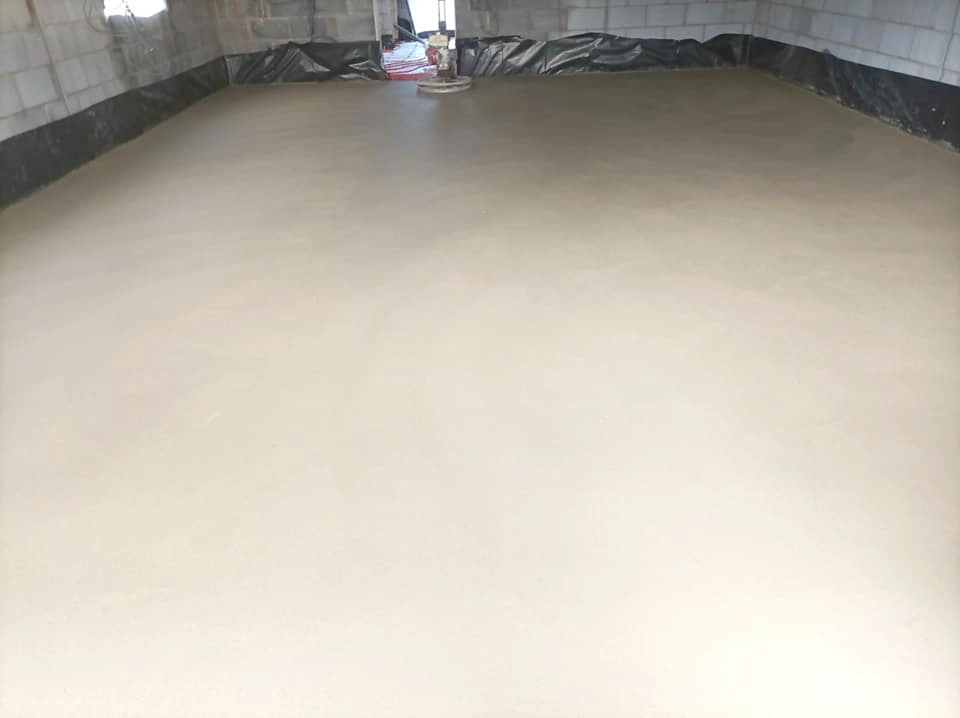
On new plots like those around Dowd's Farm, the big advantage is how little it shrinks. A whole open-plan ground floor or apartment can be poured as a few big bays on one visit, with the joints at doorways and heating zone boundaries marked out beforehand. In Hedge End, 11% of homes are in purpose-built flats, and their floors, laid over insulation and quite often heating pipes, suit this material well.
We prepare the whole build-up with our own team, from insulation and membrane to edge strip, and can offer a cement based flowing screed where calcium sulphate is not suitable. There is a plain English introduction in our anhydrite guide.
Laitance and moisture checks before Hedge End flooring
Dry does not yet mean ready for your new flooring. Drying leaves a soft crust, known as laitance, across the top. Glue or compound put straight onto that crust grips the crust and not the screed, and the floor covering can come away. So once drying is done, we sand the crust off and seal the surface with a primer that suits calcium sulphate. You get our drying and laitance notes in writing to pass to whoever lays the flooring.
Moisture limits are stricter than many people expect. A good number of flooring makers want calcium sulphate drier than a cement screed, so engineered wood or LVT waits for a passing reading, however many weeks have gone by. With heating pipes in the floor, you can usually begin drying it with the heating from about 7 days.
Keep it away from floors that could get wet, so shower enclosures, wet rooms and utility rooms get something else. Use a cement based flowing screed there, or hand-laid sand and cement in Hedge End. If the real question is pumped versus hand-laid, see the Hedge End liquid screed page.
Anhydrite & Flow Screed prices in Hedge End
Liquid flowing screed (which includes anhydrite): £24 to £31 per m² supplied and laid (MyJobQuote, August 2026), so £960 to £1,240 for 40 m². MyJobQuote does not say whether these figures include VAT. See our floor screeding cost guide or screed calculator.
Who lays your anhydrite and flow screed in Hedge End
K & B Screeding’s own team, led by director Donatas Bardisevicius. Founded 2019, company 12298780.
See what customers say in our Google reviews and on our testimonials page.
Anhydrite & Flow Screed from Slough to Hedge End
On the map, Hedge End sits south-south-west of Slough, about 51.4 miles from our base in a straight line (postcodes including SO30 and SO31), next to Eastleigh (4.4 miles), Southampton (4.4 miles), Fareham (7 miles) and Totton (8.1 miles).
More on anhydrite screed, part of our screeding services.
