
Calcium sulphate grades for Rowner and Royal Haslar
Specifications identify calcium sulphate screed by a code from the standard that sets the rules for screed materials in Britain and across Europe. Read the C figure as resistance to crushing and the F figure as resistance to bending, both in N/mm2, so a higher number means a tougher floor. For light domestic traffic there is CA-C20-F4; most houses, apartments and offices take CA-C25-F5; heavier use calls for CA-C30-F6. On a developer's plot the drawings fix the grade, and we lay exactly that product, with no substitutions.
Some designers go further and ask for an alpha hemihydrate screed instead. Those are chosen when drying time is tight or depth is limited, and the product data sheet from the manufacturer then fixes the thickness and drying rules, which we stick to exactly.
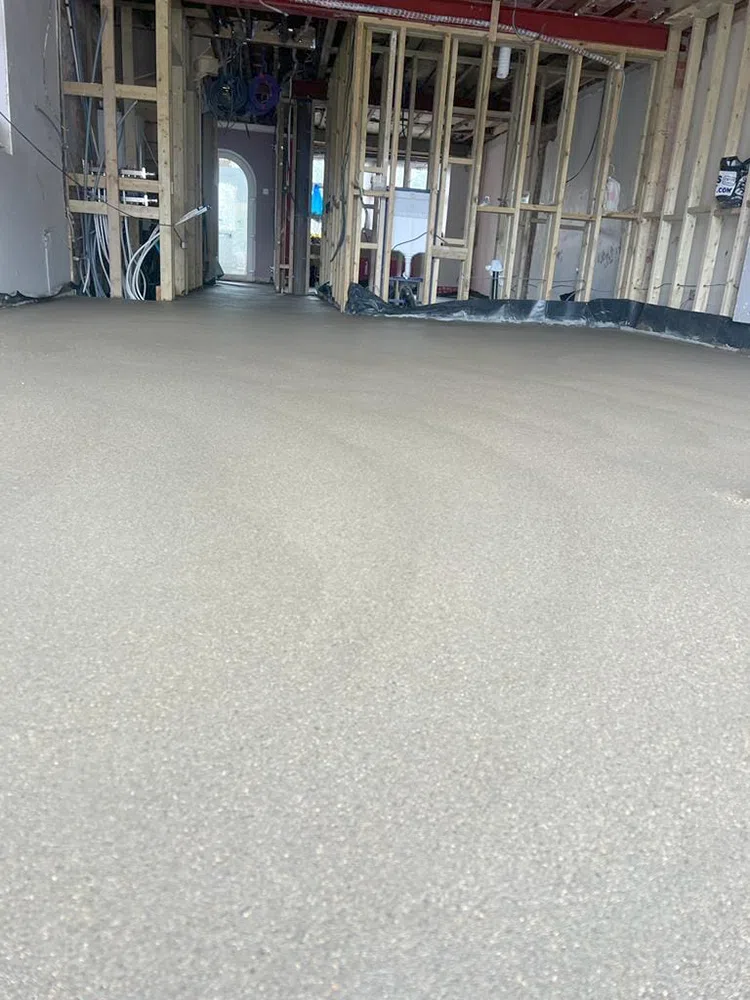
Setting causes very little shrinkage in this material. Bays can therefore be large with few joints, a good fit for apartment floors, where one visit can pour an entire level. The building still dictates some joints, under doorways or where one heating zone meets the next, and we set out bays and joints before pouring.
In Gosport, 20% of homes are purpose-built flats and just 3% date from 2015 on, so calcium sulphate mostly turns up on the drawings for a new block or a conversion. Turning a historic building into homes, as at Royal Haslar, brings its own issues: floors out of level, mixed bases and thresholds that have to stay put. Our own team prepares the whole build-up before the pour. Anhydrite screed, explained simply goes into the material in more depth.
Laitance, moisture and wet areas in Gosport flats
As the screed in a Gosport flat dries, a fragile film called laitance forms across the top. Tile adhesive bonds poorly to that film, so after drying we abrade it off and apply a primer compatible with calcium sulphate. Leave it in place and a new tiled or LVT floor may start to come loose.
Next comes moisture. Flooring makers are often fussier about a damp calcium sulphate floor than a damp cement one, which means a reading good enough on a cement screed can be too high on this one. We take a hygrometer reading instead of trusting the calendar. If the floor has heating, it can normally be force dried from about 7 days.
Calcium sulphate should never go where water could reach it. In a Gosport flat that covers walk-in showers, wet rooms and utility floors where a leak could happen, and there we pour a flowing screed made with cement instead, in the same way. A thin topping on an existing base is a job for latex screed, a different product entirely, and where old and new levels need joining, have a look at levelling floors in Gosport.
Anhydrite & Flow Screed prices in Gosport
Liquid flowing screed (which includes anhydrite): £24 to £31 per m² supplied and laid (MyJobQuote, August 2026), so £960 to £1,240 for 40 m². MyJobQuote does not say whether these figures include VAT. See our floor screeding cost guide or screed calculator.
Who lays your anhydrite and flow screed in Gosport
K & B Screeding’s own team, led by director Donatas Bardisevicius. Founded 2019, company 12298780.
See what customers say in our Google reviews and on our testimonials page.
Anhydrite & Flow Screed from Slough to Gosport
As the crow flies, our yard in Slough is about 55 miles from Gosport, which lies to the south-south-west. Postcodes here include PO12 and PO13, and Portsmouth (1.4 miles), Fareham (4.6 miles), Havant (7.4 miles) and Emsworth (8.9 miles) are close by.
More on anhydrite screed, part of our screeding services.
