
What latex screed does in Gosport refits
Latex screed is the trade name for a levelling compound supplied in two parts. The dry part is a cement powder; the wet part is a latex emulsion that does the job water would do in an ordinary mix, and that polymer gives the cured layer a little flexibility and a firm grip on difficult surfaces. It goes down thin, usually a few millimetres, and its whole purpose is to give a new floor covering a smooth face to stick to.
That makes it suited to the bases a refit in an older Gosport house tends to uncover. Quarry or ceramic tiles that are still firmly bonded can stay where they are and be skimmed over, which saves breaking them out and disturbing the slab beneath. Uneven older concrete, marked by trowels and small hollows, can be brought smooth. Sound old adhesive left behind when vinyl is lifted can often be primed and covered instead of being scraped back.
Timber needs the most care. Latex never goes straight onto bare floorboards, because boards move and the compound would crack along every joint. They are first overboarded with flooring grade plywood, screwed down at close centres, and the latex is laid on the plywood. For an upstairs bathroom in a Gosport house, that is a sound route to a smooth base for safety flooring or sheet vinyl.
The finishes that benefit are thin and flexible ones: sheet vinyl, LVT, lino, rubber, safety flooring and carpet. Each follows every bump in what lies under it, and a few millimetres of latex hides those bumps. Where a refit also needs boards fixed or ply laid, our base preparation work is planned alongside it.
When a Gosport floor needs more than latex
Latex is a finishing layer. It cannot turn a poor base into a good one, and three problems mean something else has to happen first.
Damp comes first. Many inter-war and older Gosport terraces have solid ground floors with no damp proof membrane, and latex does nothing to stop moisture rising through them. Laid over a damp slab and then sealed under vinyl, it can lose its bond. We take a moisture reading before quoting, and where there is no membrane the lasting answer is a dig-out and relaying in hand-laid sand and cement.
Movement is the second. Springy boards crack any thin compound, so loose or bouncing boards are fixed and overboarded before latex is considered.
The third is level. A floor that falls noticeably from one wall to the other is out of level, not just rough, and a few millimetres of latex will not change that. Thicker levelling compound and new screed are compared on our Gosport floor levelling page.
Flats make up 23% of Gosport's homes, and there latex has a practical advantage: it adds almost nothing to the floor height, so doors and thresholds still clear.
Priming closes the preparation. Each base gets a primer chosen for it, and any calcium sulphate screed has its laitance removed and is primed before latex goes on.
Latex under new floors in Rowner and Royal Haslar units
The Rowner Renewal scheme, which has replaced much of the 1960s estate, included a Tesco supermarket and smaller retail units. Royal Haslar adds restaurants and business premises to its homes, inside historic naval buildings. When a unit like these is fitted out or changes tenant, the new floor is often sheet vinyl, LVT or safety flooring, and the base under it has to be smooth.
A shop or café fit-out rarely starts on a perfect floor: there may be adhesive from the last tenant's flooring, filled holes where shelving or counters were fixed, a trench patched after new services went in, or ridges in the screed. Soft adhesive and high spots are taken off first, by scraping or grinding. The base is then primed to suit it, and the latex goes down a few millimetres thick across the whole area.
Timing matters on these jobs. A thin compound dries much faster than a new screed, and the product data sheet gives the time before flooring can go down, which helps where a unit has to reopen on a set date.
In a restaurant, the kitchen and washrooms usually take safety flooring that the maker wants on a specific base. Their data sheet decides the primer and compound. Latex does not stop damp, so the floor is checked with a moisture test before any compound is mixed.
How we price latex screed in Gosport
A fixed written price within 24 hours, once we know the area and the base. See our floor levelling cost guide.
Who lays your latex screed in Gosport
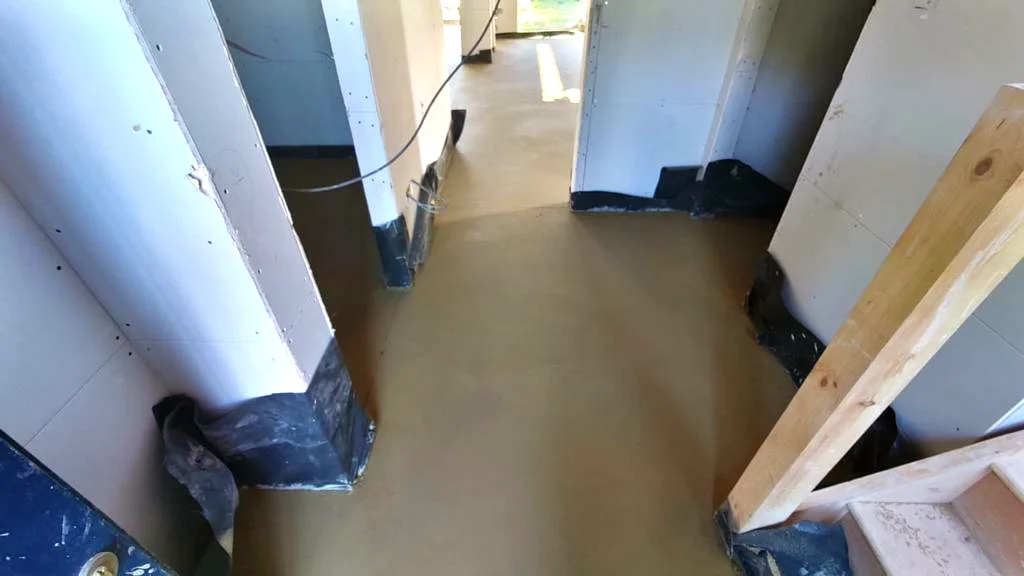
K & B Screeding’s own team, led by director Donatas Bardisevicius. Founded 2019, company 12298780.
See what customers say in our Google reviews and on our testimonials page.
Latex screed from Slough to Gosport
As the crow flies, our base in Slough is about 55 miles from Gosport, which lies to the south-south-west. Postcodes here include PO12 and PO13, and Portsmouth (1.4 miles), Fareham (4.6 miles), Havant (7.4 miles) and Emsworth (8.9 miles) are close by.
More on latex screed, part of our screeding services. For every screed we lay locally, see floor screeding in Gosport.
Further reading: latex, self levelling compound or screed.
