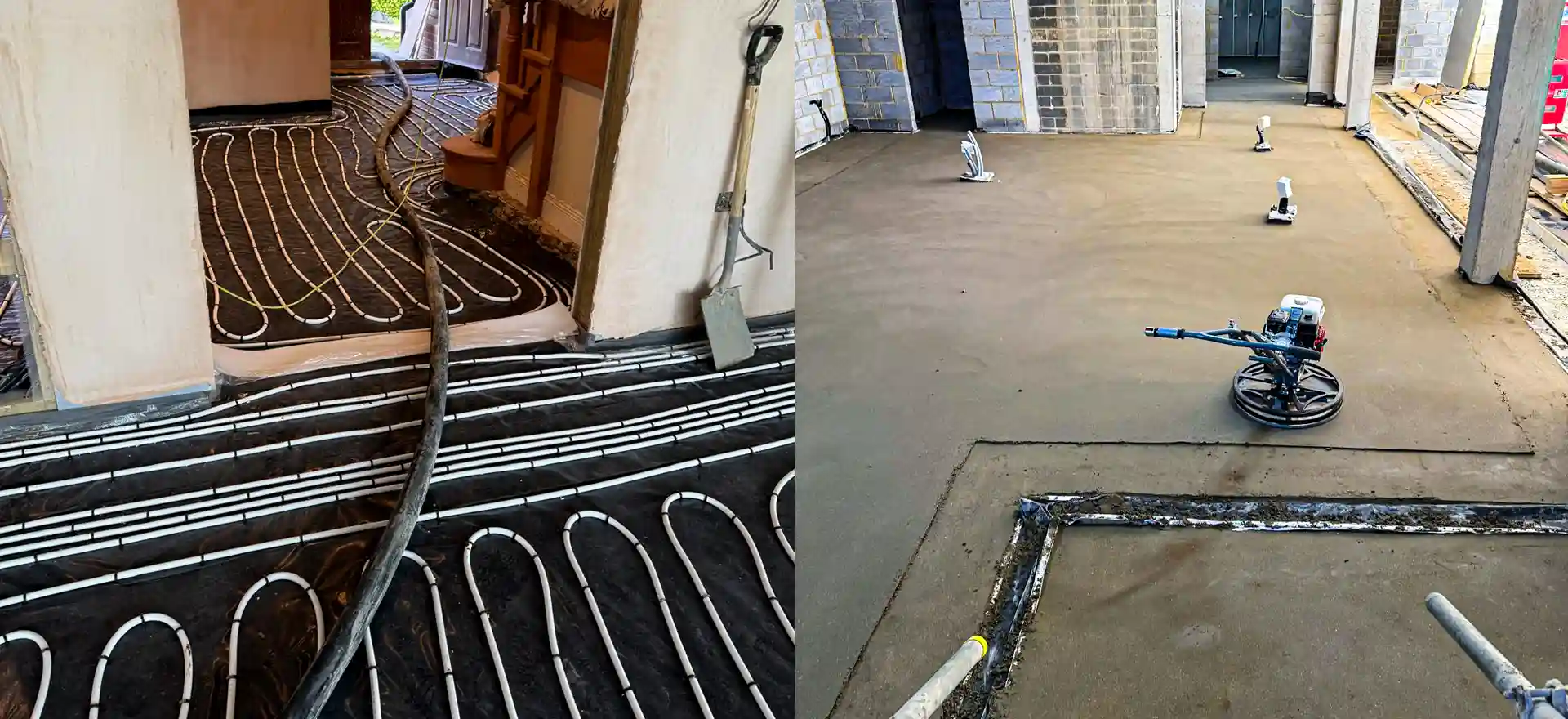
Latex over awkward bases in Fareham refits
The name confuses people. Latex screed is not a screed in the usual sense, and there is no rubber sheet involved. It is a cement based powder stirred into a milky latex liquid that replaces the water. The latex makes the cured layer slightly flexible and helps it grip surfaces that a water-mixed compound would hold less well.
That is why it suits the floors a refit uncovers. Take a 1960s or 1970s semi from the decades when Fareham spread out to Portchester and Catisfield. Lift the old kitchen vinyl and there may be a concrete slab with ridges, patches and old adhesive. Upstairs, the bathroom floor is usually timber. Each of these can take latex, with the right preparation.
Timber is the one to get right. Latex must never go straight onto bare floorboards, which move with the seasons and with every footstep. The boards are screwed down tight, then overboarded with flooring grade plywood fixed at close centres, and the latex goes over the ply. On old ceramic or quarry tiles, we check every tile is bonded, clean off grease and polish, and prime. On concrete, dust and loose material come off first.
Terraces make up 22% of Fareham's homes, and in a narrow terraced kitchen or a small bathroom a few millimetres of latex is far less disruptive than breaking out the floor.
Sheet vinyl, LVT, lino, rubber, carpet and safety flooring in a utility all suit a latex base. Thin coverings like these mirror every bump below them. For flatness classes and the wider choice between compound and a new screed, see levelling floors in Fareham.
Fareham floors that need more than latex
Latex is a finishing layer. It makes a sound base smooth; it cannot make an unsound one sound, and pricing it honestly means saying when something else must come first.
Springy boards are the first warning. If a bathroom floor flexes underfoot, the joists or boards need fixing and the overboarding doing properly, otherwise the latex will crack along the board lines within months.
Damp is the second. Latex does nothing to stop moisture rising through an old slab, and plenty of Fareham's post-war ground floors were laid without insulation, and an old slab can hold moisture without showing it. We take a reading before pricing. If the slab is wet, it needs damp proofing or a rebuild before any compound goes on.
The third is a floor that is well off true. A few millimetres of latex will not take out a dip of several centimetres across a room, and pouring it thick invites cracking. Floors like that need repairs to the failed screed or a new floor laid in sand and cement for Fareham houses.
Priming is the final check. Calcium sulphate screed must have its laitance sanded off and always takes a primer before latex. Concrete and glazed tiles get their own primers too, and picking the wrong one is a common reason the layer lets go.
Latex where Fareham extensions and garage rooms meet the house
Semis extended at the back and garages turned into rooms are a large part of Fareham's floor work, and each new screed has to be laid to meet the existing door thresholds. When the owner then wants one sheet vinyl or LVT floor running from the old kitchen into the new room, latex is often the final layer that makes it work.
The two floors are rarely the same material. The original room may be a slab from the town's 1960s and 1970s expansion with old adhesive on it, while the extension or garage room has a new screed. Each is prepared and primed for what it is, and a single latex coat then gives both one smooth face, so the join between them does not show through a thin covering.
Height is planned at the start. Latex adds only a few millimetres, but when the new screed is being set to the old thresholds, those millimetres and the thickness of the new covering should be allowed for, so the finished floor still clears the doors.
The new screed must be dry before latex goes on it. A sand and cement screed in a garage room or extension takes weeks rather than days, and a moisture reading decides when it is ready, not the date on the programme.
Where the step between old and new is more than latex can feather out, the lower floor is built up first with a deeper compound or screed.
How we price latex screed in Fareham
A fixed written price within 24 hours, once we know the area and the base. See our floor levelling cost guide.
Who lays your latex screed in Fareham
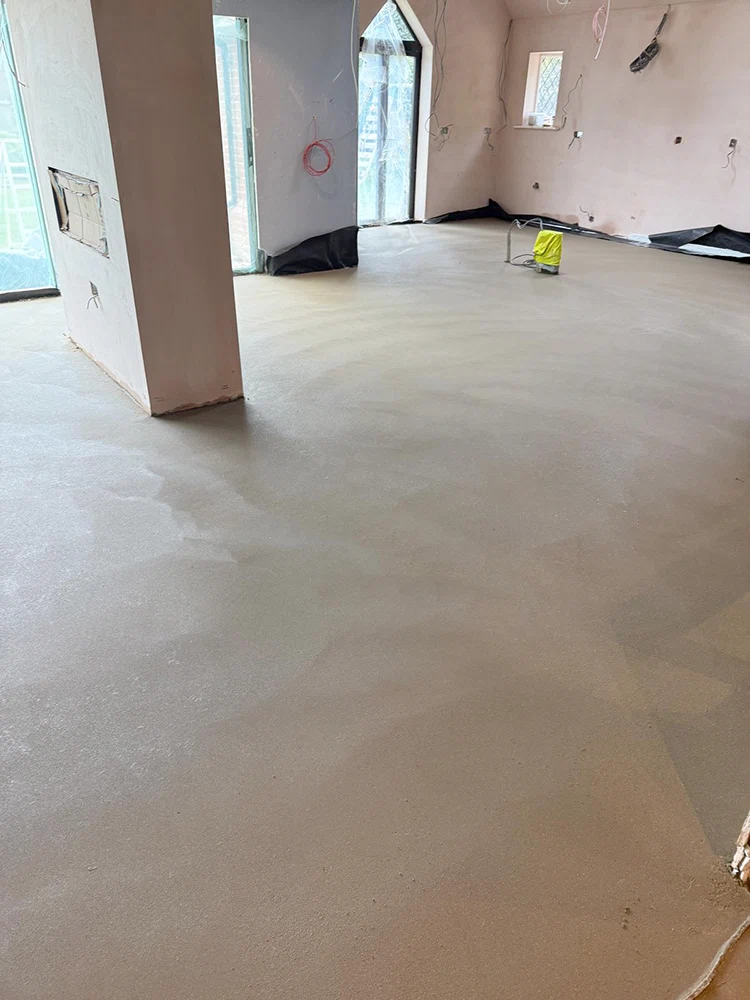
K & B Screeding’s own team, led by director Donatas Bardisevicius. Founded 2019, company 12298780.
See what customers say in our Google reviews and on our testimonials page.
Latex screed from Slough to Fareham
On the map, Fareham sits south-south-west of Slough, about 52.3 miles from our base in a straight line (postcodes including PO16, PO15 and PO14), next to Gosport (4.6 miles), Portsmouth (5.3 miles), Hedge End (7 miles) and Horndean (8.3 miles).
More on latex screed, part of our screeding services. For every screed we lay locally, see floor screeding in Fareham.
Further reading: latex, self levelling compound or screed.