
Heated floors in Fareham extensions and older semis
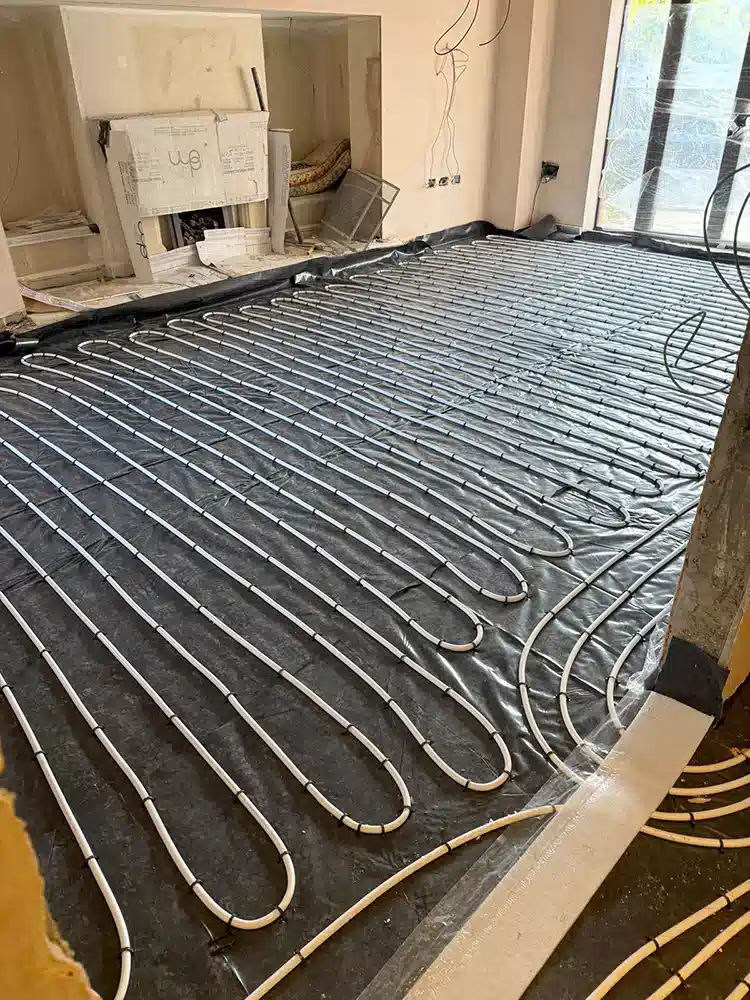
Semis make up 33% of Fareham's homes, and on houses from the town's 1960s and 1970s growth a heated rear extension is a common way to add space. The new room is built with its own insulated floor, so there is usually enough depth for a proper build-up: insulation, a membrane, the pipes clipped or tracked down, then the screed. A pumped liquid screed flows round every pipe with no air pockets and sits 45 to 50mm deep in total, which spreads heat quickly and evenly.
Retrofitting heating into the original part of the house is harder. If the old floor stays, there is rarely room for pipes plus a full screed. If it is dug out to add insulation, as often happens in Portchester and Catisfield, the depth becomes available, but it still has to be planned so the finished floor meets the door thresholds. Sand and cement needs roughly 45mm of cover, more height than liquid; the guide to how thick screed should be lists the figures.
Joining an old floor to a new heated one is where problems show up. The two screeds dry differently and may sit at slightly different levels, so allow for a levelling coat at the join before large tiles or LVT go down. Our floor levelling page for Fareham covers that step.
Commissioning underfloor heating on Welborne and Fareham plots
Only 3% of Fareham's homes were built since 2015, but Welborne will add more, and new build floors there will commonly specify liquid screed over underfloor heating. On any plot like that, two dates matter: when the pipes are ready and when the heating may come on.
Before the pour, the installer should have finished and pressure tested the circuits, ideally leaving them under pressure during screeding so any damage shows straight away. Edge strip is fixed around the walls to absorb expansion.
Once the screed is down, leave the heating off until it is ready for it. Warming a calcium sulphate screed is usually fine after about 7 days, whereas sand and cement stays cold for 21 days or more. The first firing should be gentle, raised in small increments across several days to the screed maker's schedule, and the floor then left to cool before anyone takes a moisture reading for the flooring. Rushing this can crack the floor or trap moisture under tiles.
You get the heat-up instructions from us in writing, so your heating engineer and your floor fitter are working to one plan. Where the spec calls for a calcium sulphate grade, our Fareham anhydrite screed page covers it, and pumped liquid screed for Fareham explains the method.
Underfloor Heating Screed prices in Fareham
Liquid screed over underfloor heating: £20 to £35 per m² supplied and laid (trade2base, June 2026), so £700 to £1,230 for 35 m². trade2base gives these figures excluding VAT. See our floor screeding cost guide or screed calculator.
Who lays your underfloor heating screed in Fareham
K & B Screeding’s own team, led by director Donatas Bardisevicius. Founded 2019, company 12298780.
See what customers say in our Google reviews and on our testimonials page.
Underfloor Heating Screed from Slough to Fareham
On the map, Fareham sits south-south-west of Slough, about 52.3 miles from our base in a straight line (postcodes including PO16, PO15 and PO14), next to Gosport (4.6 miles), Portsmouth (5.3 miles), Hedge End (7 miles) and Horndean (8.3 miles).
More on underfloor heating screed, part of our screeding services.
