
Pairing heating with new floors on the Hazleton estate
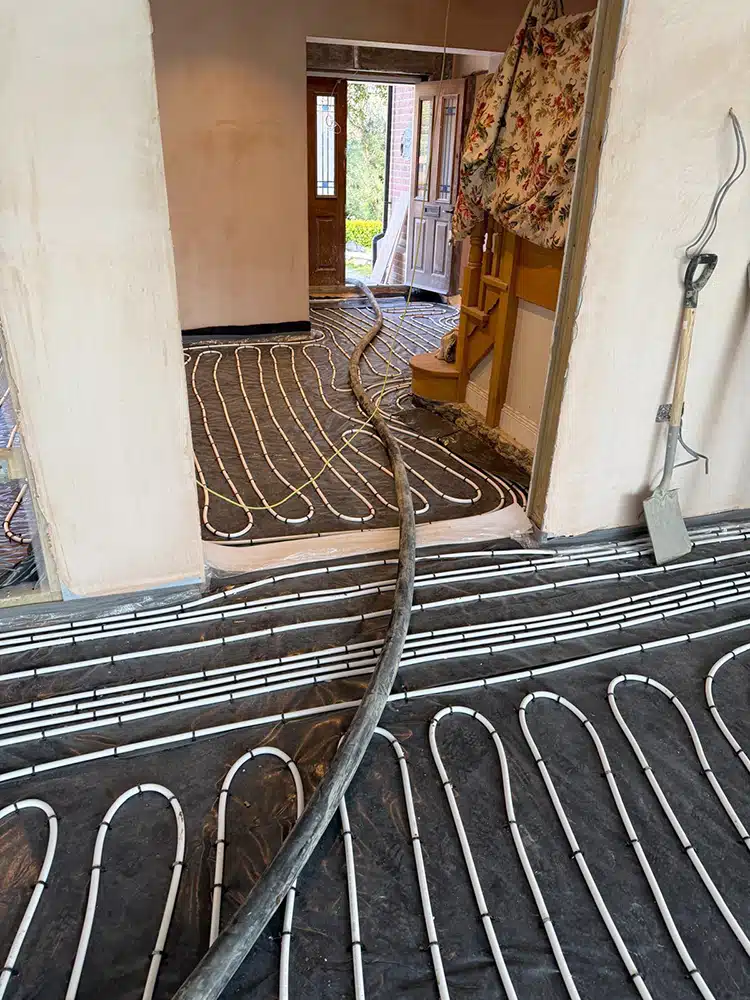
If a Horndean ground floor is coming up because it never had insulation, that is the moment to put heating in. Digging out has already made the depth, so insulation, pipes and screed can be planned as one build-up and not squeezed onto an old slab. In Hazleton estate houses and others from the 1960s and 1970s, a new insulated screed with underfloor heating is a common way to modernise the ground floor.
The depth still needs working out. A pumped screed wants 25mm clear above the pipe tops at the least, which puts the whole layer at 45 to 50mm in most rooms. Hand-laid, it is roughly 45mm over the pipe crowns, so that floor finishes thicker. When the new floor has to meet existing thresholds and the bottom stair, the thinner liquid build leaves space for more insulation, and the insulation is what keeps heat from draining into the ground.
Liquid is also chosen because it wraps the pipes completely. Flowing around every run with no air gaps, it lets heat spread evenly. Hand-laid screed can achieve that, but only if it is compacted carefully around each pipe.
When just part of the ground floor is being rebuilt, the join between new heated floor and old unheated floor needs planning, and tiles may need a skim of levelling compound over the join first. Pump access and pour day are explained under pumped screed in Horndean.
Heated extensions and garden rooms around Horndean
Extensions are the easiest place for underfloor heating because the floor height can be set from nothing. Insulated garden rooms are similar, though they need their own insulation, membrane and edge strip in before the screed. With only 7% of Horndean's homes built since 2015, heating is usually being added to an older house, not planned in from day one.
Fresh screed and a hot boiler do not mix. A calcium sulphate floor will usually take gentle warmth after roughly a week (7 days); give sand and cement three weeks, 21 days, as the minimum. Even then, start the water cool and nudge the temperature up in stages over several days. The heating engineer operates the system, and our schedule is left with you in writing.
Turning it straight up to full is a frequent cause of cracks and debonding. Handled correctly, though, the heating is the quickest way to get a calcium sulphate floor dry enough for flooring.
Expect a published £20 to £35 per m² when liquid screed goes over the pipe loops. What pushes a price up or down is explained in our guide to floor screeding costs, and we offer the same work in Havant, next door.
Underfloor Heating Screed prices in Horndean
Liquid screed over underfloor heating: £20 to £35 per m² supplied and laid (trade2base, June 2026), so £700 to £1,230 for 35 m². trade2base gives these figures excluding VAT. See our floor screeding cost guide or screed calculator.
Who lays your underfloor heating screed in Horndean
K & B Screeding’s own team, led by director Donatas Bardisevicius. Founded 2019, company 12298780.
See what customers say in our Google reviews and on our testimonials page.
Underfloor Heating Screed from Slough to Horndean
As the crow flies, our yard in Slough is about 45.9 miles from Horndean, which lies to the south-south-west. Postcodes here include PO8, and Havant (3.7 miles), Emsworth (5.2 miles), Petersfield (7.3 miles) and Fareham (8.3 miles) are close by.
More on underfloor heating screed, part of our screeding services.
