
Retrofitting heated floors in post-war Selsey homes
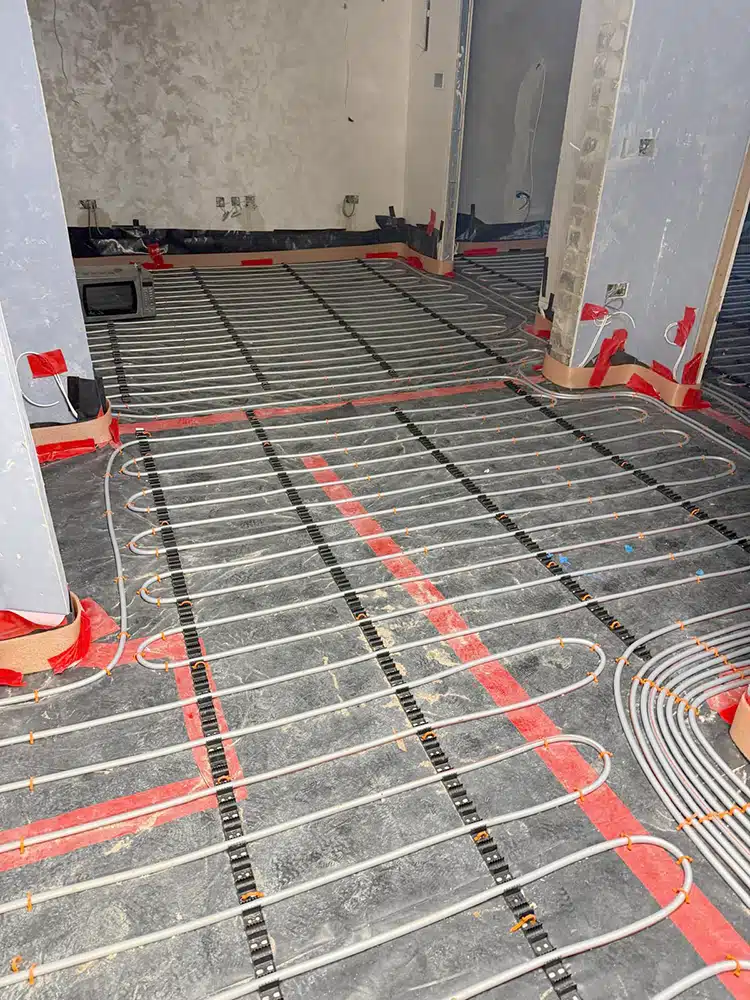
Underfloor heating loses much of its value over an uninsulated floor, because the heat goes down into the ground instead of up into the room. In a post-war Selsey house or bungalow, a full upgrade normally follows the same sequence. The old floor is dug out, insulation boards and a membrane go down, the heating pipes are fixed on top by the heating installer, and the screed is laid over them.
Fitting the pipes is your plumber's or heating engineer's job, not ours, and we work alongside them; their loops have to be in and pressure tested before we pour.
Floor height is usually the tight part of a retrofit. Insulation, pipes and screed together must come up flush with the doors, thresholds and any rooms you are leaving alone. That decides how deep we can dig and which screed suits the space.
Pipe cover is the next decision. With liquid screed you need 25mm or more above the pipes, often 45 to 50mm in all. Sand and cement wants around 45mm over them, so that floor ends up thicker. The liquid also wraps the pipes completely, leaving no air gaps, which lets the warmth spread evenly. Where height is short, that difference can decide the choice.
In small rooms and bathrooms, hand-laid sand and cement over heating pipes is still common. Our insulation and membranes service can supply the layers beneath when the floor is rebuilt.
Switching on the heating in a Selsey floor
The first heating cycle needs patience. A new screed has to cure before it is warmed, and the timing depends on the material. With calcium sulphate, the heating can normally go on after around 7 days. With sand and cement, leave it off for 21 days or more.
Even then, the heat goes up slowly. Your heating engineer brings the flow temperature up a little at a time over several days, holds it there, then lowers it again, which is how the system is commissioned. Rushing that stage can crack the screed or lift tiles later. We hand over clear guidance so the installer and the homeowner know what to do.
Run gently, that same heat speeds up the drying. In a house near the sea, where damp air can slow drying, that controlled warm-up is useful before the floor covering goes on. A moisture test with a hygrometer still comes before flooring. Our guide to screed drying times covers what to expect.
Garden rooms and new extensions are simpler than a retrofit, because the floor is built from scratch with height to spare. About ten miles away, we also lay heated floor screeds in Emsworth.
Underfloor Heating Screed prices in Selsey
Liquid screed over underfloor heating: £20 to £35 per m² supplied and laid (trade2base, June 2026), so £700 to £1,230 for 35 m². trade2base gives these figures excluding VAT. See our floor screeding cost guide or screed calculator.
Who lays your underfloor heating screed in Selsey
K & B Screeding’s own team, led by director Donatas Bardisevicius. Founded 2019, company 12298780.
See what customers say in our Google reviews and on our testimonials page.
Underfloor Heating Screed from Slough to Selsey
As the crow flies, our yard in Slough is about 55.6 miles from Selsey, which lies to the south. Postcodes here include PO20, and Bognor Regis (6.4 miles), Chichester (7.2 miles), Emsworth (10.2 miles) and Havant (12.1 miles) are close by.
More on underfloor heating screed, part of our screeding services.