
Heated extensions around Wick and Toddington
If a kitchen extension on a Littlehampton semi is to be heated, the new floor has insulation, pipes and screed, and it must finish level with the existing kitchen floor. Working back from that finished level sets everything else.
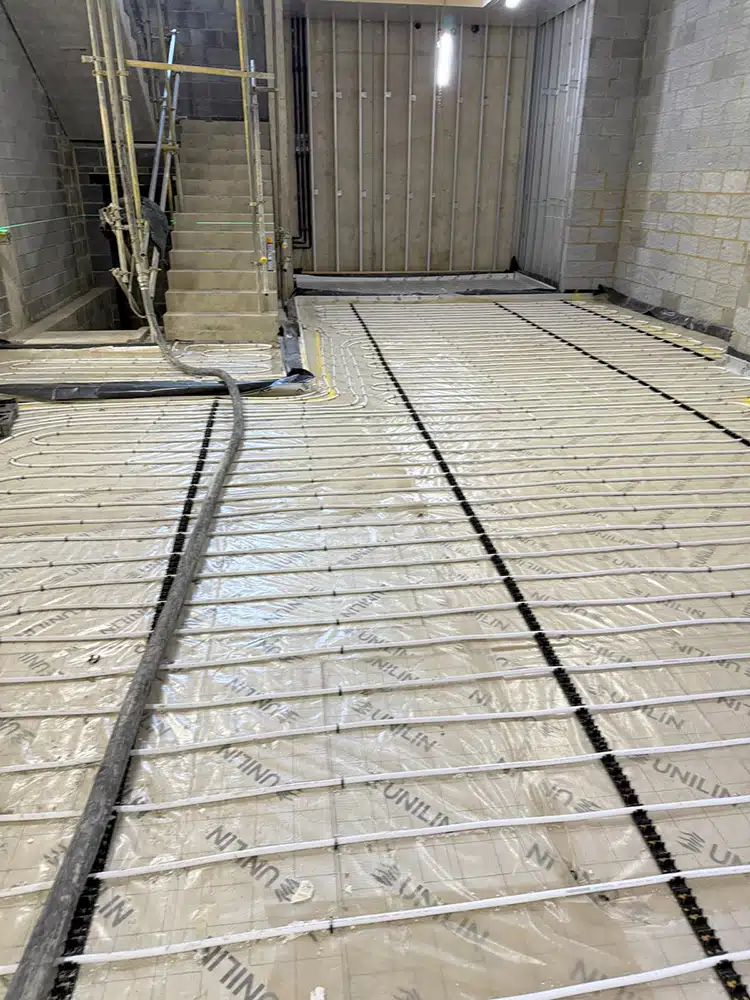
Start with how much screed sits above the pipes. With a pumped floor that is 25mm or more, so the whole layer usually comes to 45 to 50mm. Hand-laid sand and cement calls for around 45mm of cover, making the floor deeper. Too little cover risks cracks along the pipe runs; too much slows the heat response.
Because a liquid mix wraps each pipe completely, there are no pockets of air, warmth travels evenly and the kitchen heats up sooner. That is why it suits most heated extensions. Sand and cement still works, and is useful where the room might get wet, but needs careful compaction around the pipes.
With 17% of homes in the town detached, some gardens are big enough for a separate garden room. A garden room with underfloor heating needs the same build-up as an extension: insulation, a membrane, an edge strip around the walls and the correct screed depth. The screed thickness guide gives minimum depths, and our residential screeding page covers other home projects.
Only 4% of homes were built since 2015, so most heated floors here are additions to existing houses rather than new builds.
Retrofit and warm-up in older Littlehampton homes
Adding underfloor heating to an older terrace or pre-war house is mostly a height problem. Stacking insulation, pipes and screed over the old floor nearly always leaves a step at each doorway. The usual answer is to take the old floor out and rebuild it, which in an older terrace also allows a new membrane. Liquid screed often wins because it needs the least depth.
After the pour, the heating must come on slowly. With calcium sulphate, warmth can normally go in at around 7 days; with sand and cement, hold off for 21 days or more. Begin with the water barely warm and turn it up bit by bit across several days, as your installer's schedule sets out. Never turn it straight up to full, as a sudden jump in temperature can crack a new screed.
Once the floor is dry, tiles, LVT and engineered wood all suit a heated screed. Check the flooring maker's limit on surface temperature and its guidance on heating settings while the floor is laid.
The pipework is your heating engineer's part: they lay it and test it under pressure, and only then do we pour. For the same service about 6 miles away, see underfloor heating screed in Bognor Regis.
Underfloor Heating Screed prices in Littlehampton
Liquid screed over underfloor heating: £20 to £35 per m² supplied and laid (trade2base, June 2026), so £700 to £1,230 for 35 m². trade2base gives these figures excluding VAT. See our floor screeding cost guide or screed calculator.
Who lays your underfloor heating screed in Littlehampton
K & B Screeding’s own team, led by director Donatas Bardisevicius. Founded 2019, company 12298780.
See what customers say in our Google reviews and on our testimonials page.
Underfloor Heating Screed from Slough to Littlehampton
As the crow flies, our yard in Slough is about 50.2 miles from Littlehampton, which lies to the south. Postcodes here include BN17, and Bognor Regis (6 miles), Worthing (7.4 miles), Chichester (10.6 miles) and Shoreham-by-Sea (11.8 miles) are close by.
More on underfloor heating screed, part of our screeding services.
