
Retrofits in Findon Valley and High Salvington
Detached houses make up 21% of Worthing's homes, and on the hillside at Findon Valley and High Salvington they are the kind of house where owners add underfloor heating to an existing ground floor. That is rarely a simple job. The heating needs insulation beneath it, a pipe layout, and enough screed above the pipes to spread heat and carry load, all within the height between the slab and the door thresholds.
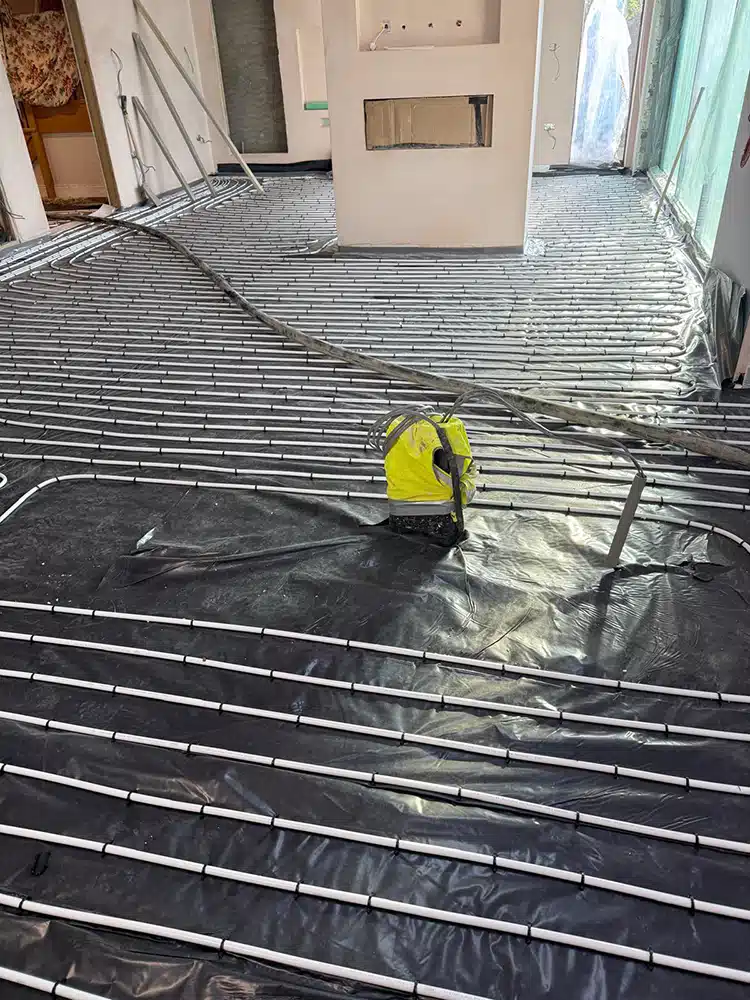
In most of these houses that means breaking out the existing floor. Once it is dug down, the new build-up goes in: membrane, insulation board, edge strip, the pipes laid and pressure tested by the heating installer, then the screed. Laying the pipes falls to your heating engineer, not us, yet the boards and polythene beneath them get checked before a drop of screed goes in, and we can supply both via our insulation and membranes service.
The screed type then follows the height. Under pumped screed the pipes want a minimum 25mm blanket on top, putting the finished floor somewhere around 45 to 50mm. The traditional mix needs nearer 45mm on top of the pipework, so it eats more height. Where height is tight, pumped liquid screed over the pipes usually fits better, and it surrounds the pipes completely with no air pockets.
Full encapsulation also gives a faster warm-up and better heating efficiency, which is what makes the disruption of a dig-out worthwhile.
Heated extensions and switching on in Worthing
The other heated floors in Worthing are new rooms: rear extensions, garden rooms and kitchen knock-throughs on semis and bungalows. With no old floor to remove, these are simpler, and the build-up is planned from the start, so the insulation depth and the screed type can be chosen together before the walls go up.
The question everyone asks is when the heating can go on. Anhydrite can usually take heat from about 7 days. Sand and cement has to sit for 21 days at the very least. In both cases the first heat-up is gradual: low flow temperature to begin with, raised a few degrees a day, held, then brought down. Switching straight to full heat can crack a screed or debond tiles later.
That heat-up also helps the floor dry, but drying still takes weeks, and our guide to screed drying times explains how depth affects it. Tile adhesive, LVT and engineered boards all set different moisture limits, so the screed is tested against whichever one you have chosen. We cover nearby towns too, including underfloor heating screed in Brighton and Hove.
Underfloor Heating Screed prices in Worthing
Liquid screed over underfloor heating: £20 to £35 per m² supplied and laid (trade2base, June 2026), so £700 to £1,230 for 35 m². trade2base gives these figures excluding VAT. See our floor screeding cost guide or screed calculator.
Who lays your underfloor heating screed in Worthing
K & B Screeding’s own team, led by director Donatas Bardisevicius. Founded 2019, company 12298780.
See what customers say in our Google reviews and on our testimonials page.
Underfloor Heating Screed from Slough to Worthing
Worthing is about 51 miles south-south-east of our Slough base as the crow flies, with postcodes including BN11, BN14, BN12 and BN13. The nearest towns to it are Shoreham-by-Sea (4.5 miles), Southwick (6 miles), Littlehampton (7.4 miles) and Brighton and Hove (10 miles).
More on underfloor heating screed, part of our screeding services.