
Grades and products for Worthing apartment floors
Look at a drawing for a Worthing block and the screed appears as a code, CA-C25-F5 being typical. CA stands for calcium sulphate, while the numbers after C and F give its compressive and flexural strength in N/mm2, as defined in the European standard for screeds.
Three grades cover most specifications. CA-C20-F4 covers domestic rooms that see little traffic. Houses, flats and offices generally take CA-C25-F5, so expect that code on most Worthing apartment drawings. Where wear is heavier, CA-C30-F6 steps in.
Now and then a Worthing specification lists an alpha hemihydrate screed by product name instead. Those are picked to dry sooner or go down thinner, and their own product sheets set the depth, drying and heat-up, so we follow the sheet ahead of the rules of thumb.
The material has two strengths that suit apartment blocks. Because shrinkage is minimal, a wide bay needs few joints, and the screed can go onto insulation, heating pipes or a concrete base. How the material behaves once poured is set out in anhydrite screed explained.
Only 10% of Worthing's homes were built since 2000, so new plots like those planned at Teville Gate stand apart from the older stock. On a scheme of that kind the bay and joint layout is planned before the pour, the build-up is checked plot by plot, and drying and laitance advice is handed over in writing.
Laitance, moisture and wet areas in Worthing
Anhydrite leaves a weak, powdery skin on top as it cures, and that skin is the laitance. It must be removed. With the floor dry, a sander takes it back to hard screed, the dust is hoovered off, and a calcium sulphate compatible primer follows. Skip that and adhesives can fail, tiles can come loose and LVT can lift. We can do the sanding and priming as part of preparing the floor for its covering.
Moisture testing comes next. Plenty of flooring brands set a tighter moisture figure for anhydrite than for cement, so the same floor might be ready for one covering and still too damp for the next. Checking with a hygrometer shows the actual figure. Firing up the underfloor heating once it is about 7 days old usually helps force the drying.
The one place it does not belong is anywhere that may get wet. So a new shower in a converted Worthing flat, or a utility with a gully in the floor, wants a cement base instead, either pumped cement screed or a traditional hand-trowelled screed. We also pour this material in nearby towns, including anhydrite screed in Bognor Regis.
Anhydrite & Flow Screed prices in Worthing
Liquid flowing screed (which includes anhydrite): £24 to £31 per m² supplied and laid (MyJobQuote, August 2026), so £960 to £1,240 for 40 m². MyJobQuote does not say whether these figures include VAT. See our floor screeding cost guide or screed calculator.
Who lays your anhydrite and flow screed in Worthing
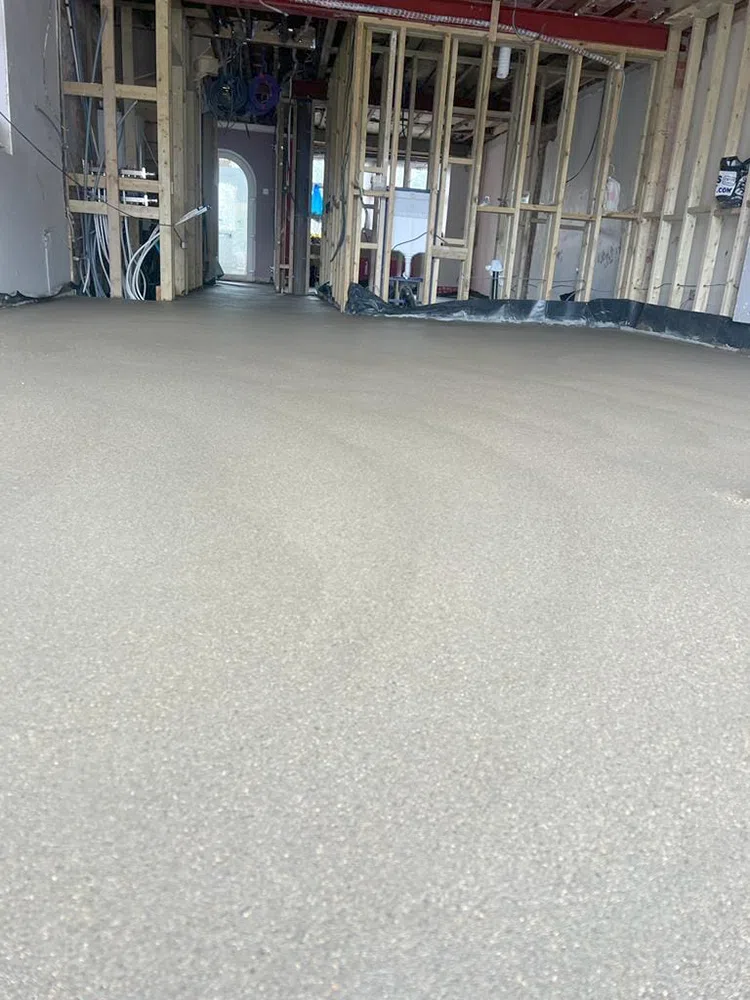
K & B Screeding’s own team, led by director Donatas Bardisevicius. Founded 2019, company 12298780.
See what customers say in our Google reviews and on our testimonials page.
Anhydrite & Flow Screed from Slough to Worthing
Worthing is about 51 miles south-south-east of our Slough base as the crow flies, with postcodes including BN11, BN14, BN12 and BN13. The nearest towns to it are Shoreham-by-Sea (4.5 miles), Southwick (6 miles), Littlehampton (7.4 miles) and Brighton and Hove (10 miles).
More on anhydrite screed, part of our screeding services.
