
Anhydrite grades and bays in Bognor Regis apartments
A code like CA-C25-F5 tells you what you are getting. The CA part names the material, while the C and F figures give compressive and flexural strength in N/mm2. For a lightly used domestic floor, CA-C20-F4 is enough. CA-C25-F5 is the usual choice across homes, apartments and offices, and CA-C30-F6 is reserved for heavier use.
The grade should come from the specification or the engineer, and we pour what is named. An alpha hemihydrate product sometimes appears on the drawings instead, picked because it dries faster or can go down thinner. It comes with a data sheet of its own covering depth and heating, and that sheet is what we follow.
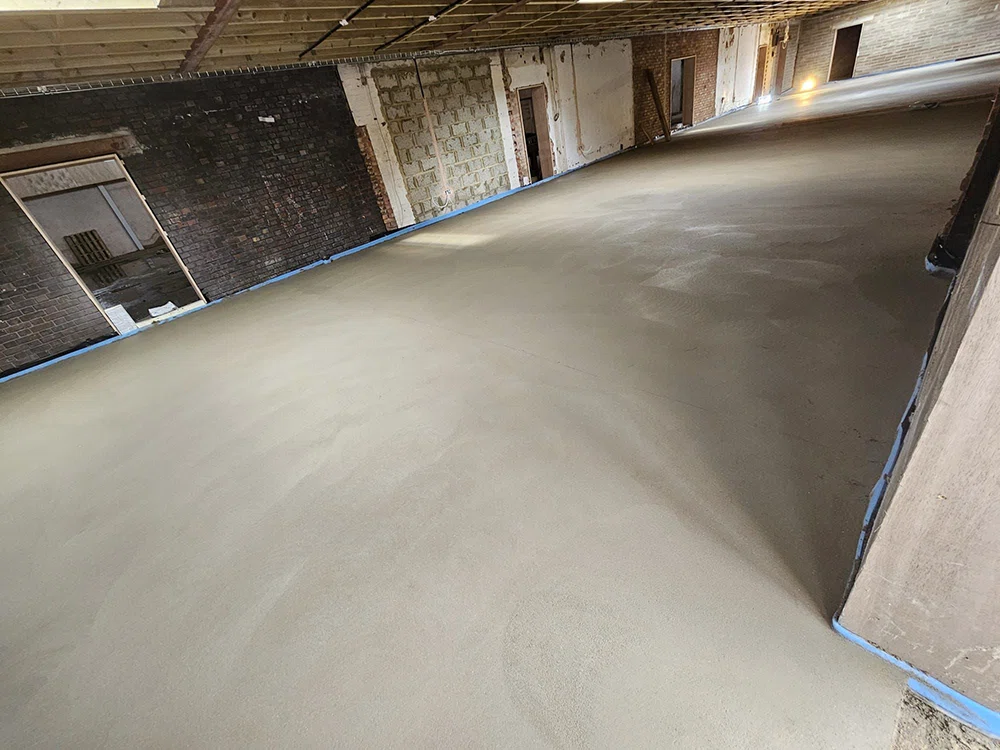
What makes the material useful in flats is how little it shrinks. A calcium sulphate floor can be poured in large bays with very few joints, which suits an open-plan apartment and reduces the risk of cracks telegraphing through tiles. Doorways and the boundaries between heating zones still need joints, and we settle where the bays and joints go before the pump starts.
New homes are a smaller part of the stock here: 5% of homes date from 2015 or later. Where a recent plot or block in the town was finished on a calcium sulphate floor, any extension or alteration usually continues in the same material. Our anhydrite screed guide goes deeper into the material.
Sanding, priming and testing Bognor Regis anhydrite floors
A drying calcium sulphate floor grows a weak skin on its surface, called laitance. If tiles or LVT are stuck to that layer, they can lift later. When the screed has dried far enough, we sand that skin off, vacuum the dust and prime with a product meant for calcium sulphate rather than one made only for cement.
Moisture testing comes next. Flooring makers often allow calcium sulphate less moisture than cement, so it has to reach a drier reading than you might expect. A hygrometer reading is taken and checked against the figure for the flooring you have chosen. A heated floor can normally be force dried by the system from about 7 days, warming it up in stages.
Keep it out of rooms where water could reach the floor. A shower room on the ground floor, a utility that might leak or any wet room should get a cement based flow screed, or a Bognor Regis sand and cement floor laid by hand. For a sound but uneven calcium sulphate floor, a thin latex screed over the right primer can bring it flat. For specification work along the coast, see anhydrite screed in Selsey.
Anhydrite & Flow Screed prices in Bognor Regis
Liquid flowing screed (which includes anhydrite): £24 to £31 per m² supplied and laid (MyJobQuote, August 2026), so £960 to £1,240 for 40 m². MyJobQuote does not say whether these figures include VAT. See our floor screeding cost guide or screed calculator.
Who lays your anhydrite and flow screed in Bognor Regis
K & B Screeding’s own team, led by director Donatas Bardisevicius. Founded 2019, company 12298780.
See what customers say in our Google reviews and on our testimonials page.
Anhydrite & Flow Screed from Slough to Bognor Regis
On the map, Bognor Regis sits south of Slough, about 51.7 miles from our base in a straight line (postcodes including PO21 and PO22), next to Littlehampton (6 miles), Chichester (6 miles), Selsey (6.4 miles) and Emsworth (12.5 miles).
More on anhydrite screed, part of our screeding services.