
Reading CA grades on Havant new build plots
Calcium sulphate screed gets a short code under the European standard for screeds, and that code spells out what loads the floor can carry. The CA part means calcium sulphate, the number after C is how much it resists crushing, and the number after F how much it resists bending, each measured in N/mm2. You will see CA-C20-F4 on lightly used domestic floors. Ordinary homes, flats and offices mostly get CA-C25-F5. Where wear will be heavier, the grade goes up to CA-C30-F6.
For a developer's site, such as the new homes on the former Procter and Gamble land, the grade is the engineer's decision, and the specified product is the one that goes in. Where drying has to be quicker or the layer thinner, the drawings may call for an alpha hemihydrate product. Those products follow their own data sheets for depth and drying time, and we work from the sheet.
The material's main strength on a housing site is how little it shrinks. That lets us pour big bays with hardly any joints, so a whole open-plan ground floor or apartment level is done as one area. We still mark out joints before the day, under doorways and where heating zones meet. Where pipes are laid in it, the heating can normally start drying it out from about 7 days, which helps a plot stay on schedule.
Our own team sets up everything below the screed, and the boards, membrane and perimeter strip are all inspected before pouring. Where a plot or a single room cannot take calcium sulphate, we offer a cement based flowing screed. Anhydrite screed explained covers the material in plain terms, and underfloor heating screed in Havant covers the heated floors themselves.
Sanding and moisture testing Havant anhydrite floors
As it dries, calcium sulphate forms a weak, thin skin on top known as laitance. It has to go before any adhesive or levelling compound, because they will only grip as well as the surface beneath them. Once drying is finished, the skin is machine sanded off and a calcium sulphate primer goes down. Leave it on and tiles or LVT have a habit of letting go.
Moisture comes next. Plenty of flooring makers allow less moisture in calcium sulphate than in cement, which is why your fitter should wait for a hygrometer reading rather than count weeks.
Then there are the rooms where it should not go. Water is its weak point, so in wet rooms, walk-in showers and utility areas where a leak could happen we use a flowing screed made with cement, or lay cement screed by hand. For a thin finishing layer over an existing floor, latex screed is a separate product. If an older Havant house is being extended rather than built new, the page on liquid screed for extensions sets out the general pumped option.
Anhydrite & Flow Screed prices in Havant
Liquid flowing screed (which includes anhydrite): £24 to £31 per m² supplied and laid (MyJobQuote, August 2026), so £960 to £1,240 for 40 m². MyJobQuote does not say whether these figures include VAT. See our floor screeding cost guide or screed calculator.
Who lays your anhydrite and flow screed in Havant
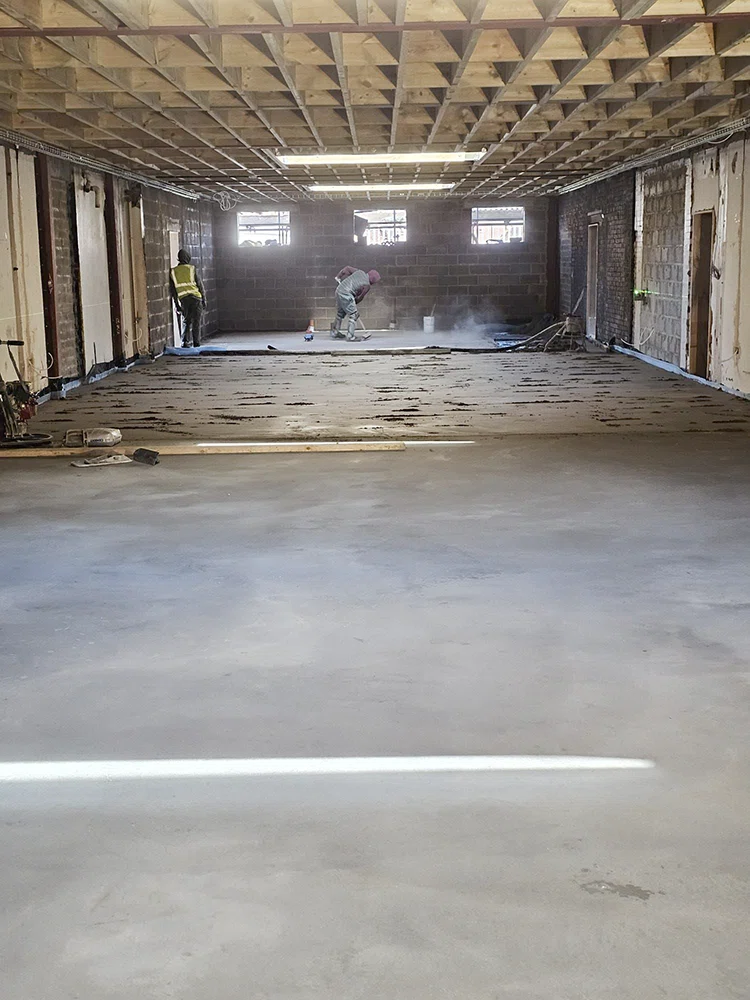
K & B Screeding’s own team, led by director Donatas Bardisevicius. Founded 2019, company 12298780.
See what customers say in our Google reviews and on our testimonials page.
Anhydrite & Flow Screed from Slough to Havant
On the map, Havant sits south-south-west of Slough, about 49 miles from our base in a straight line (postcodes including PO9 and PO7), next to Emsworth (2.2 miles), Horndean (3.7 miles), Portsmouth (6.2 miles) and Gosport (7.4 miles).
More on anhydrite screed, part of our screeding services.