
Reading an anhydrite grade on a Petersfield drawing
On a drawing, this material is written as a short code, for example CA-C25-F5. The CA means calcium sulphate. Read the C number as resistance to crushing and the F number as resistance to bending; the European screed standard measures each of them in N/mm2.
Three grades cover most work. The lightest, CA-C20-F4, is meant for houses where floors take light traffic. Next comes CA-C25-F5, the grade written into most homes, apartments and offices. At the top, CA-C30-F6 is kept for floors that work harder. An office floor would usually be CA-C25-F5, moving up to CA-C30-F6 where the engineer expects heavier loads.
Then there is alpha hemihydrate, which works differently. You pick it when the floor has to dry sooner or sit thinner, and every product comes with its own sheet setting out depth, drying and heating, so we work to that sheet rather than a general rule.
The material brings real benefits on large floors. It shrinks very little, so bays can be much bigger than with a cement screed, and an apartment floor can often be poured with few joints. Even so, we mark out bays and joints on the plan first, paying most attention to door openings and to lines where one heating zone meets the next. Where pipes are fitted, our underfloor heating screed page covers the cover depth and first heat-up.
For a plain explanation of how the material behaves, read our anhydrite screed guide. If you have a specification, send it over with the drawings and we will price to it.
Laitance, moisture and primers before Petersfield flooring
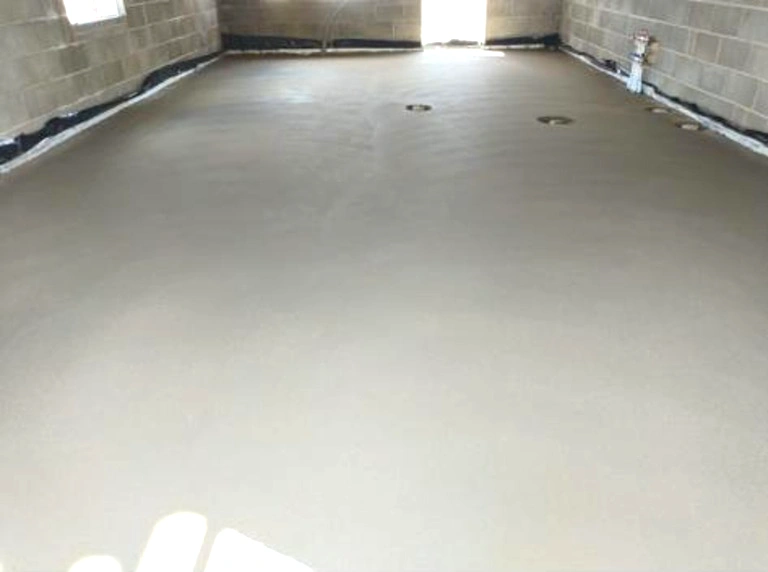
A Petersfield flat floored in calcium sulphate is not finished on the day it is poured, in a way a cement floor would be.
While the screed cures, a weak, thin crust known as laitance builds up on top. It must be removed before any flooring or adhesive goes on, usually by sanding once the screed is dry. Left in place, it can cause tiles and floor coverings to debond. Sanding back and cleaning that top surface is part of our floor preparation work.
Moisture testing follows. Plenty of fitters work to a hygrometer figure of roughly seventy-five per cent relative humidity, yet the maker of your vinyl or wood may demand a drier floor on calcium sulphate than on cement, so their data sheet has the final say. If pipes run through it, the heating can usually be used to speed drying once the floor is around a week old.
When the surface is sanded and dry, it gets a primer made to suit calcium sulphate. Check that the primer and the adhesive are both approved for calcium sulphate, because the bond depends on it.
Water is its weak point. If the same building has a shower room, a utility or a garage to floor, those rooms want a cement based flowing screed or a traditional hand-laid floor instead.
Anhydrite & Flow Screed prices in Petersfield
Liquid flowing screed (which includes anhydrite): £24 to £31 per m² supplied and laid (MyJobQuote, August 2026), so £960 to £1,240 for 40 m². MyJobQuote does not say whether these figures include VAT. See our floor screeding cost guide or screed calculator.
Who lays your anhydrite and flow screed in Petersfield
K & B Screeding’s own team, led by director Donatas Bardisevicius. Founded 2019, company 12298780.
See what customers say in our Google reviews and on our testimonials page.
Anhydrite & Flow Screed from Slough to Petersfield
Petersfield is about 38.6 miles south-south-west of our Slough base as the crow flies, with postcodes including GU32, GU31 and GU33. The nearest towns to it are Horndean (7.3 miles), Alton (10.1 miles), Havant (10.4 miles) and Emsworth (10.8 miles).
More on anhydrite screed, part of our screeding services.
