
Where pumped screed earns its place in Petersfield
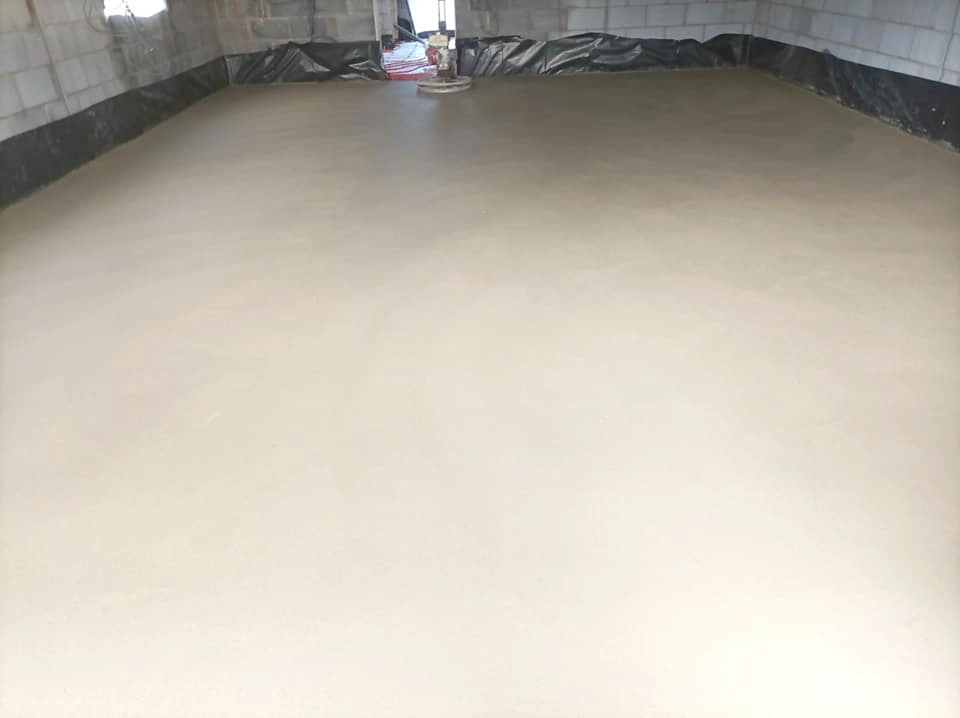
Big, unbroken floors are where a pumped screed pays its way. A rear extension that joins an old kitchen and dining room into one space can be poured in a single session, and because the screed finds its own level, it reaches SR1 or SR2 flatness far more readily than a hand-laid floor. It also shrinks very little, so a wide room needs fewer joints.
The town's newer houses were planned around it. Some 18% of Petersfield homes date from 2000 onwards, and builders of that period generally gave the ground floor a layer of insulation for a flowing screed to sit on. On a new plot the pipes or insulation are often already down when the pump arrives.
Then there are the flats. They account for 21% of homes in Petersfield, so plenty of floors sit above street level, and hauling sand and cement up a communal stair in bags is slow, heavy work. With a pump, the hose goes up the stairs and nobody carries anything.
You also give up less height. In one of Petersfield's 1970s to 1990s houses being extended, that matters: pumped screed floated on insulation can stop at around 35mm, while the traditional mix needs nearer 65mm, and the difference is often what lets the new floor run flush into the old doorway. Both calcium sulphate and cement based versions exist; the grades themselves are explained under anhydrite flow screed. To weigh the two approaches side by side, read how liquid and sand and cement screeds compare.
Getting the hose into a Petersfield house
Our mixer and pump are parked outside, with the hose fed through whichever door is closest to the room. Where a Petersfield house has its own drive, there is little more to it than that. In the town centre, around the High Street and College Street, a mixer lorry needs somewhere legal to stand for the length of the pour, so mention loading restrictions or shared access when you ask for a price. A long hall or a flight of stairs is no obstacle for the hose, as long as nothing blocks the way and the floors it crosses are covered.
Get the room ready ahead of the lorry. Foam strip goes along the foot of every wall, the polythene sheet over the insulation needs its seams taped, and each doorway gets a dam so the screed cannot run into the hall. On the morning of the pour we go over that build-up ourselves. We supply and operate our own pump through our screed pumping service; we do not hire pumps out.
Do not book the floor fitter too soon. Being able to cross the room after a day or two tells you nothing about how much moisture is left, and most coverings go down only once a test shows the screed has dried. Over the first 40mm, think of each millimetre as costing you a day; past that depth, it creeps along more slowly. The reasons are set out in how long screed takes to dry.
Liquid Screed prices in Petersfield
Liquid screed: £24 to £31 per m² supplied and laid (MyJobQuote, August 2026), so £960 to £1,240 for 40 m². MyJobQuote does not say whether these figures include VAT. See our floor screeding cost guide or screed calculator.
Who lays your liquid screed in Petersfield
K & B Screeding’s own team, led by director Donatas Bardisevicius. Founded 2019, company 12298780.
See what customers say in our Google reviews and on our testimonials page.
Liquid Screed from Slough to Petersfield
Petersfield is about 38.6 miles south-south-west of our Slough base as the crow flies, with postcodes including GU32, GU31 and GU33. The nearest towns to it are Horndean (7.3 miles), Alton (10.1 miles), Havant (10.4 miles) and Emsworth (10.8 miles).
More on liquid screed, part of our screeding services.
