
Where liquid screed suits Alton's extensions and new homes
The strength of a flowing screed is coverage. It self-levels across a large area, fills every corner and leaves a dense surface with low shrinkage and far fewer joints than a hand-laid floor.
Plenty of Alton's homes are semis and detached houses from the decades after the war or later in the twentieth century, and when one is opened up into a single open-plan space, a pumped floor suits it well. A kitchen knock-through or a rear extension that turns two rooms into one wants a single, continuous floor that meets the existing level exactly, and a pumped screed delivers that in a day.
Newer housing is the other obvious fit. Homes built from 2015 onwards are 16% of the town's stock, and a new ground floor over insulation is well suited to a floating pumped screed. On the former Molson Coors brewery site, the new houses and apartments are the kind of project where liquid screed over heating is often specified.
How deep it goes comes down to what sits beneath. In a house it floats on the insulation at a minimum of about 35mm; bury heating pipes in it and you need at least 25mm over them, which takes a heated floor to somewhere between 45 and 50mm. Reaching SR1 or SR2 for flatness is readily done.
You can choose a calcium sulphate mix or a cement based one, and what usually tips it is whether the floor may see water and what covering it will carry. If your drawings name a calcium sulphate grade, our Alton anhydrite screed page explains what that involves, and the comparison with sand and cement covers when a traditional screed is the better fit.
Pumping into Alton homes: access, drying and cost
Because the screed is pumped, the room does not need a clear path for barrows, but the truck and pump do need somewhere to stand within reach. A driveway makes that simple. A house with limited parking or a long hose route through the building needs a little planning, so mention it when you ask for a quote.
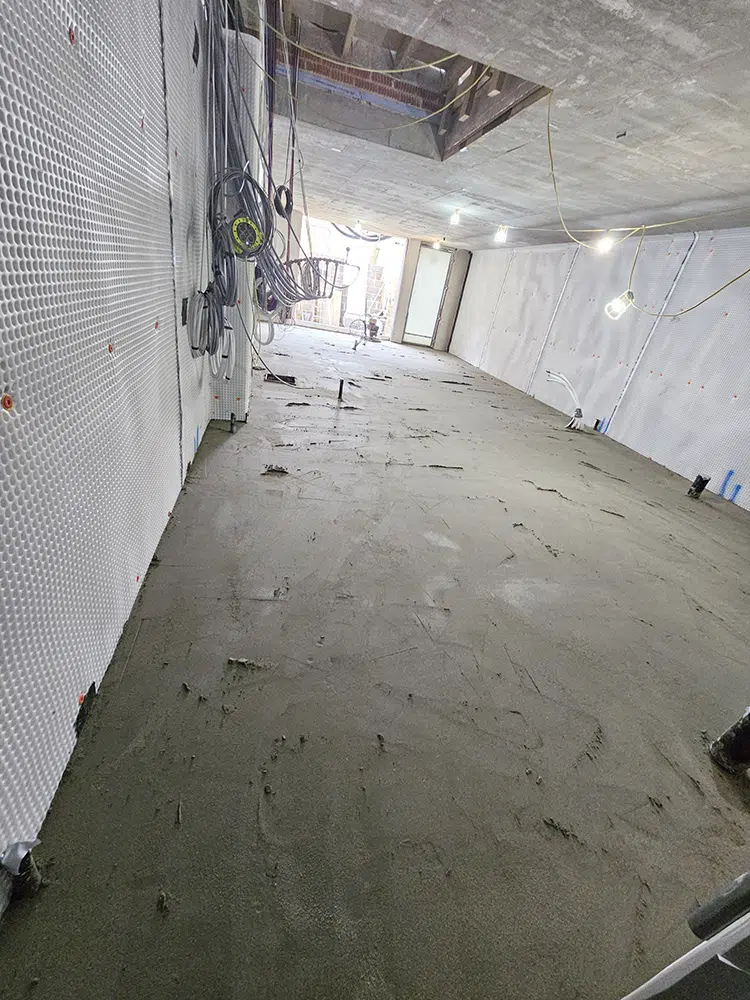
Preparation happens before the truck turns up. Insulation and a membrane are laid, an edge strip runs around every wall, and the membrane is taped so the screed cannot escape underneath. If there is underfloor heating, its pipes must be clipped firmly and tested under pressure.
You can step onto it after a day or two, yet full drying takes a good deal longer. Expect each millimetre of depth to need roughly a day up to 40mm, with the deeper part slower still. Our guide to drying times goes into what speeds that up.
UK prices published for 2026 show £24 to £31 per m² for a pumped floor, and £20 to £35 where it goes over underfloor heating. Access, depth and the area covered all move the final figure, and our floor screeding cost guide explains the rest.
Liquid Screed prices in Alton
Liquid screed: £24 to £31 per m² supplied and laid (MyJobQuote, August 2026), so £960 to £1,240 for 40 m². MyJobQuote does not say whether these figures include VAT. See our floor screeding cost guide or screed calculator.
Who lays your liquid screed in Alton
K & B Screeding’s own team, led by director Donatas Bardisevicius. Founded 2019, company 12298780.
See what customers say in our Google reviews and on our testimonials page.
Liquid Screed from Slough to Alton
Alton is about 30.1 miles south-south-west of our Slough base as the crow flies, with postcodes including GU34. The nearest towns to it are Farnham (8.9 miles), Basingstoke (9.6 miles), Petersfield (10.1 miles) and Fleet (10.8 miles).
More on liquid screed, part of our screeding services.
