
Pipe cover for heated knock-throughs in Alton
An underfloor heating system is only as good as the screed on top. The screed locks the pipes in place, spreads their heat evenly and gives the floor finish a flat base.
A liquid mix needs 25mm or more over the pipes, which puts the whole floor at roughly 45 to 50mm. With sand and cement you want about 45mm on top of them. A flowing screed wraps around the pipes with no air pockets and, being thinner, warms up faster, which is why new heated floors usually use it. Sand and cement remains useful where a room may get wet.
The awkward part on an Alton extension is usually the finished level. When a new heated floor joins a kitchen through a knock-through, both must end up at the same height. That fixes the budget for insulation, pipes and screed, and we check it before anything is ordered. The layer by layer arithmetic is in how deep a screed needs to be.
In an older cottage, adding heat to an existing ground floor is harder. There is rarely room for a full build-up without digging out, and even then a thin liquid screed may be needed to keep the finished level low enough for the doors. Ask your heating engineer for the pipe diameter and insulation board thickness early, because those two figures decide whether a retrofit is practical at all.
Brewery site homes and the first heat-up in Alton
On the former Molson Coors brewery site, Cala Homes' new houses and apartments and the conversion of Culverton House are the kind of project where liquid screed over underfloor heating is often specified. New build plots usually arrive with insulation, membrane and pipes already down, ready for a pump.
Brewery plot or cottage, the heating has to be brought up slowly the first time. Calcium sulphate will normally accept heat from around day 7, whereas sand and cement should be left 21 days or more. For the first firing, keep the flow temperature low and nudge it upwards day by day for several days. Put it on full from the start and the top dries ahead of the rest, which can crack the floor.
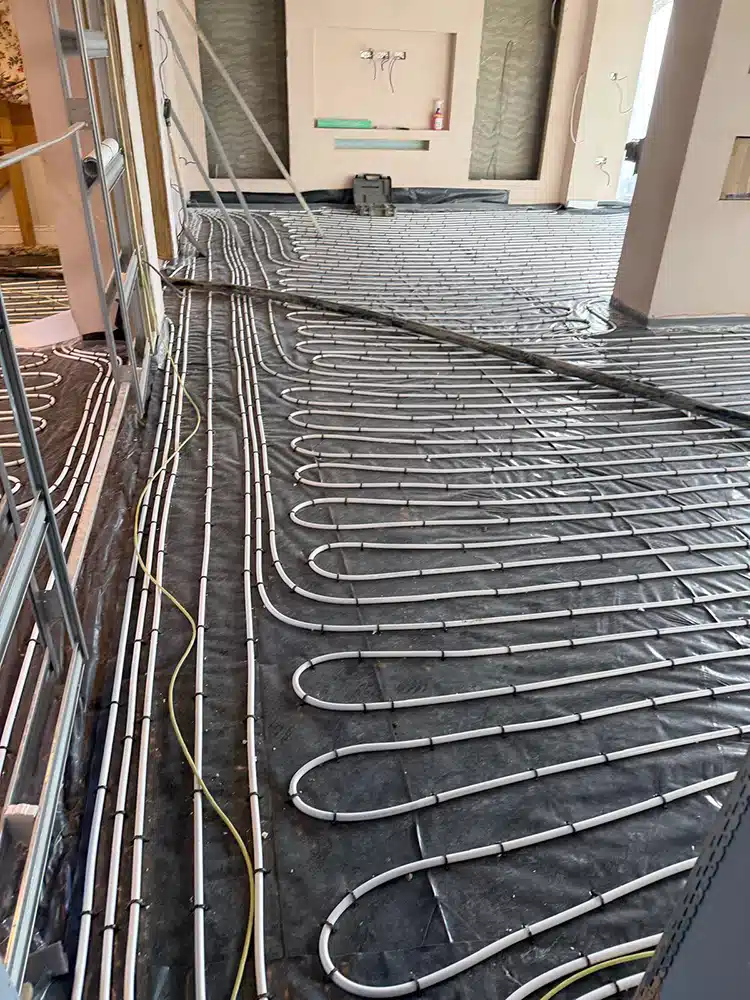
Before we pour, the pipes should be firmly clipped, pressure tested and left under pressure, and an edge strip fitted around the walls to allow for expansion. The insulation and membrane get checked too, and if any is missing we can supply insulation and membranes. For the pumped method itself, see liquid screed in Alton, and for a cement option, the Alton sand and cement page.
Underfloor Heating Screed prices in Alton
Liquid screed over underfloor heating: £20 to £35 per m² supplied and laid (trade2base, June 2026), so £700 to £1,230 for 35 m². trade2base gives these figures excluding VAT. See our floor screeding cost guide or screed calculator.
Who lays your underfloor heating screed in Alton
K & B Screeding’s own team, led by director Donatas Bardisevicius. Founded 2019, company 12298780.
See what customers say in our Google reviews and on our testimonials page.
Underfloor Heating Screed from Slough to Alton
Alton is about 30.1 miles south-south-west of our Slough base as the crow flies, with postcodes including GU34. The nearest towns to it are Farnham (8.9 miles), Basingstoke (9.6 miles), Petersfield (10.1 miles) and Fleet (10.8 miles).
More on underfloor heating screed, part of our screeding services.
