
Adding heat under old Haslemere and Shottermill floors
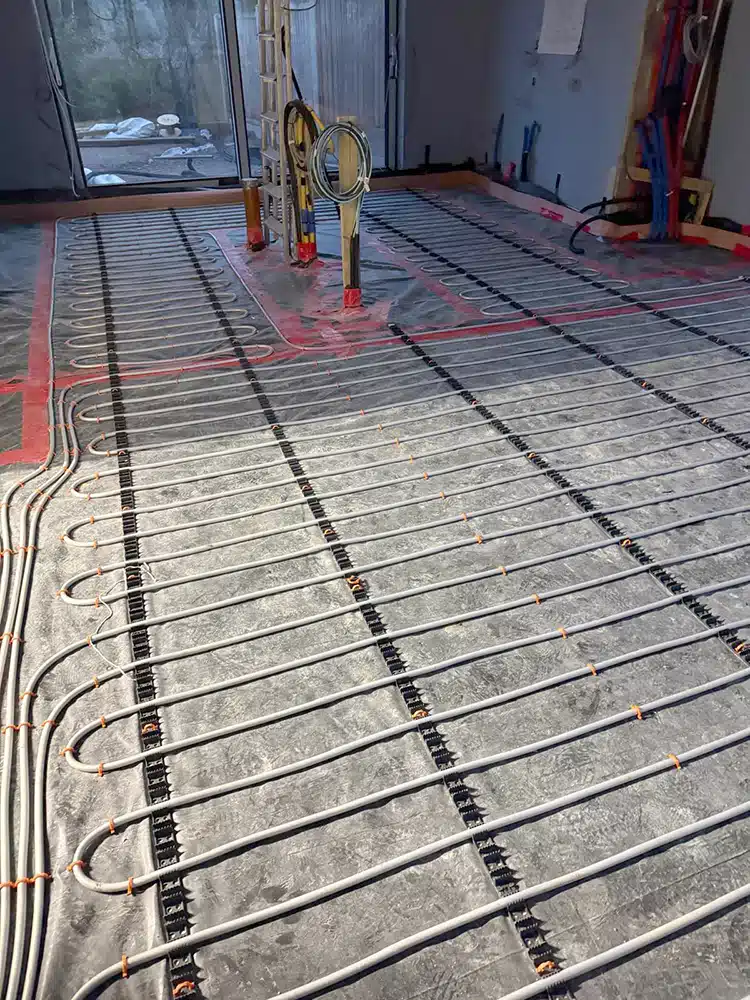
A renovation that takes the ground floor out is the natural time to fit underfloor heating. In the older houses of Haslemere and Shottermill, the excavation is already happening to fit a membrane and insulation, so the heating pipes can go in on top of the insulation before the screed.
The constraint is height. The new floor has to finish level with existing doors, stairs and thresholds, so insulation, pipes and screed must fit inside the depth available. That is where screed choice matters. With liquid, the pipes need 25mm or more on top, around 45 to 50mm for the whole screed. Sand and cement wants about 45mm over them, which makes the floor thicker overall.
Liquid screed has a second advantage on heated floors. Because it flows all round each pipe and leaves no gaps, heat spreads evenly and the room warms up faster. Sand and cement can be used, but it has to be worked carefully around every pipe.
Inter-war homes raise the same questions. About 14% of Haslemere homes were built between 1919 and 1944, and adding heating to those usually means rebuilding the floor too.
We either supply or check the insulation, the membrane and the edge strip before pouring, and your installer should have pressure tested the pipes. For the material options, see our liquid screed page for Haslemere, and for the layers underneath, our insulation and membranes service.
Commissioning heated floors in Haslemere homes
A new heated floor needs a patient start. Go straight to full heat and the screed can crack, which is why the temperature goes up in stages, with a hold at each, to the screed maker's schedule.
The start date depends on the material. Calcium sulphate can normally take heat at around 7 days, which then speeds its drying. Sand and cement must sit for 21 days or more before the heating is switched on. We hand over written guidance, and your installer sets the controls to match.
Newer homes follow the same rules. Only 6% of Haslemere homes date from 2015 onward, and new plots may be built with heating in a flowing screed from the start, and where the drawings name a calcium sulphate grade, our anhydrite screed page for Haslemere covers laitance and testing.
Flooring comes last. Stone, tiles and engineered wood over heating all need a dry, flat screed, and a moisture test tells you when it is ready. Engineered wood is the most sensitive, because boards can move once the heat comes on if moisture is left behind.
Underfloor Heating Screed prices in Haslemere
Liquid screed over underfloor heating: £20 to £35 per m² supplied and laid (trade2base, June 2026), so £700 to £1,230 for 35 m². trade2base gives these figures excluding VAT. See our floor screeding cost guide or screed calculator.
Who lays your underfloor heating screed in Haslemere
K & B Screeding’s own team, led by director Donatas Bardisevicius. Founded 2019, company 12298780.
See what customers say in our Google reviews and on our testimonials page.
Underfloor Heating Screed from Slough to Haslemere
Haslemere is about 30.8 miles south of our Slough base as the crow flies, with postcodes including GU27. The nearest towns to it are Godalming (7.9 miles), Farnham (9.6 miles), Aldershot (11.4 miles) and Petersfield (11.5 miles).
More on underfloor heating screed, part of our screeding services.