
Heated floors in Farnborough extensions and replacements
Adding heating is easiest when the floor is new. An extension on a post-war semi or terrace in Farnborough is built with its own insulated base, so there is room for the pipes and a full screed. The same applies when the old slab is broken out: once insulation and a membrane go in, the pipes can be clipped down on top before screeding. Detached houses, 20% of the town's homes, can have larger rooms where a single heated zone makes sense.
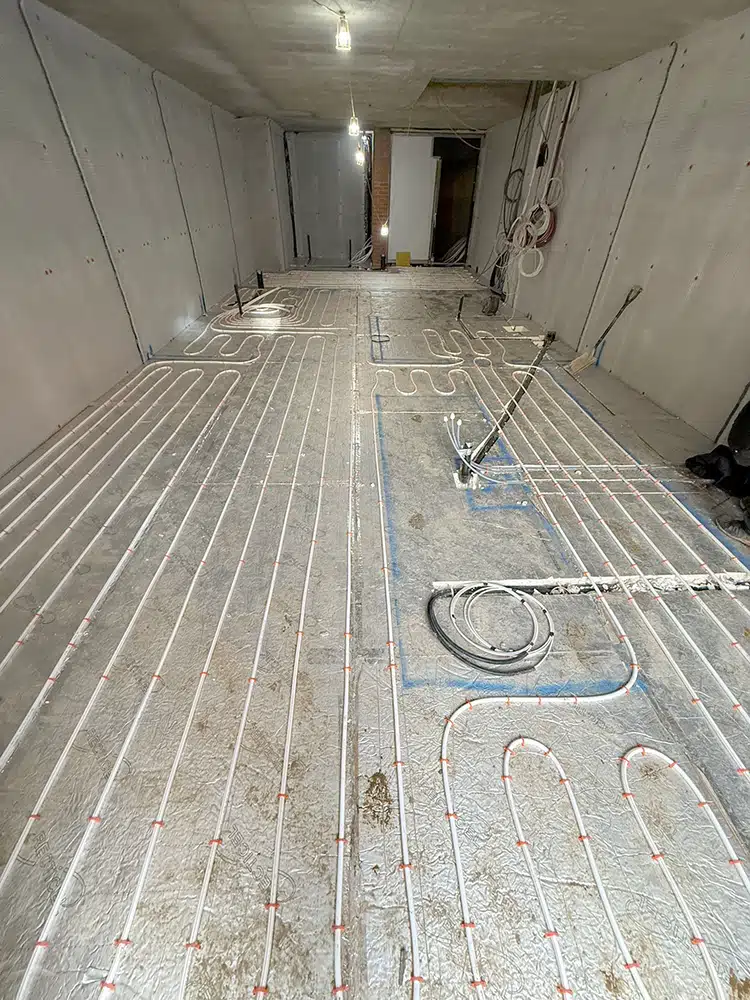
The two screeds behave differently over pipes. Pumped liquid flows into every gap round the pipes, so there are no air pockets, and with at least 25mm over them the floor normally totals 45 to 50mm. Sand and cement has to sit roughly 45mm above them, making a deeper floor overall. Thinner screed warms up faster and uses less height, which is often the deciding factor in a retrofit where every millimetre counts.
Where heating is being added to part of an existing ground floor, the height problem gets sharper. The new heated floor has to finish at the level of the unheated rooms and doorways, which can mean digging down or choosing a thin liquid screed. Our page on liquid screed for Farnborough covers the pumped option, and the sand and cement page covers the hand-laid one.
Acoustic heated floors for Farnborough town centre flats
The town centre redevelopment planned by Rushmoor Borough Council includes new homes, and the flats there will need screeds that meet sound insulation requirements between dwellings. Where those floors are also heated, the build-up typically combines an acoustic layer, insulation, the heating pipes and a floating screed, and each layer has to suit the others. Only 5% of Farnborough's homes were built since 2015, so this kind of floor is still a small part of the housing, but it is set to grow.
Whatever the building, commissioning follows the same rules. Your installer pressure tests the circuits before the pour, and ideally leaves them pressurised while we screed. Then the heating waits: calcium sulphate can take it at around 7 days, sand and cement only after 21 days at the least. First runs are low, and the temperature goes up a little at a time.
Only when a test shows the screed is dry does flooring go down. Whatever goes on top, whether tile, LVT or engineered boards, needs the base to be flat. A floor whose heating was brought up carefully stands a better chance of staying free of cracks. Where the spec names a calcium sulphate grade, anhydrite screed in Farnborough explains what it means. For the layers beneath, see insulation and membranes.
Underfloor Heating Screed prices in Farnborough
Liquid screed over underfloor heating: £20 to £35 per m² supplied and laid (trade2base, June 2026), so £700 to £1,230 for 35 m². trade2base gives these figures excluding VAT. See our floor screeding cost guide or screed calculator.
Who lays your underfloor heating screed in Farnborough
K & B Screeding’s own team, led by director Donatas Bardisevicius. Founded 2019, company 12298780.
See what customers say in our Google reviews and on our testimonials page.
Underfloor Heating Screed from Slough to Farnborough
Farnborough is about 17.4 miles south-south-west of our Slough base as the crow flies, with postcodes including GU14 and GU11. The nearest towns to it are Frimley (1.8 miles), Aldershot (2.8 miles), Camberley (3.4 miles) and Fleet (3.9 miles).
More on underfloor heating screed, part of our screeding services.