
Kitchen and bathroom refits in Farnborough's post-war homes
Two parts go into the mix, which is where the name comes from. The powder is cement based, and instead of water it is stirred into a latex emulsion supplied with it. The result is a thin coat that bonds well and tolerates slight movement, so it can sit on surfaces that would shed an ordinary compound.
In a Farnborough semi or terrace built in the decades after the war, a refit uncovers a predictable set of bases. Downstairs, the old kitchen may have ceramic or quarry tiles laid long ago, or a concrete floor with patches where pipes were rerouted. Upstairs, the bathroom sits on timber boards. Each needs a slightly different approach before latex goes on.
Tiles are the simplest. If every tile is still stuck fast, there is no need to break them out. We degrease, abrade the glaze where needed, prime and lay the latex straight over. Hollow tiles come up first.
Timber needs more work. Bare floorboards move too much, so latex never goes on them directly. The boards are fixed down, then covered with flooring grade plywood screwed at close centres, and the latex is laid over that ply.
Old adhesive is the last common case. Some residues are sound enough to latex over after priming; soft or bitumen based ones are taken off first, as our page on concrete floor grinding in Farnborough explains.
Homes in council tax bands A to C make up 62% of Farnborough's stock, and on a careful budget, keeping the existing floor and smoothing it with latex usually costs less than starting again.
Damp, bounce and dips: limits of latex in Farnborough
Before quoting, we check the floor for three things latex cannot cure.
Movement. A bathroom floor that bounces will crack any thin layer laid over it. The fix is structural: secure the joists and boards, then overboard properly. Only then does latex go on.
Moisture. A ground floor slab without a working membrane will push damp up through the latex and into the adhesive above. Homes built between 1919 and 1944 are 7% of Farnborough's housing, and floors of that age may predate modern damp proofing, so a reading comes before any price. A wet slab needs treating or replacing.
Level. Latex smooths; it does not rebuild. If a floor is several centimetres out, or cracked and loose, the screed needs repairing before any finish goes down, or a new floor is laid. In the town's houses from the 1970s on, cracked screed is a common find under old flooring, and any crack is assessed before latex is considered.
Primer is part of every job. Concrete, tiles, plywood and calcium sulphate each take a specific primer, and calcium sulphate must also have its laitance sanded off. The broader question of compound versus screed, with the flatness classes, sits on our page about floor levelling for Farnborough.
How we price latex screed in Farnborough
A fixed written price within 24 hours, once we know the area and the base. See our floor screeding cost guide.
Who lays your latex screed in Farnborough
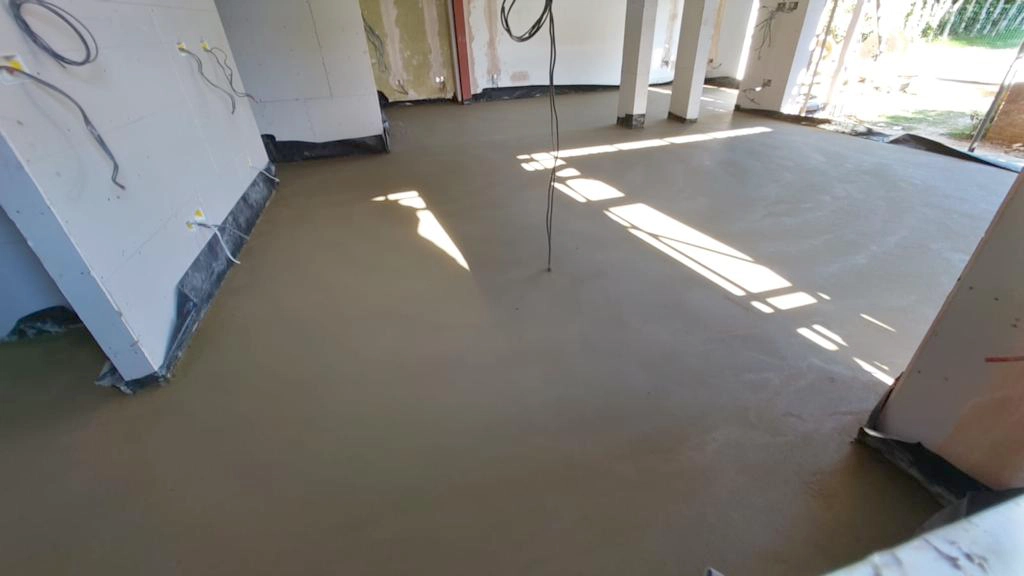
K & B Screeding’s own team, led by director Donatas Bardisevicius. Founded 2019, company 12298780.
See what customers say in our Google reviews and on our testimonials page.
Latex Screed from Slough to Farnborough
Farnborough is about 17.4 miles south-south-west of our Slough base as the crow flies, with postcodes including GU14 and GU11. The nearest towns to it are Frimley (1.8 miles), Aldershot (2.8 miles), Camberley (3.4 miles) and Fleet (3.9 miles).
More on latex screed, part of our screeding services.
