
Awkward bases in Old Dean and older Camberley homes
Most new floor finishes are thin, and thin finishes copy whatever lies beneath them. In a Camberley kitchen or bathroom being refitted, what lies beneath is rarely a clean new screed. It may be a run of old quarry or ceramic tiles, a concrete floor worn uneven over decades, traces of an old adhesive bed, or timber boards that a builder has covered with plywood. Latex screed is made for bases like these.
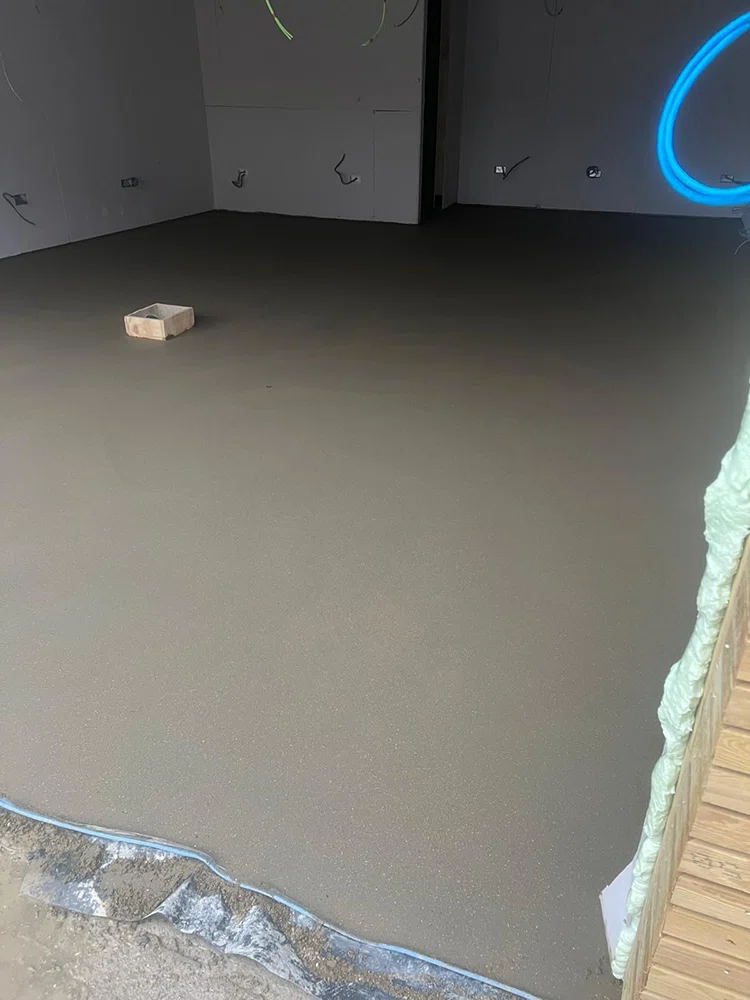
The name causes some confusion. It is not a screed in the sense of a 65mm sand and cement floor. It is a levelling compound supplied in two parts: a cement based powder and a container of latex liquid that is used in place of water. Mixed together they make a slurry that flows out to a smooth skin, normally just a few millimetres thick, and the latex gives it a little flexibility and a strong grip on the surface below.
Terraced houses account for 11% of homes across the town, and the Old Dean estate on the former Old Dean Common holds terraces alongside its semis and maisonettes. A ground floor that has carried several kitchens is likely to hide layers of earlier flooring. Where old tiles are still stuck fast, they can stay, and the latex goes over them once they are cleaned and primed. Loose or hollow tiles have to come up first.
Timber floors are different. Latex is never poured straight onto bare floorboards, because the boards move and the thin layer would crack along every joint. They are first overboarded with flooring grade plywood, screwed down tight, and the latex then goes onto the ply. For a floor that simply needs a general skim to meet a flatness class, our Camberley floor levelling page covers that wider subject.
When latex is the wrong answer in Camberley
Latex smooths a floor that is already sound. It does not cure damp, it does not stiffen springy boards and it cannot build up a floor that is badly out of level. Before mixing anything we check those three points.
Damp comes first. A concrete floor with no working membrane can push moisture up into a new finish, and a thin compound will not stop it. In that case the moisture has to be dealt with, and sometimes the floor relaid, before any latex goes down. Only 7% of Camberley homes were built between 1919 and 1944, but any older solid floor deserves a moisture test before it is covered with vinyl or LVT.
Movement comes next. If boards bounce underfoot, extra screws and a layer of ply are needed before latex can be laid. If a concrete floor is cracked and hollow, a screed repair or a new screed is the right starting point.
Level is the third. Latex is laid a few millimetres thick, so a floor that falls away by much more than that across a room needs a screed, not a thick pour of compound.
Primer ties it together. Concrete, old tiles, plywood and calcium sulphate screed each take a different primer, and calcium sulphate always needs its laitance taken off before it is primed. Where old coatings or ridges need cutting back before latex, grinding the concrete comes first. Crowthorne is about three miles away, and we also lay latex screed in Crowthorne.
How we price latex screed in Camberley
A fixed written price within 24 hours, once we know the area and the base. See our floor screeding cost guide.
Who lays your latex screed in Camberley
K & B Screeding’s own team, led by director Donatas Bardisevicius. Founded 2019, company 12298780.
See what customers say in our Google reviews and on our testimonials page.
Latex Screed from Slough to Camberley
Camberley is about 14 miles south-south-west of our Slough base as the crow flies, with postcodes including GU15. The nearest towns to it are Frimley (1.7 miles), Sandhurst (2.6 miles), Crowthorne (3 miles) and Yateley (3.2 miles).
More on latex screed, part of our screeding services.
