
Latex over boards and tiles in Bracknell homes
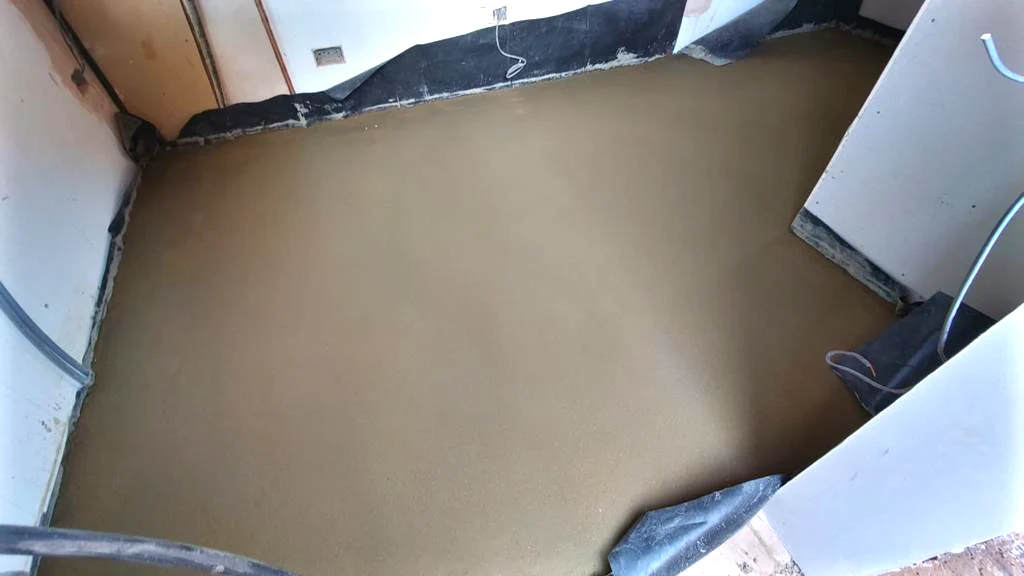
Latex screed earns its place on bases that a sand and cement or flowing screed cannot sensibly go over. In Bracknell that usually means a kitchen or bathroom refit, where the old covering has come up and whatever lies underneath is anything but smooth.
Upstairs, the floor is normally timber. Latex is never poured straight onto bare floorboards, because boards move and the gaps between them would crack a thin compound within weeks. The boards are screwed down first, a layer of flooring grade plywood is fixed over them, and the latex goes on the ply. A bathroom then gets a surface for sheet vinyl or LVT with no board lines printing through.
Downstairs, a ground floor in an older new town house may still carry quarry or ceramic tiles from an earlier kitchen. If they are firmly stuck and not cracked, there is no need to break them out. We clean and key them, prime them and spread latex across the top, filling the grout lines and bringing the room to one smooth plane.
Uneven older concrete, and a slab still holding a thin film of sound old adhesive, can be treated in a similar way, provided nothing is loose or powdery. Where weak residue sits on top, diamond grinding the slab clears it first.
The finishes that depend on all this are the thin, flexible ones: sheet vinyl, LVT, lino, rubber, safety flooring in a cloakroom or utility, and carpet that wears better over a smooth base. Thick tiles and timber can hide small faults. A vinyl only a couple of millimetres thick hides none.
When a Bracknell floor needs more than latex
Latex is a finishing layer, not a cure. Three things stop it working, and each one is checked before we price.
Movement comes first. A floor that flexes underfoot will crack a thin compound however good the product is. Springy boards are fixed down, any loose joist is dealt with and the plywood goes on before a single bag of latex is mixed.
Damp is next. Latex does nothing to hold back moisture rising through an old slab, and vinyl laid over a damp floor will lift or blister. We test the floor, and if it reads wet, a membrane or a rebuilt floor comes before any skim.
Level is the third. A few millimetres of latex will smooth and true a surface, but it will not correct a floor that falls away across the room or drops into a hollow. That floor needs building up or relaying, and the choice between compound and fresh screed is set out on our Bracknell floor levelling page. Cracked or crumbling patches go to screed repairs beforehand.
Primer deserves the same care as the latex itself. Plywood, tiles, concrete and calcium sulphate each take their own primer, and on calcium sulphate screed the laitance must be sanded away and a primer applied, or the latex can let go. We cover Easthampstead, Hanworth, Popeswood, Martin's Heron and the rest of Bracknell, and lay latex screed in Wokingham too.
How we price latex screed in Bracknell
A fixed written price within 24 hours, once we know the area and the base. See our floor screeding cost guide.
Who lays your latex screed in Bracknell
K & B Screeding’s own team, led by director Donatas Bardisevicius. Founded 2019, company 12298780.
See what customers say in our Google reviews and on our testimonials page.
Latex Screed from Slough to Bracknell
On the map, Bracknell sits south-south-west of Slough, about 9.2 miles from our base in a straight line (postcodes including RG12 and RG42), next to Wokingham (3.5 miles), Crowthorne (3.8 miles), Sandhurst (5.3 miles) and Camberley (5.4 miles).
More on latex screed, part of our screeding services.
