
Rebuilding older floors in Priestwood, Great Hollands and Wildridings
Houses in Priestwood, Great Hollands and Wildridings are now 50 years old or more. When their owners open up a kitchen and living room, the floor underneath is often the weak point: a slab that has cracked, dipped at one side or lost whatever damp protection it had. Levelling over a floor like that only hides the problem.
A floor like that is only properly sorted by removing it and starting again. Our team excavates the failed material, lays insulation and a damp proof membrane, and finishes with a floating sand and cement screed, usually 65mm deep in a home. If the concrete underneath is still sound and only its surface has crumbled, we can prepare it and bond 25 to 40mm of screed directly onto it. Getting that base right is covered by our floor preparation service.
Sand and cement suits these rooms for practical reasons. It is mixed in small batches on site, so a hallway, a downstairs toilet and a kitchen can each be laid to their own level in one visit. It can be built up where one room sits lower than the next. And because it is laid by hand, there is no need for a pump to reach the house.
For the right depth over insulation or on a bonded base, our screed thickness guide sets out the figures. If the new floor is going to take a heavy load early, adding fibres or using a stronger mix is worth discussing when we price the job.
Terraces, wet rooms and garages around Bracknell
Terraced houses make up 37% of Bracknell's homes, and a terrace can mean a narrow hallway, small rooms and no space for a pump by the door. A traditional screed is barrowed through the house, so it suits those properties without any special access.
A wet room is the other job it suits. A walk-in shower floor must fall towards its drain, and cement based screed puts up with water that would damage calcium sulphate. Shaping the falls by hand is part of the job, and the result is ready for tanking and tiles once dry.
Garages being turned into a study or a bedroom often need the floor raised to match the house, with insulation and a membrane added. Our guide to screeding a garage floor walks through each layer.
The catch is time: a hand-laid floor holds on to its water far longer than a pumped one. Count on roughly a day for every millimetre up to 40mm and longer after, so a 65mm floor laid at the start of a month is nowhere near ready for flooring a fortnight on. If your fitter's date cannot move, a rapid drying screed shortens the wait.
Sand and Cement Screed prices in Bracknell
Sand and cement screed: £18 to £25 per m² supplied and laid (MyJobQuote, August 2026), so £450 to £630 for 25 m². MyJobQuote does not say whether these figures include VAT. See our floor screeding cost guide or screed calculator.
Who lays your sand and cement screed in Bracknell
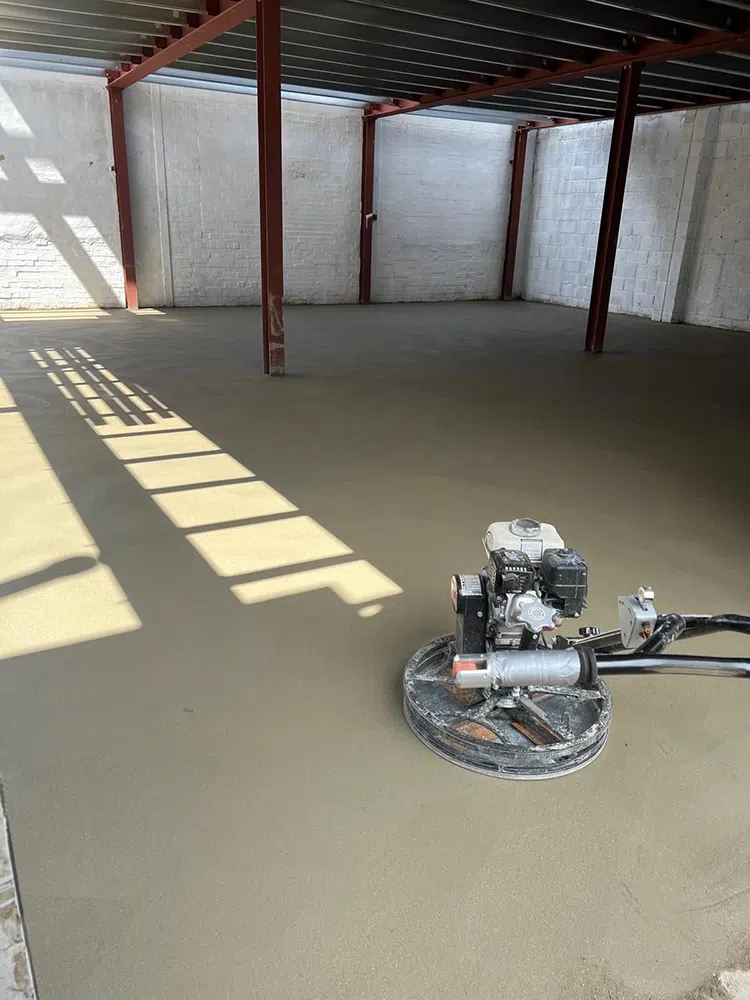
K & B Screeding’s own team, led by director Donatas Bardisevicius. Founded 2019, company 12298780.
See what customers say in our Google reviews and on our testimonials page.
Sand and Cement Screed from Slough to Bracknell
On the map, Bracknell sits south-south-west of Slough, about 9.2 miles from our base in a straight line (postcodes including RG12 and RG42), next to Wokingham (3.5 miles), Crowthorne (3.8 miles), Sandhurst (5.3 miles) and Camberley (5.4 miles).
More on sand & cement screed, part of our screeding services.
