
Rebuilding solid floors in Newtown and Katesgrove terraces
Terraced houses make up 25% of Reading's homes, and the Victorian ones in Newtown and Katesgrove are where floor trouble concentrates. In Newtown, terraces put up for Huntley and Palmers and Sutton's Seeds workers show off polychrome brickwork, and in Katesgrove narrow streets are lined mainly with Victorian terraces. Under plenty of those front rooms is an old solid floor with nothing to stop damp rising. Damp comes up, finishes lift, and each new covering fails faster than the last.
The lasting repair is a full rebuild of the floor. We break up the old slab and excavate deep enough for a membrane, a layer of insulation and fresh screed. Floating on that insulation, the house screed is laid to about 65mm, whereas a commercial floor would take 75mm. It is mixed on site, placed, compacted and finished flat to meet the existing thresholds.
Hand laying fits these houses. Rooms are often narrow, doorways are tight and the new level has to match the hall and the rooms either side. A mixer outside and barrows through the house deal with that better than a pump.
The Redlands conservation area shares the same floor problem. Before any screed goes in, the old floor has to come out and the base be made ready, which our floor preparation service covers. The screed depth guide explains how the numbers are chosen.
Wet rooms, garages and bonded screeds in Reading
Whatever the age of the house, two rooms point firmly towards sand and cement. The first is a wet room. Calcium sulphate screed is weakened by water, so a floor that will be wet needs a cement based screed, and hand laying lets us form the falls to the drain in the screed itself. The tiler then follows a true slope instead of packing adhesive to create one.
Next comes the converted garage. Garage floors are usually a step down from the rest of the house, so the level is raised using a membrane plus insulation, and the screed finishing it off has to take loads from early on. How a garage floor is built up takes you through it layer by layer.
No room for insulation? Then 25 to 40mm of bonded screed can be laid directly on a sound concrete base. That helps in a house of any age where a door height or an existing step fixes the finished level, including the interwar homes that make up 11% of the town's housing.
Expect a longer wait for it to dry than a pumped floor would need. The first 40mm take roughly a day per millimetre and the rest longer, so a 65mm floor needs weeks. Where the programme cannot wait, fast drying screed is worth considering.
Sand and Cement Screed prices in Reading
Sand and cement screed: £18 to £25 per m² supplied and laid (MyJobQuote, August 2026), so £450 to £630 for 25 m². MyJobQuote does not say whether these figures include VAT. See our floor screeding cost guide or screed calculator.
Who lays your sand and cement screed in Reading
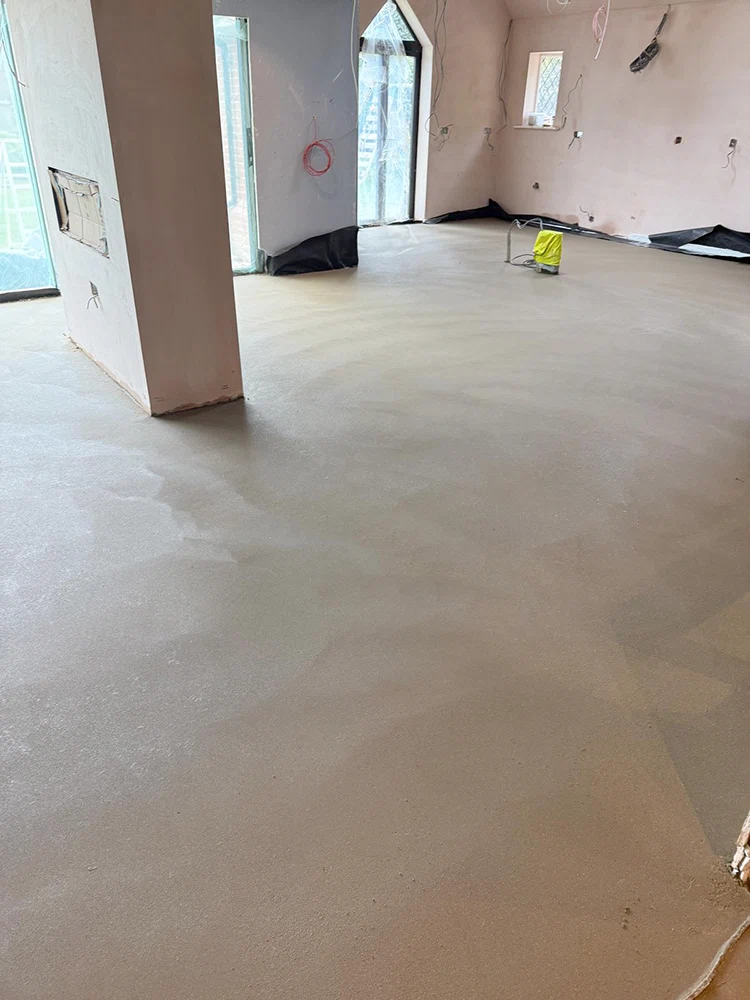
K & B Screeding’s own team, led by director Donatas Bardisevicius. Founded 2019, company 12298780.
See what customers say in our Google reviews and on our testimonials page.
Sand and Cement Screed from Slough to Reading
As the crow flies, our yard in Slough is about 15.2 miles from Reading, which lies to the west-south-west. Postcodes here include RG1, RG31, RG4 and RG30, and Woodley (2.9 miles), Henley-on-Thames (6.5 miles), Wokingham (6.8 miles) and Crowthorne (9.8 miles) are close by.
More on sand & cement screed, part of our screeding services.