
Turning a Thatcham garage into a habitable room
A garage floor was never meant to be lived on. It is usually a bare concrete slab, often lower than the floor of the house, with no insulation and sometimes no damp protection. To make it a bedroom, office or playroom, the floor has to be built up to meet the hallway with a membrane, a layer of insulation and a screed on top.
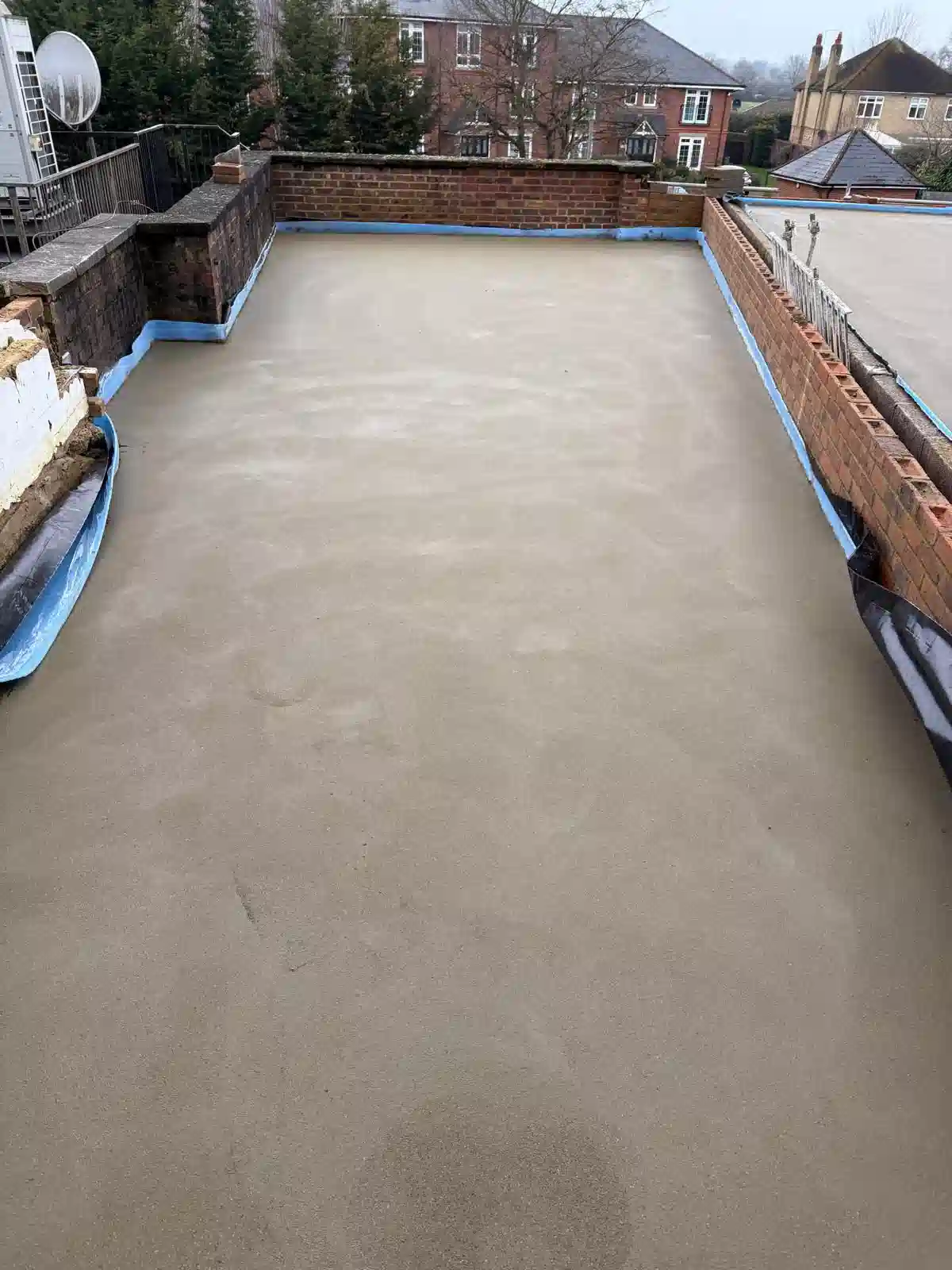
That layered build-up is a good fit for a trowelled sand and cement screed. It is mixed on site to the depth each part of the floor needs, so a slab that dips towards the old door can be brought level without ordering a truckload of material for a single room. A floating domestic screed over insulation is laid at 65mm, and it is compacted and finished by hand or power float to take tiles, laminate or carpet.
There are ways to adapt it. Adding fibres, at around £1 to £3 per m² extra, helps control cracking in a floor over insulation; see our fibre reinforced screed service. If the new bedroom or office is wanted soon, a rapid drying additive cuts the waiting time; fast drying screed costs between £20 and £28 a square metre on 2026 published figures.
The order of work is simple: fill and seal the old door opening, lay the membrane and insulation, fit an edge strip around the walls and then screed. Every layer is covered, in order, in our guide to converting a garage floor.
Older Thatcham floors, wet rooms and small spaces
Not every Thatcham house is modern. Some 23% of Thatcham homes went up in the years 1945 to 1972, and a solid ground floor that old can crack, settle or lose the damp protection it had. If yours has, compound only hides the fault; the proper repair is to break it up, take it away and relay it with fresh screed over new insulation and a membrane.
Terraces account for 21% of local homes, and on those the materials often have to travel through the front door. Sand and cement is barrowed in, so there is no hose to run and no pump to park.
Wet rooms are the other case. The floor of a walk-in shower must slope to its drain; a cement mix can be trowelled to those slopes, and unlike calcium sulphate, water does not weaken it.
Bonded screeds, fixed straight to a sound concrete base at 25 to 40mm, are an option where floor height is limited. The trade-off for all of this is drying time, which runs at about a day per millimetre for the first 40mm and slower beyond. If the floor only needs flattening rather than replacing, levelling an existing floor may be enough. The same service in Reading is covered on our page for sand and cement screeding in Reading.
Sand and Cement Screed prices in Thatcham
Sand and cement screed: £18 to £25 per m² supplied and laid (MyJobQuote, August 2026), so £450 to £630 for 25 m². MyJobQuote does not say whether these figures include VAT. See our floor screeding cost guide or screed calculator.
Who lays your sand and cement screed in Thatcham
K & B Screeding’s own team, led by director Donatas Bardisevicius. Founded 2019, company 12298780.
See what customers say in our Google reviews and on our testimonials page.
Sand and Cement Screed from Slough to Thatcham
As the crow flies, our yard in Slough is about 27.9 miles from Thatcham, which lies to the west-south-west. Postcodes here include RG19, and Newbury (2.8 miles), Tadley (5.7 miles), Basingstoke (11.9 miles) and Reading (12.8 miles) are close by.
More on sand & cement screed, part of our screeding services.
