
Rebuilding tired ground floors in Basingstoke estate terraces
The typical job starts with a floor that has cracked, sunk in places or feels cold underfoot. Patching it rarely lasts. The better fix is to break out the old concrete, lay insulation and a membrane, and finish with a new screed at the right height for the doors, skirting and kitchen units.
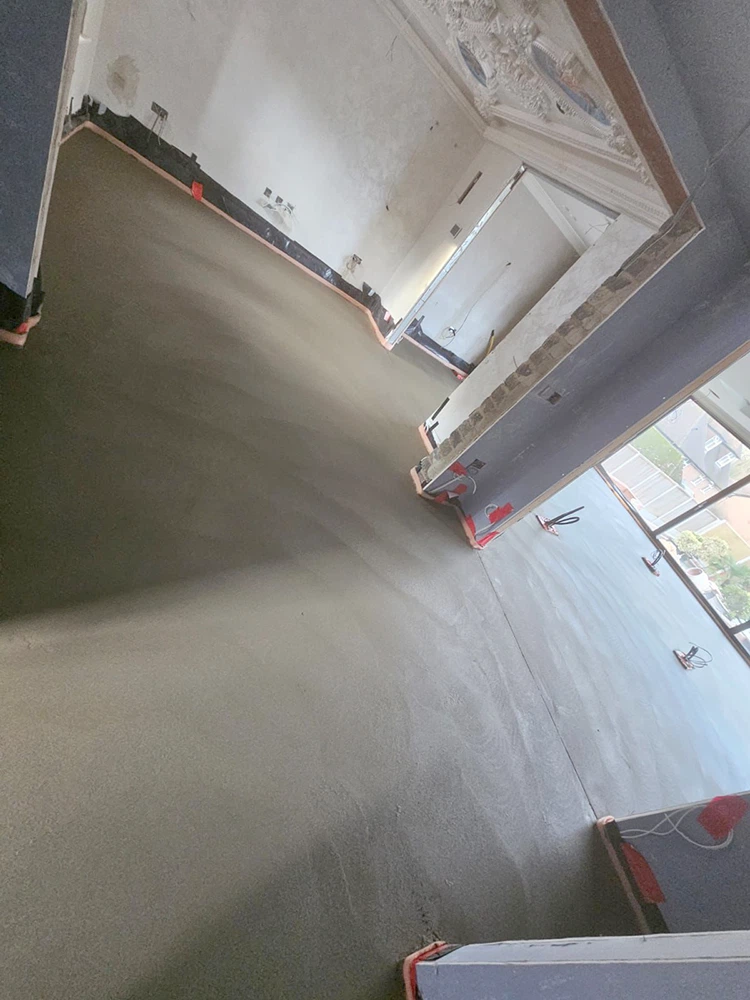
Sand and cement suits that work. It is mixed on site to suit each room and depth, so a narrow hallway, a cloakroom and a kitchen can all be done in the same visit without a pump. It is compacted by hand and finished to a dense, level surface ready for tiles, LVT or carpet.
Depth depends on how the screed is laid. A floating screed over insulation in a house is usually 65mm, and 75mm on commercial floors. Where the screed is bonded straight to a sound concrete base, 25 to 40mm is normal, which helps when there is not much height to play with. Our screed thickness guide explains the difference.
Many of these floors are being rebuilt at the same time as a rear extension goes on. Laying both in sand and cement keeps the two floors to the same material and the same finish, so the join is less likely to show through thin flooring. Where one floor needs to take load early, such as a garage or workshop, a cement screed is also the safer choice. The older houses in the town, only 4% of the stock built before 1919, need the same care with membranes and levels.
Wet rooms, garages and falls in Basingstoke houses
In a Basingstoke bathroom, cement is the binder to choose, since calcium sulphate screed must be kept away from water. A walk-in shower or wet room needs a floor laid to falls so water runs to the drain, and hand-laid screed can be shaped to those falls accurately. Utility rooms at risk of leaks are better on cement too.
The same goes for a garage that is becoming part of the house. The garage slab is often lower than the house floor, so the new floor is built up with insulation and screed to meet the hallway. Our garage floor screed guide walks through that build-up.
Where it loses out is the wait. A 65mm hand-laid floor holds its water far longer than a thin pumped one, so allow roughly 24 hours for every millimetre of the first 40mm, and longer for the rest. If the programme is tight, a quick drying screed can bring flooring forward, and fibres can be added where cracking is a concern.
For budgeting, the published 2026 UK figures put this kind of floor at £18 to £25 a square metre. If you are weighing the two main types for an extension, the comparison of liquid and sand and cement screed sets out the differences.
Sand and Cement Screed prices in Basingstoke
Sand and cement screed: £18 to £25 per m² supplied and laid (MyJobQuote, August 2026), so £450 to £630 for 25 m². MyJobQuote does not say whether these figures include VAT. See our floor screeding cost guide or screed calculator.
Who lays your sand and cement screed in Basingstoke
K & B Screeding’s own team, led by director Donatas Bardisevicius. Founded 2019, company 12298780.
See what customers say in our Google reviews and on our testimonials page.
Sand and Cement Screed from Slough to Basingstoke
On the map, Basingstoke sits south-west of Slough, about 26.5 miles from our base in a straight line (postcodes including RG21, RG22, RG24 and RG23), next to Tadley (6.7 miles), Alton (9.6 miles), Fleet (10.7 miles) and Thatcham (11.9 miles).
More on sand & cement screed, part of our screeding services.
