
Replacing ground floors in Andover's overspill terraces
When an original ground floor is replaced, the new one has to do more than the old. It must finish at the same level as the thresholds and neighbouring rooms, and it has to include the insulation that floors of that era usually lack. That leaves a fixed depth to work within, which is why the job starts with measurements rather than materials.
The sequence is to break out the existing floor, dig down to make room, then lay insulation, a damp proof membrane and the screed. Because it floats on that new insulation, the screed alone normally needs to be 65mm in a house. If there is not enough depth for that, a thinner bonded screed of 25 to 40mm on a sound slab, or a different build-up, may be needed.
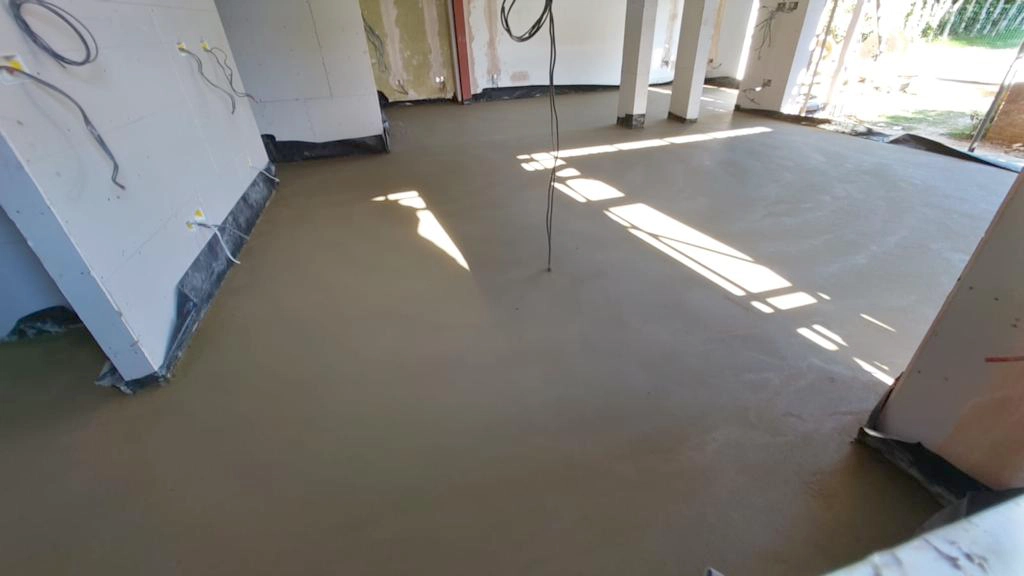
Sand and cement suits these houses because it can be laid one room at a time, mixed to the exact depth each area needs, and compacted around steps and doorways. The result is a cement base, which is what tiles and wet areas want.
Only 5% of the town's homes were built before 1919, so a floor being replaced here is more often a post-war slab than a very old one. Our screed thickness guide shows how the depths add up, and floor preparation covers the breakout and cleaning before a new screed goes down.
Garages, wet rooms and workshops in Andover homes
Detached houses are a large share of Andover's homes, and they tend to produce garage conversions. A garage slab normally sits lower than the house, may slope to the door and has no insulation, so the conversion needs a built-up floor to meet the hall. Sand and cement lets the depth vary across the room to take out that slope, and our garage floor screed guide goes through the layers.
Wet rooms are another job for it. Since calcium sulphate must be kept away from water, a level access shower is laid in sand and cement, with the falls shaped by hand to the drain.
Its weak point is how slowly it dries. The top 40mm or so dries at roughly a day a millimetre, anything deeper slower again, and so a 65mm garage screed leaves most floor coverings several weeks away. If the build cannot wait that long, a faster drying mix cuts the gap, priced at £20 to £28 per square metre. Where a floor will take heavier loads, such as a workshop, high strength screed is an option, and for a wide open extension the Andover liquid screed page may suit better.
Sand and Cement Screed prices in Andover
Sand and cement screed: £18 to £25 per m² supplied and laid (MyJobQuote, August 2026), so £450 to £630 for 25 m². MyJobQuote does not say whether these figures include VAT. See our floor screeding cost guide or screed calculator.
Who lays your sand and cement screed in Andover
K & B Screeding’s own team, led by director Donatas Bardisevicius. Founded 2019, company 12298780.
See what customers say in our Google reviews and on our testimonials page.
Sand and Cement Screed from Slough to Andover
As the crow flies, our yard in Slough is about 42.5 miles from Andover, which lies to the west-south-west. Postcodes here include SP10 and SP11, and Tidworth (8.4 miles), Winchester (12.4 miles), Amesbury (13.3 miles) and Newbury (14.9 miles) are close by.
More on sand & cement screed, part of our screeding services.
