
Retrofitting heat on Augusta Park and Picket Twenty floors
Adding underfloor heating to an existing house comes down to height. Every layer, from insulation and pipes to screed and finish, adds thickness, and the new floor still has to meet doors, stairs and the rooms next to it.
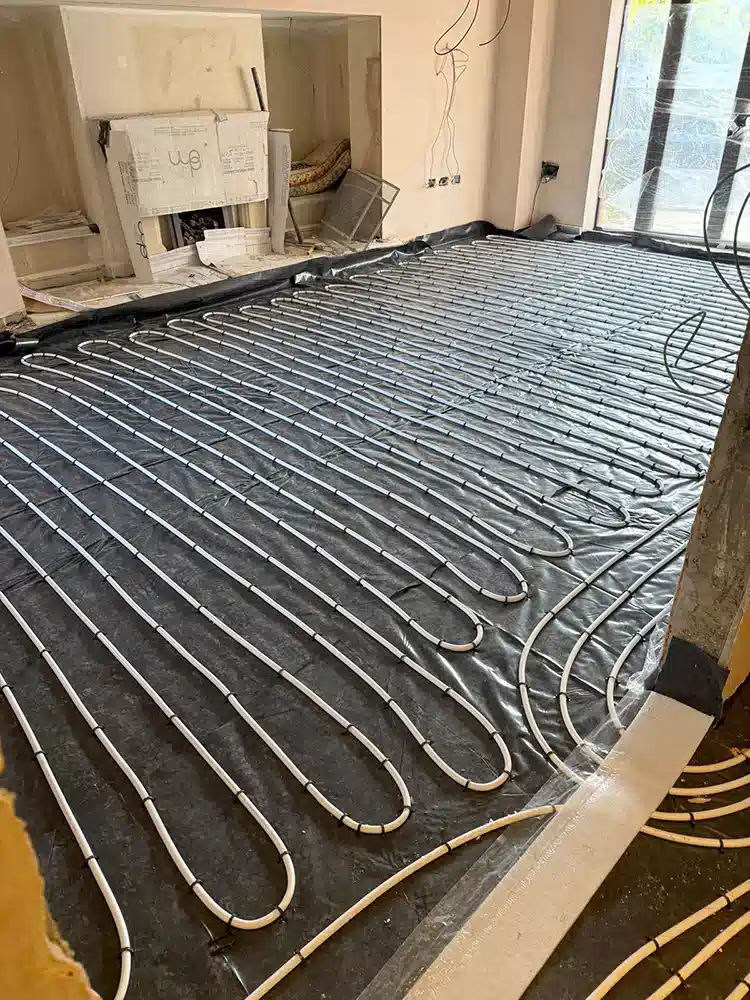
A liquid screed is the usual answer when height is tight. It wraps the pipes without leaving air gaps, so 25mm or more on top is enough, and the floor ends up about 45 to 50mm thick. If the choice is sand and cement, the cover goes up to about 45mm, adding to the overall depth. On a newer estate house, a thin liquid screed keeps the floor height down, which is what makes a retrofit workable when the finishes are being replaced anyway.
Thinner screeds also warm up faster and respond more quickly to the thermostat, which suits a room that is used at set times of day rather than heated constantly. Where depth is very limited, alpha hemihydrate products are designed for reduced depth and follow their own product sheet.
Before we quote, we need the pipe size, the insulation thickness and the finished floor level you have to meet. Laying the pipes and testing them under pressure is your heating engineer's part; ours is to inspect the edge strip, membrane and insulation and screed to the depth agreed. For the depths worked through layer by layer, read our guide to screed thickness.
Heated extensions on Andover's detached houses and semis
Detached houses make up 24% of Andover's homes, and they tend to produce larger extensions and garage conversions. Semi-detached houses, 27% of the town's homes, are often extended too, and on a big heated floor the screed choice matters. A pumped liquid screed covers a large heated area in a single visit and flows fully around the pipes; see liquid screed in Andover for how the pour works. A sand and cement screed suits a room that may get wet.
Most heated floor failures start with the first heat-up. Calcium sulphate is generally ready for the heating around day 7; sand and cement must be left 21 days or longer. Whichever you have, begin cool and turn it up a little each day across several days. Turning the system up to full on day one dries the screed unevenly and risks cracking.
Keep the heating engineer, the screeder and the flooring fitter talking. Tiles, LVT or wood should only go on once a moisture test has been passed. If an old ground floor has to be removed first, sand and cement screed in Andover covers the dig-out and rebuild, and insulation and membranes explains the layers under the pipes.
Underfloor Heating Screed prices in Andover
Liquid screed over underfloor heating: £20 to £35 per m² supplied and laid (trade2base, June 2026), so £700 to £1,230 for 35 m². trade2base gives these figures excluding VAT. See our floor screeding cost guide or screed calculator.
Who lays your underfloor heating screed in Andover
K & B Screeding’s own team, led by director Donatas Bardisevicius. Founded 2019, company 12298780.
See what customers say in our Google reviews and on our testimonials page.
Underfloor Heating Screed from Slough to Andover
As the crow flies, our yard in Slough is about 42.5 miles from Andover, which lies to the west-south-west. Postcodes here include SP10 and SP11, and Tidworth (8.4 miles), Winchester (12.4 miles), Amesbury (13.3 miles) and Newbury (14.9 miles) are close by.
More on underfloor heating screed, part of our screeding services.
