
Heated extensions on Newbury semis and older houses
Retrofitting underfloor heating is where the screed decision gets harder. Some 27% of Newbury homes are semi-detached, the kind of house that often gains a heated garden room or rear extension. Into that new floor go insulation, pipework and screed, and the top still has to meet the old house without a step.
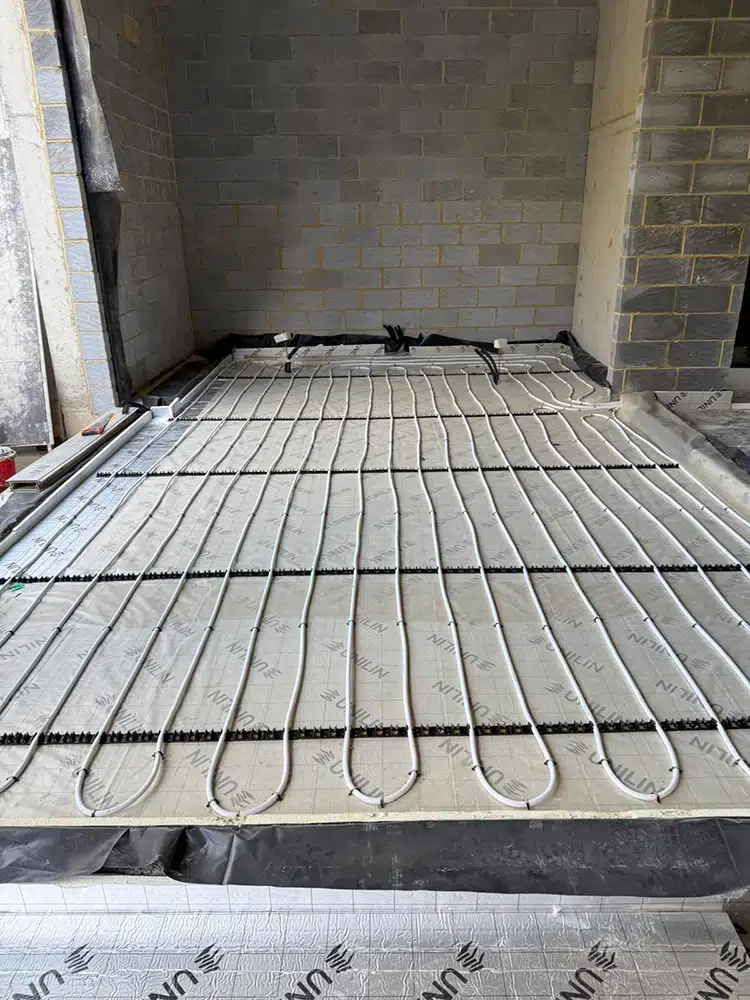
Getting that right comes down to millimetres. With a pumped liquid screed, the pipes need at least 25mm of cover, which puts the floor at 45 to 50mm in total. Hand-laid sand and cement needs roughly 45mm over the pipework, so the whole build-up ends up deeper. Where the finished level is fixed by an existing door or step, those extra millimetres usually decide the choice. In the older part of a house, digging out a solid floor to add heating creates room for the full build-up, and it is the moment to add a membrane too.
No pipe can be left with a gap around it. Air pockets around a pipe slow heat transfer and leave cold patches in the room. A flowing screed fills round them by itself, while a traditional screed has to be compacted carefully over and between them.
The same height check applies to the 23% of homes built between 1973 and 1999 if a kitchen refit brings heating with it. What sits under the pipework is covered by our insulation and membranes work, and the pour itself is described under pumped liquid floors in Newbury.
Commissioning the heating under a Newbury screed
A new screed and a new heating system need to be introduced gently. Switching the system straight to full temperature can crack a young floor and debond tiles later on.
A calcium sulphate floor can normally take heat from around day 7, and running the system then speeds its drying. Sand and cement must sit for 21 days at the very least before the system is switched on. Either way, the flow temperature climbs a little at a time across several days, stays at its top setting for a spell, then comes down again before the floor covering goes on. Your heating engineer runs the system, and we hand over clear written guidance so the heat-up matches the screed.
A screed over heating also has to be flat enough for the final finish. Tiles, LVT and engineered wood each have their own tolerance, and a well-laid flowing screed usually meets them without extra work. Where a finish calls for a smoother base, floor levelling in Newbury is the next step.
Drying and heat-up run side by side, so it is worth reading how long screed takes to dry before fixing a date for the flooring fitter.
Underfloor Heating Screed prices in Newbury
Liquid screed over underfloor heating: £20 to £35 per m² supplied and laid (trade2base, June 2026), so £700 to £1,230 for 35 m². trade2base gives these figures excluding VAT. See our floor screeding cost guide or screed calculator.
Who lays your underfloor heating screed in Newbury
K & B Screeding’s own team, led by director Donatas Bardisevicius. Founded 2019, company 12298780.
See what customers say in our Google reviews and on our testimonials page.
Underfloor Heating Screed from Slough to Newbury
On the map, Newbury sits west-south-west of Slough, about 30.7 miles from our base in a straight line (postcodes including RG14), next to Thatcham (2.8 miles), Tadley (8.1 miles), Basingstoke (13.7 miles) and Wantage (13.7 miles).
More on underfloor heating screed, part of our screeding services.