
Specifying anhydrite for Newbury apartment floors
Every calcium sulphate screed carries a two-number grade from the European screed materials standard. Read the C number as how much squeezing the screed can take and the F number as its resistance to bending, both in N/mm2. CA-C20-F4 is enough for a quiet room in a house that sees little traffic. In a Newbury apartment block the flats themselves usually get CA-C25-F5, as do most houses and offices, and CA-C30-F6 is kept for the hard-wearing shared areas of the building.
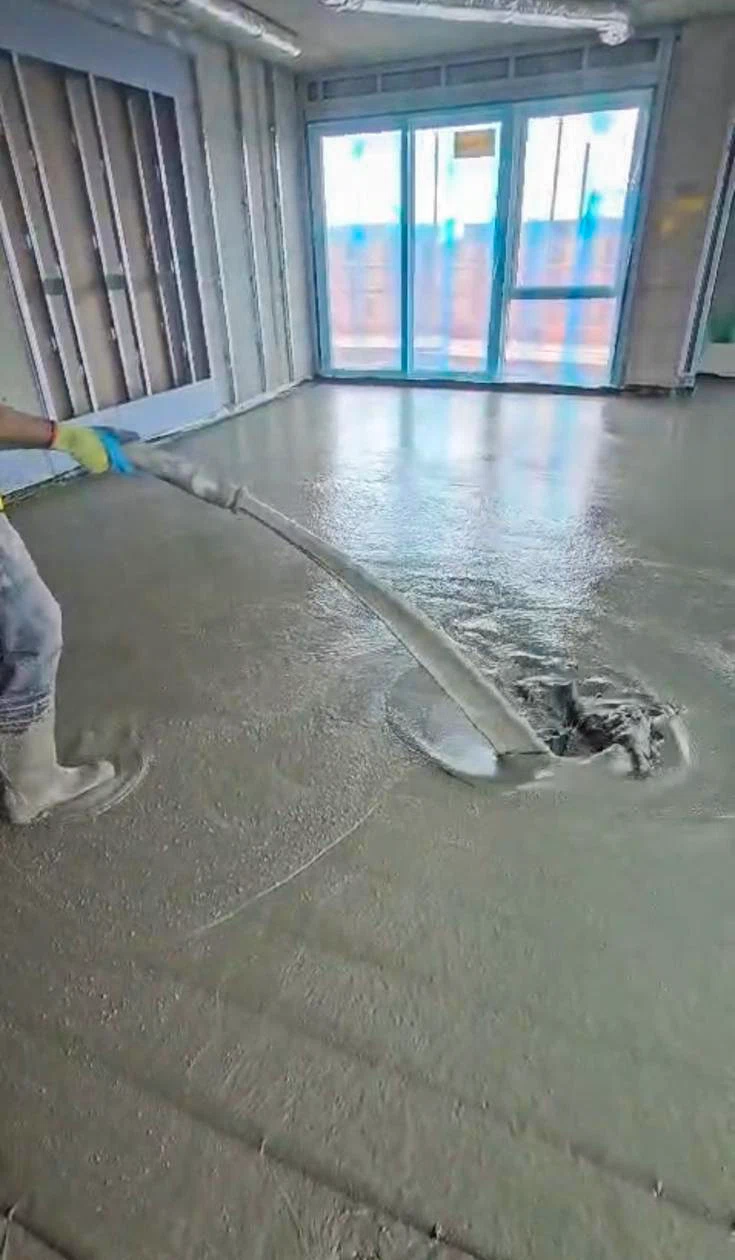
An apartment block suits the material because it shrinks very little as it sets. Bays can therefore be large, and often an entire Newbury flat goes down as a single pour. Some joints are still needed, usually across doorways and where one heating zone meets another, and their positions are drawn up ahead of time, not decided with the hose running.
Some specifications call for an alpha hemihydrate product instead, typically when time is short or the depth has to be thinner. With those products we pour to the thickness and drying time the maker publishes for that specific material.
Newbury's former industrial land is part of its housing future: the Sterling Industrial Estate on Kings Road has been identified for about 167 homes, and on any new scheme the screed grade is set on the drawings, not chosen on site. Converted flats, 4% of the housing, are a different case, since an older floor structure needs assessing before anything is poured onto it. There is more on how the material behaves in our anhydrite screed explainer.
Laitance, moisture and primers on Newbury pours
Two jobs follow every calcium sulphate pour, and skipping either one causes flooring failures. The first is laitance. Drying leaves a thin, chalky crust on the surface with little strength of its own. Glue flooring to it and the bond fails when the crust does, which is why we sand it off down to solid screed and vacuum up the dust after the floor has dried sufficiently.
The second is moisture testing. Flooring makers often allow less moisture in calcium sulphate than in a cement screed, which is how a floor that seems dry to the touch can still be over the limit for LVT or wood. Our hygrometer reading is checked against that manufacturer's number. Where pipes run through the screed, as in the new houses around the Racecourse, switching the heating on from around day 7 can usually speed the drying.
After sanding and testing comes a primer made for calcium sulphate, rather than a general purpose one, so the adhesive or compound that follows has a compatible surface to grip.
Water weakens anhydrite, so bathrooms, wet rooms and plant rooms in a Newbury block are better served by a cement based flowing screed, or by hand-laid sand and cement where the floor needs falls. For a site outside the town, see anhydrite screed in Basingstoke.
Anhydrite & Flow Screed prices in Newbury
Liquid flowing screed (which includes anhydrite): £24 to £31 per m² supplied and laid (MyJobQuote, August 2026), so £960 to £1,240 for 40 m². MyJobQuote does not say whether these figures include VAT. See our floor screeding cost guide or screed calculator.
Who lays your anhydrite and flow screed in Newbury
K & B Screeding’s own team, led by director Donatas Bardisevicius. Founded 2019, company 12298780.
See what customers say in our Google reviews and on our testimonials page.
Anhydrite & Flow Screed from Slough to Newbury
On the map, Newbury sits west-south-west of Slough, about 30.7 miles from our base in a straight line (postcodes including RG14), next to Thatcham (2.8 miles), Tadley (8.1 miles), Basingstoke (13.7 miles) and Wantage (13.7 miles).
More on anhydrite screed, part of our screeding services.
