
Specifying calcium sulphate screed for Bulmershe-era plots
Built in 2013 and 2014, the Bulmershe estate sits within the 7% of Woodley's housing put up between 2000 and 2014. On drawings for homes like these, and for apartment floors in any modern block, calcium sulphate screed is a regular entry.
The grade is normally written into the specification. For a domestic floor with light traffic it is CA-C20-F4; most houses, flats and offices sit at CA-C25-F5; heavier use calls for CA-C30-F6. Read the code as two strengths in N/mm2, C for compression and F for bending, which is what flexural means; bigger numbers make for a stronger floor. If the drawings name an alpha hemihydrate material, it is usually there to dry faster or allow a thinner pour, and the depth and drying then follow that product's data sheet.
Developers pick this material because it hardly shrinks. Large pours with few joints are therefore possible, suiting an open-plan ground floor or a long corridor in a block of flats. Before pouring, we set out where bays and joints will fall, with door thresholds and changes in floor shape getting particular attention.
It is not right everywhere. Keep it out of wet rooms and floors exposed to damp; those take a flowing screed with a cement base, which we also supply. Our explainer, anhydrite screed in detail, goes further into the material, and heated floors have their own page on screeding over underfloor heating, covering pipe cover and commissioning.
Laitance, moisture and primers on Woodley anhydrite floors
While calcium sulphate dries, a thin, weak crust called laitance forms on its surface. That skin has to come off before flooring is laid, normally by sanding once the floor is dry enough and then vacuuming up the dust. Leaving the laitance in place is a common reason for tiles or vinyl coming loose later. Where a floor needs more than light sanding, our floor preparation service covers it.
Moisture comes next. Flooring makers often allow less moisture in calcium sulphate than in cement screed, and a hygrometer reading of relative humidity in the screed is how it is normally checked. Check the flooring maker's own figure, because some are stricter. Where pipes are in, switching the heating on from around day 7 can usually force the drying along and shorten the wait.
Then there is the primer. With the laitance gone and the floor dry, it gets a primer made for calcium sulphate before any adhesive or levelling compound. Your flooring fitter gets our drying and laitance notes in writing, so nobody has to guess what is underneath. For the same material a few miles south-east, see anhydrite screed in Bracknell.
Anhydrite & Flow Screed prices in Woodley
Liquid flowing screed (which includes anhydrite): £24 to £31 per m² supplied and laid (MyJobQuote, August 2026), so £960 to £1,240 for 40 m². MyJobQuote does not say whether these figures include VAT. See our floor screeding cost guide or screed calculator.
Who lays your anhydrite and flow screed in Woodley
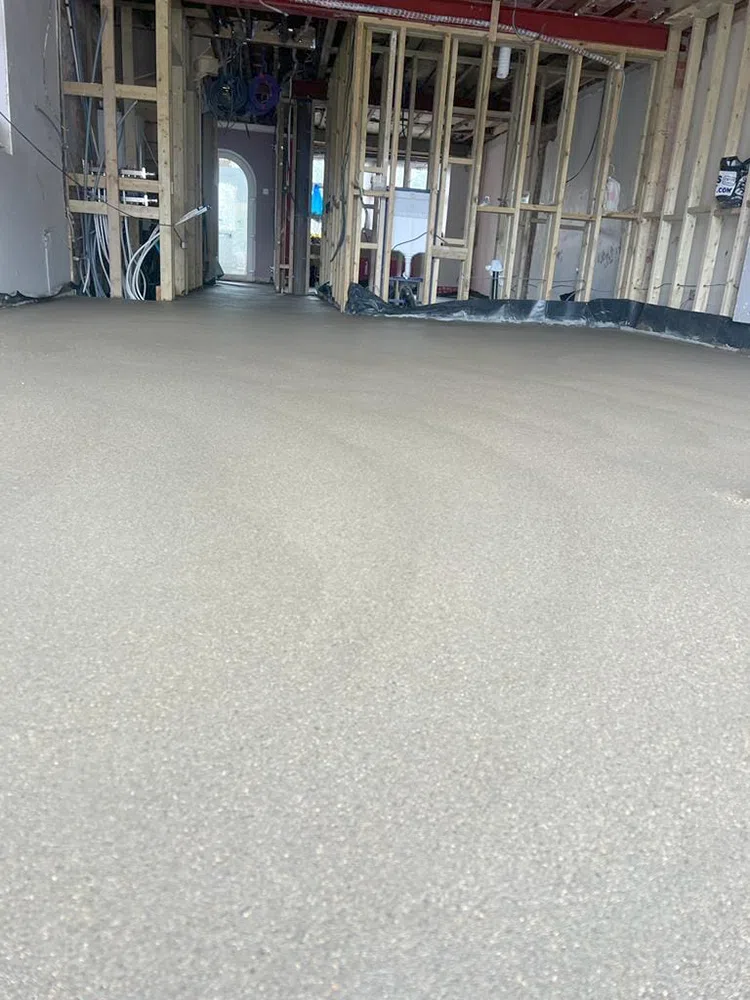
K & B Screeding’s own team, led by director Donatas Bardisevicius. Founded 2019, company 12298780.
See what customers say in our Google reviews and on our testimonials page.
Anhydrite & Flow Screed from Slough to Woodley
Woodley is about 12.5 miles west-south-west of our Slough base as the crow flies, with postcodes including RG5 and RG41. The nearest towns to it are Reading (2.9 miles), Wokingham (4.4 miles), Henley-on-Thames (5.8 miles) and Bracknell (7.1 miles).
More on anhydrite screed, part of our screeding services.