
Retrofitting heating in the former Woodley Aerodrome houses
Woodley Aerodrome opened in 1929, the land was later worked for gravel, and in the 1980s Adwest Properties built housing and light industry on it. Woodley has 25% of its homes dating from 1973 to 1999, and plenty of them are now due new kitchens and floors. Adding underfloor heating at that point is common, but it raises one practical problem: floor height.
A retrofit has to fit insulation, pipes and screed into the space between the existing slab and the finished floor level at the doors and stairs. If the old screed is lifted, that space is usually the old screed depth plus whatever the flooring will add. This is where liquid screed earns its place: 25mm over the pipes is its minimum, so the layer usually ends up 45 to 50mm deep overall. A traditional sand and cement topping needs roughly 45mm above the pipes, so the whole floor ends up thicker.
Where the depth is tight, we measure before quoting and tell you honestly what will fit. Sometimes the answer is to take the floor down further; sometimes it is a thinner insulation board with better performance. If you are planning this in one of the 1980s houses on the old aerodrome land, our screed thickness guide shows common build-ups layer by layer.
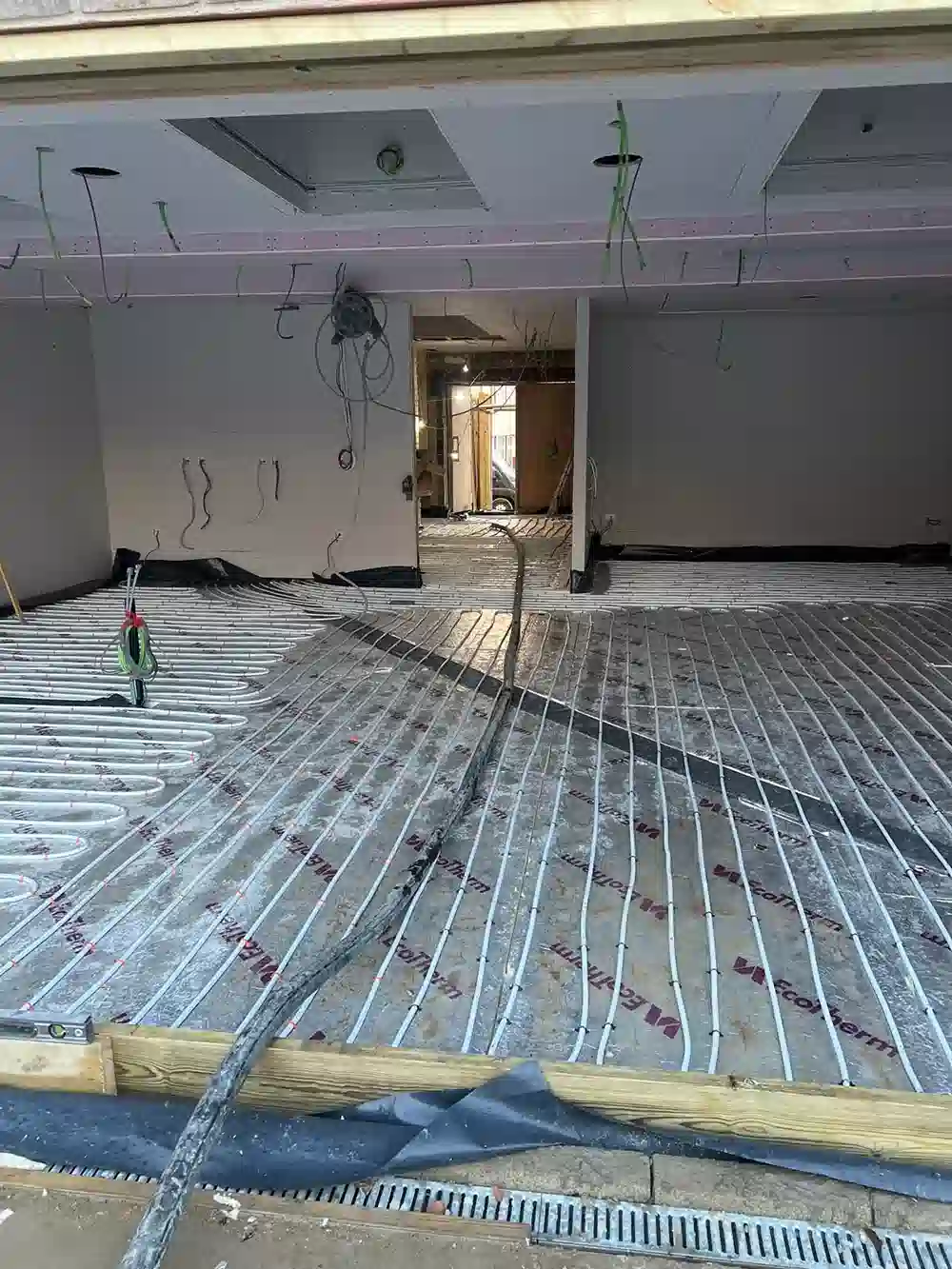
Below the pipes, insulation and membrane count for as much as the screed itself. If either is missing or damaged, we supply and fit them as part of our insulation and membrane work before the heating engineer lays the pipes.
Heated extensions and first firing in Woodley
A new rear extension on a post-war semi is the simplest place for underfloor heating. The slab is new, the floor level is set by the builder, and the pipes can be laid on insulation with full depth to spare.
Air trapped around a pipe cuts heat transfer, so whatever type is used, the screed has to wrap each pipe completely. Liquid screed pumped over the pipes does that as it flows. Sand and cement is compacted by hand around the pipes and needs more care.
You cannot turn the heating on the day after the pour. A calcium sulphate screed can usually have its commissioning started at around the 7 day mark; give sand and cement at least 21 days. Either way, the first firing should be gradual, starting low and stepping the flow temperature up over several days, then holding before flooring goes down. Your heating engineer sets the schedule; we give you written guidance on what the screed needs.
Keep the room ventilated during that period, and do not lay rugs or stack boxes on the new floor. Wokingham is a few miles south, and our Wokingham heated floor screed page covers the same work there.
Underfloor Heating Screed prices in Woodley
Liquid screed over underfloor heating: £20 to £35 per m² supplied and laid (trade2base, June 2026), so £700 to £1,230 for 35 m². trade2base gives these figures excluding VAT. See our floor screeding cost guide or screed calculator.
Who lays your underfloor heating screed in Woodley
K & B Screeding’s own team, led by director Donatas Bardisevicius. Founded 2019, company 12298780.
See what customers say in our Google reviews and on our testimonials page.
Underfloor Heating Screed from Slough to Woodley
Woodley is about 12.5 miles west-south-west of our Slough base as the crow flies, with postcodes including RG5 and RG41. The nearest towns to it are Reading (2.9 miles), Wokingham (4.4 miles), Henley-on-Thames (5.8 miles) and Bracknell (7.1 miles).
More on underfloor heating screed, part of our screeding services.