
Fitting heating into Sandhurst's 1970s and 1980s houses
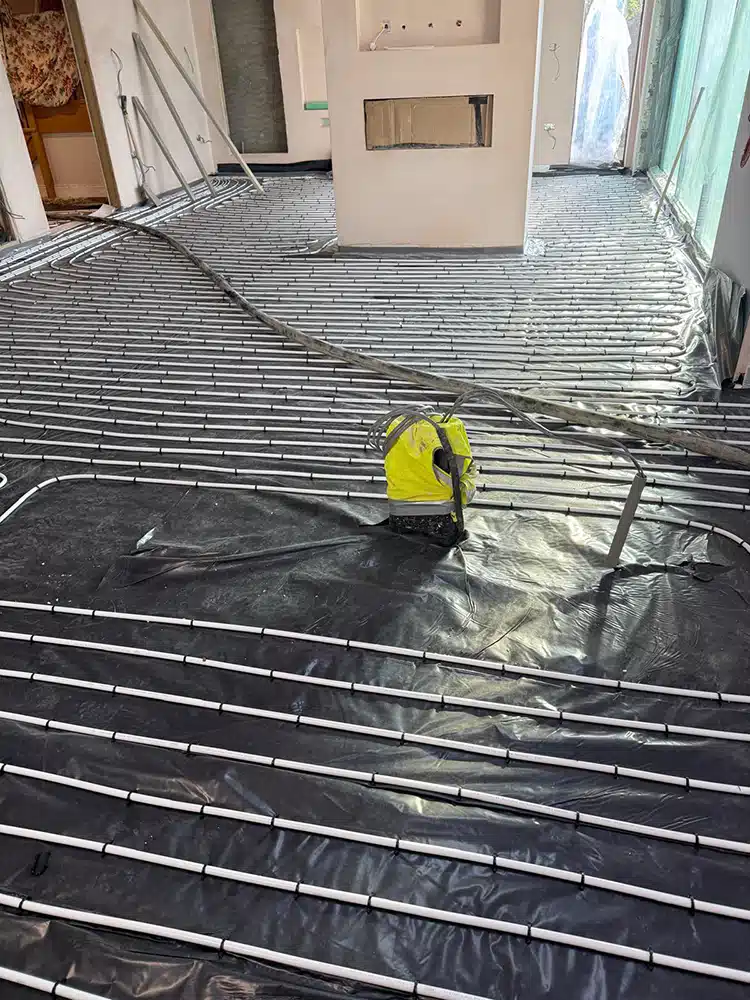
Putting heating pipes into a house that already stands is, above all, a fight for depth. Insulation, pipework and screed all have to fit, and the surface must still come out level with the neighbouring rooms. In a knock-through kitchen in one of Sandhurst's 1970s or 1980s houses, that means taking up the old finish and working out how much depth the slab leaves.
Liquid screed is usually the answer where depth is tight. Its minimum is 25mm above the pipes, around 45 to 50mm overall, whereas sand and cement wants about 45mm of cover and so builds up thicker. It also flows round every pipe, leaving no voids, and because it sits in close contact with them it warms up faster.
A new extension is simpler, because the slab level can be set to allow the full build-up. The screed then runs across both the extension and the knocked-through room, and the pour is timed after the pipes have been pressure tested.
Houses from 1945 to 1972 make up 30% of Sandhurst's homes, and in a house of that age the depth above the slab is worth measuring early, since an older build-up may leave less room. Whatever the age, we check the depth available before recommending a screed, and our insulation and membrane service supplies the layers beneath if they are not already in. How the pour itself goes is covered under pumping flowing screed in Sandhurst.
The first heat-up in a Sandhurst floor
A freshly screeded floor must be warmed gently. Calcium sulphate will normally take heat a week or so after pouring, about 7 days, but sand and cement has to wait 21 days as a minimum. The flow temperature then goes up a notch at a time over several days, sits at its peak, and drops back before the flooring is laid. Rushing that stage risks cracks in the screed and failures in the finish above.
Commissioning falls to your heating engineer, and we put the heat-up schedule in writing so the two trades follow one plan. The heating also speeds the drying of a calcium sulphate screed, which helps when a kitchen fitter is waiting to start. Keep a note of the dates each stage began, as the flooring fitter will want to know the floor has been through a full cycle.
Finish matters too. Whatever goes on top, tiles, LVT or engineered wood, needs a flat bed, and a poured screed over pipes generally provides it. If a floor needs a final smoothing layer, floor levelling in Sandhurst follows. For a project in Camberley, see underfloor heating screed in Camberley.
Underfloor Heating Screed prices in Sandhurst
Liquid screed over underfloor heating: £20 to £35 per m² supplied and laid (trade2base, June 2026), so £700 to £1,230 for 35 m². trade2base gives these figures excluding VAT. See our floor screeding cost guide or screed calculator.
Who lays your underfloor heating screed in Sandhurst
K & B Screeding’s own team, led by director Donatas Bardisevicius. Founded 2019, company 12298780.
See what customers say in our Google reviews and on our testimonials page.
Underfloor Heating Screed from Slough to Sandhurst
Sandhurst is about 14.5 miles south-south-west of our Slough base as the crow flies, with postcodes including GU47. The nearest towns to it are Yateley (0.8 miles), Crowthorne (1.6 miles), Camberley (2.6 miles) and Frimley (3.5 miles).
More on underfloor heating screed, part of our screeding services.